

 admin
admin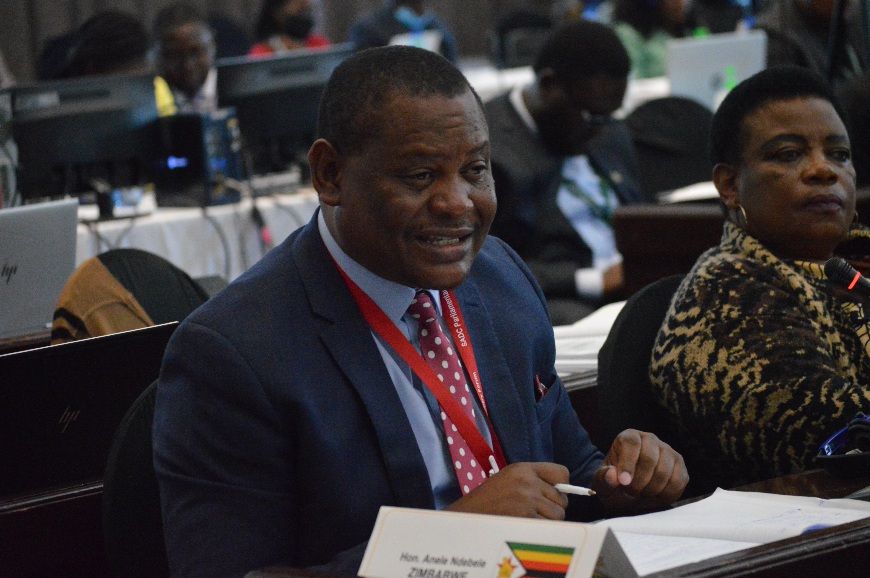
Moses Magadza recently in Malawi
LILONGWE – The just ended 51st Plenary Assembly Session of the SADC Parliamentary Forum held in Lilongwe, Malawi, was held under the theme “Towards Energy efficiency, sustainability and Self-sufficiency in the SADC region”.
Leaders of delegations from SADC member countries shared experiences on energy security during a symposium organised at the start of the plenary.
The Minister of Energy for Malawi, Honourable Ibrahim Matola moderated during the symposium. He supported calls for regional integration of the energy sector.
He said Malawi was hit by cyclone Nana on 24 and 25 January this year and lost 130 megawatts.
“I urge the parliamentarians to remove all the obstacles to achieving access to energy. Malawi and Tanzania are jointly developing Songwe River Basin project which will produce almost 190 megawatts,” he said.
Honourable Matola said Malawi had hydro power plants on one river which was not good for energy security because should a cyclone hit the first plant and then the second and the third, then Malawi would be plunged into darkness.
He called for countries to have mini grids on small rivers and parliaments to pass laws that all government institutions like hospitals, prisons and schools should invest in solar energy and stop using wood fuel.
Zimbabwean lawmaker Anele Ndebele made remarks on behalf of the Zimbabwean delegation. He said Zimbabwe is mainly dependent on coal, petroleum, hydroelectric power and biomass for its energy needs.
The country had come up with a raft of legislation to spur growth in the sector and was also looking at exploiting oil and gas deposits.
He noted that in 2018, an Australian company Invictus Energy limited confirmed a potential 215 million barrels of oil deposits in Muzarabani, Mashonaland Central.
“These deposits show that if adequate investment is made, the country has potential for energy self-sufficiency in the long run,” said Honourable Ndebele.
He said the Government of Zimbabwe was implementing a US$1,5 billion Hwange Thermal Power Station expansion project in Matabeleland North province, which was set to impact positively on the economy.
Zimbabwe had established a Rural Electrification Fund, whose objectives are to facilitate rapid and equitable electrification of the rural areas of Zimbabwe.
He said the role of Parliament is to promulgate laws that promote energy production.
“In that respect, our Parliaments need to ratify and domesticate the SADC protocols on energy as well as Continental and International energy protocols,” he added.
From the Mountain Kingdom of Lesotho, the Right Honourable Siphiri Motanyane, Speaker of Parliament said Lesotho was constructing big dams to export water and generate electricity.
“We generate electricity on these dams but not enough to sell. We are connected to the South African power grid and because we do not generate enough for our own use, during peak periods we import about five percent of our needs from Mozambique.
“We have realized that through a scheme called Pumped up Station, we can pump water onto the mountain tops during the day using solar power. At night that water is released to power turbines,” he said.
He said in one area, 29 such places had been identified which could generate about 200 kilowatts of electricity.
“Lesotho has that potential. In terms of wind power, we have one of the most stable winds. We are supplementing our rural electrification with solar energy. So those three – wind, sun and water – can produce massive energy. We are on the way to producing our own electricity,” he said.
The Speaker said things were looking up.
“Half of the country has been electrified and we are planning to electrify the whole country. The only problem is that our terrain is not very friendly. To move big turbines into the mountains is a problem because you pass through very unfriendly mountains,” he noted.
The leader of the Namibian delegation, Honourable Agnes Kafula, said Namibia’s main energy sources are petroleum, hydropower, imported electricity and imported coal. She said the country generates about a third of its energy needs.
“Although Namibia has made progress in electricity provision, the country still faces many challenges including that just 50 per cent of citizens have access to power,” she said, adding that many people use renewable energy to supplement the national grid energy supply.
She noted that Namibia recently introduced a US$12 billion hydrogen project to transform the country into a major renewable energy player by producing 300 000 metric tonnes of green hydrogen a year.
Although the world is moving away from non-renewable energy sources such as oil, Honourable Kafula said Namibia believes in mixed energy – taking advantage of both sources for the benefit of all Namibians.
Honourable Seiso Joel Mohai, (MP) who led the South African delegation, said a national development plan had identified the need to invest in energy infrastructure to meet industrial and household energy needs.
He said coal would continue to play an important role in electricity generation in South Africa as the country has an abundance of the resource.
“New investment will be directed towards more efficient coal technologies – of high efficiency, low emissions, underground coal precipitation and carbon capture and storage – to enable us to continue using our coal resource in a responsible way,” Honourable Mohai said.
He said the government accepts that nuclear energy can contribute to a significant reduction of emissions as there is a global move towards developing small reactors.
He revealed that in addition to wind and solar power, South Africa has reserves of high grade vanadium, platinum, palladium, nickel, manganese, rare earth, copper and cobalt, that are vital for the energy sector.
The Speaker of the Tanzania Parliament, Honourable Dr Tuli Ackson, said if Malawi was using renewable sources and it was working, then everyone should be able to do that.
“When you consider that most of the SADC countries are still in the dark, we should be looking at solutions to give our people access to electricity first, then start cleaning up from there,” the Speaker said.
She said the United Republic of Tanzania recently signed an agreement to develop natural gas projects.
“We have a large project to generate power, the Julias Nyerere project expected to produce 2115 megawatts and we hope it is completed in 2024,” she said.
From Zambia, Honourable Jeff Murebwa (MP), said demand for energy in Zambia had been increasing because of the country’s economic growth.
He explained that to have consistent and affordable energy for the country and beyond, the Zambian government had embarked on a vigorous programme to harness renewable energy.
“Solar generation sites were identified and solar mini grids were set up to provide electricity to the rural communities. Despite the enormous potential in the sector, the biggest challenge is the lack of investment, resulting in the country facing in medium- to long-term debt,” Honourable Murebwa said.
Honourable Phandu Tombola Chaha Skelemani, Speaker of the Parliament of Botswana said his parliament recently passed a national energy policy because Botswana relies on South Africa, Mozambique, Namibia and Zambia.
“The problem is that we rely on coal to generate power, but we have not developed the technology to cure the coal to reduce the gases emitted.
“We, however, have lots of sunshine for solar power and we have identified three sites where we can set up solar energy plants,” Honourable Skelemani said.
“As we move on to establish a SADC Parliament, we should also plan at that level so that those who are able to produce efficiently can share with others,” the Speaker of Botswana suggested.
Minister Matola concurred.
“We need to add more power and focus on the regional integration and there is an opportunity of power trading within the region,” he said.
A Member Parliament from the Democratic Republic of Congo said producing renewable energy in Congo was very expensive and said even getting solar panels was beyond the reach of many citizens.
“We have the big Congo River which can provide enough electricity for Africa but it is too expensive to get it done,” he said.
He added that the volatile security situation in the country does not allow for development.
Honourable Petros Mavimbela, Speaker of the Eswatini National Assembly said the kingdom had developed an energy efficiency policy in 2019 and a national energy strategy and action plan in 2020.
He said the Government of the Kingdom of Eswatini was in partnership with private and public sector shareholders to establish sustainable energy in line with the energy efficiency policy.
The Speaker said the kingdom had made strides towards overcoming energy insecurity by developing an energy masterplan which promotes the adoption of all forms of energy, in particular renewable energy.
The Speaker of the Parliament of Malawi, Right Honourable Catherine Gotani Hara, argued that change and development in SADC were slow because most resources come from the West.
“If you look at solar energy, we have the sun but the technology comes from elsewhere. What are we doing in our region?” she asked.
“It’s time we invest in research because that’s the only way we can develop. We export raw materials to developed countries who send us expensive finished products. Zimbabwe, Malawi and Zambia grow tobacco but cigarettes are made elsewhere,” she said to applause.
Honourable Maria Marta Marteus Zalimba, MP, from Mozambique, said Mozambicans were fortunate because much of the country’s population had access to electricity while the government planned building another dam to supply electricity.
She said it was ironic that some countries had water but did not have the means to convert that water into energy while other countries had the technology but lacked access to water.
She recommended that SADC works as one to ensure energy efficiency and security.


 Online Reporter
 dyton mupawaenda