admin
admin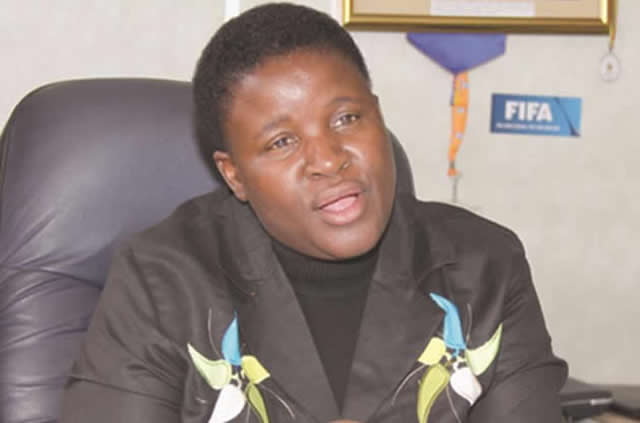
Fatima Bulla
IRON Lady and former Zimbabwe Women’s Football League boss, Mavis Gumbo is worried by the further marginalisation of women’s football.
What worries her most is the dramatic decline in recent years even before the Covid-19 pandemic struck Zimbabwe.
While she expressed anguish at the prospects of the women’s game post the Covid- 19 pandemic, Gumbo who assumed chairperson of the women’s football in 2010 said the fact that the Mighty Warriors had been reduced to runners- up behind South Africa in the Cosafa Championships was worrying.
In recent years, women’s football has returned to the woods again with the lowest point probably being last year when the Mighty Warriors boycotted its Olympic qualifier against Zambia at the National Sports Stadium.
This was a result of a fall out emanating from Zifa’s failure to pay the women’s national team their dues for participating in the Cosafa Women’s Championship qualifiers.
The Mighty Warriors and the Young Mighty Warriors had failed to make it to the Cosafa Women’s Championship final losing in the semis-finals.
Added to that were challenges of clubs failing to fulfill fixtures.
“No doubt Covid-19 has wreaked havoc not just to football but basically every facet of life, the way we live, business, how we congregate at churches, weddings and funerals.
“With all due respect to the current women’s football leadership, it must be noted that the women’s game had already begun to dramatically slide well before Covid-19 struck. I shudder to think what could now become of it post Covid-19 when things are looking to get worse,” Gumbo said.
The Mighty Warriors are a pale shadow of a team that had become a force to reckon with, qualifying for the 2016 Olympic Games in Brazil and Africa Women Cup of Nations as well as the 2015 All Africa Games.
They had become a competitive outfit to the extent of beating such heavy weights as Cameron, Angola and Zambia.
In 2013 the senior women’s football team also managed its best ranking to date placed at position 82 while also winning the Cosafa Championship on home soil, two years earlier.
Gumbo singled out the boycott of the qualifier against Zambia at the National Sports Stadium by the senior national women’s football team as one of a plethora of problems that were being faced in the women’s game.
According to Gumbo, women’s football reached the lowest point last year.
This is when the Mighty Warriors, which is the flagship team, was defeated at home by Zambia because ZIFA had failed to raise a team.
“This is a national team and not a club that is restricted to 25 or 30 registered players, but still we suffered the embarrassment of players being withdrawn from camp.
“For me there is actually a worrying trend to further marginalise women’s football in the last three years or so.”
She said before Covid-19, the only notable achievement worth talking about the Mighty Warriors in the last three years is finishing as runners-up to South Africa in the Cosafa Championships hosted in Bulawayo.
Added Gumbo: “Fast forward to last year before Covid-19, the majority of clubs were struggling to fulfil fixtures.
“Now in terms of the impact of Covid-19, yes there are massive challenges in store for women football. Apart from such teams like Black Rhinos, (army owned), Harare City (and) Correctional Services Queens, I foresee challenges for individually-owned clubs.”
She said teams that rely on company sponsorship could also face problems of budgetary cuts and that does not paint a good picture for the game.
“In my view I think there is need for a stakeholder meeting to try and find solutions to the survival of the Women’s game post Covid-19.”
Having rallied corporates like Marange Resources to assist women during her tenure, Gumbo also pushed to have women’s soccer considered for all forms of support.
This saw the Mighty Warriors embarking on well- resourced preparation camps stretching to a month long while also touring abroad to countries like Germany.
She said there is need for the ZIFA leadership to embrace other ideas and to be brutally frank with each other.
“FIFA has been trying to support women football and isn’t this the time for ZIFA to get expert advice on how best football for the women clubs can be assisted to remain viable?
“And one such big way to avail real grants to the clubs and for ZIFA to use some of the FIFA Forward funds to bankroll a competition for women football.
“There is need to create incentives to also attract investors for the clubs and to acknowledge women football as an industry that is capable of creating employment for the girl child and to keep them away from the social vices afflicting communities,” Gumbo noted.
While Gumbo is known for her experience in the public relations field, she will also be remembered for her relentless calls to support women’s football.
“It is also important for the women’s leadership to really stand for their constituency especially in ZIFA board meetings. If they don’t make noise and expect things to come on a silver platter there will be no league to even talk about, let alone clubs when this pandemic is finally declared over.”
Gumbo lost the reigns of the women’s game to Miriam Sibanda in 2014.
However, Sibanda was suspended in 2015 leaving Rosemary Kagonye taking over as chairperson on an interim basis.
The current chairperson of the women’s game is Barbra Chikosi who beat Kagonye in an election in 2018.


 Online Reporter