Chronicle Editor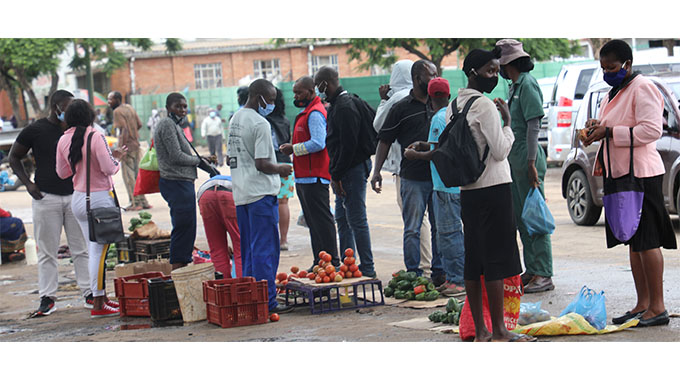
Yoliswa Dube-Moyo, Senior Features Reporter
THE Covid-19 pandemic has claimed the lives of over two million people globally, yet some people still believe the infection is a hoax.
They still ask if Covid-19 is “real” and think if it were, they “would be dead by now”.
And yet it is no longer just about statistics. We have since started putting names and faces to fatalities on a daily basis.
Our friends, relatives, colleagues and acquaintances are testing positive to the virus every other day, some struggling with symptoms and barely making it through each day.
In Zimbabwe, the Covid-19 death toll had risen to 713 after 30 more people had succumbed to the disease by Sunday.
Statistics from the Ministry of Health and Child Care show that 322 people tested positive to the pandemic on Sunday, 118 of them from Harare province.
Of the 30 new deaths, 13 were recorded in Harare, four from Masvingo and Mashonaland East provinces and three from Bulawayo and Midlands provinces.
Mashonaland Central and Manicaland province recorded one death each.
The Ministry says the recovery rate now stands at 60 percent as 640 recoveries were recorded countrywide on Sunday.
“We recorded 30 deaths and 322 new Covid-19 cases in the last 24 hours and of the cases, only one is of a returnee.
As at 17 January 2021, Zimbabwe had 27 203 confirmed cases, including 16 512 recoveries and 713 deaths,” the ministry said.
Despite these alarming statistics, some people still won’t wear their masks correctly, avoid social gatherings or stay at home when there is no need to move around.
Government health agencies and other experts have repeatedly emphasised that the decisions people make about leaving the house and sanitising their surroundings have a significant effect on how quickly the disease spreads but a noteworthy number of people still have not taken heed to this advice.
However, with months to go before a vaccine is widely deployed, there’s still some time to change minds and save lives that would otherwise be lost to Covid-19 denial.
Experts say updated messaging can change hearts and minds this deep into the pandemic.
In 2016, researchers in the United States conducted a study across 56 middle schools in New Jersey that had significant issues with bullying.
The team was able to reduce conflicts by 30 percent within a year by targeting the tastemakers, the popular or influential students in the schools, and encouraged them to post about the dangers of bullying on Instagram, wear bracelets for the cause, and speak to other students about better means of conflict resolution.
Leveraging a handful of influencers – the people we model to learn and create social realities – researchers were able to quantifiably reduce bullying across dozens of schools.
This model could be duplicated on a larger scale to get people to believe in the dangers of Covid-19, wear masks, and actually take the vaccine when it’s available so that we can put this pandemic behind us.
We would need politicians, celebrities, micro-influencers and members of the conservative-leaning media with a simple, unified message, in which all of these different power brokers actually demonstrate themselves social distancing, wearing a mask, and taking the vaccine.
This kind of marketing campaign could create a new social reality for Covid-19 deniers, one that’s in line with physical reality, experts say.
According to research, people will copy people they admire.
Meanwhile, the current Covid-19 denial could be mirrored with the HIV/Aids pandemic in South Africa.
In 2019, 7,7 million South Africans were HIV positive and the HIV prevalence among adults ages 15 to 49 was 20 percent.
Research shows that between 1997 and 2010, as many as 2,8 million South Africans died of HIV/Aids-related causes – an average of over 200 000 deaths per year.
These numbers were once incomprehensible to many, that is, until 2020, when the United States lost over 300 000 people to the coronavirus. The truth about what can happen in the absence of a carefully calibrated public health plan became painfully clear.
Of course, HIV and Covid-19 are two very different viruses. HIV is transmitted through the exchange of bodily fluid and Covid-19 is passed through small droplets in a person’s breath.
On the other hand, because Covid-19 is transmitted through casual contact and not an intimate exchange, it spreads much more easily. With HIV, you have to primarily think carefully about whom to sleep with and how; with Covid-19, you need to worry about getting within one metre of anyone – lover, family member, neighbour or stranger.
But despite these differences between the viruses, there is one factor that has played out in tragically similar ways: neglect and misinformation.
Research shows that because of the general inattention given to Aids, denialism continued to run deep, even as South Africans found themselves attending multiple funerals each month.
South Africa’s tragic Aids history should sound disturbingly familiar to all of us. There are, of course, Donald Trump’s various manifestations of denialism: his claims that Covid-19 wasn’t going to spread in the United States and would magically disappear if it did take hold; that lockdowns were a bigger threat than the virus itself; that hydrochloroquine was a cure-all for the hospitalised; that 99 percent of cases were totally harmless; and that the virus would disappear as soon as the 2020 elections were over.
These dangerous assertions have been echoed by both conspiracy theorists and officials and the consequences of such misinformation are easily observed in the portion of the population that ignores social distancing guidelines and considers mask-wearing a threat to the normal way of life.
Recovering from denialism takes time and there isn’t much time to spare.
The authorisation of two effective vaccines shows there is a light at the end of the tunnel although experts say there will still be formidable challenges in the coming months: coordinating the distribution of the vaccine to those who need it most; instilling patience in those who must wait their turn; and creating public health messaging for those wary of vaccination.
Regrettably, the recovery will continue to be hindered by those who, under the spell of denialism, refuse to confront the realities of a virus that has taken such a costly toll globally.


 Online Reporter