Chronicle Editor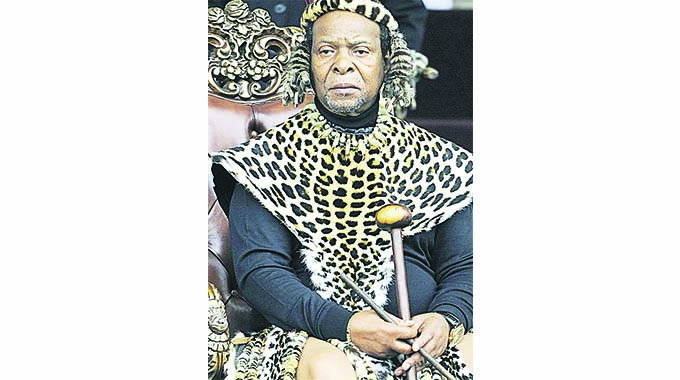
Pathisa Nyathi
Zulu King Goodwill Zwelithini is dead. Long live the King! Incumbent Zulu King, on the throne from 17 September 1968 following the demise of his father Cyprian Dinuzulu had been admitted to the Chief Albert Luthuli Central Hospital when his blood sugar levels became uncontrollable. In the morning of Friday the 12th of March 2021 he passed on. He had been the longest serving Zulu monarch, having ruled for 50 years.
As our thrust in this series of articles focusses on Covid-19, we shall accordingly do a two-part series. The first part will render the historical background to the King but more on the Zulu royal lineage to the throne as the first monarch. The second part will then delve more specifically on his reign and demise in the context of Covid-19.
It is important from the outset to appreciate that prior to the reign of King Shaka (Tshaka in IsiNdebele) the Zulu people were a mere lineage just like the Ndebele before the rise to the throne of King Mzilikazi. Perhaps the rise of powerful nation states in southern Africa has not been adequately dealt with. All we do is rush, by way of little analysis, to blame King Tshaka for the cataclysmic scattering of people in southern Africa. We fail to see a common thread between the creation of powerful nation states in the north and those in the south.
Slaving and commercial trade with the East Coast were responsible for the emergence of the said states as a measure taken to counter the economic and social activities of the Portuguese and the Arabs in the East Coast (Mozambique). The creation of the powerful states with a strong resistance force enables them to some measure to counter the menace-causing activities of the Portuguese and the Arabs. The resistance state were able to tap into a larger armed male population and a broader economic base.
Slaving business and commercial trade were initially confined to the northern parts. As a result, the first African lineages to experience the coastal menace were in the areas nearest to the source of the menace. As one would expect, reaction to coastal activities witnessed the emergence of resistance state in the interior but in trade routes that were used to import and export goods. Arabs were engaging in slave and economic trade, earlier than the Portuguese and the British. As a counter measure the lineages coalesced into powerful states with the capacity to fight the traders at the coast. Meanwhile, the Nguni people had, by that time, moved further south and as a result they were free from the coastal menace until much later. What we then observe in their situation is delayed state formation meant to create resistance states with a military capacity to stand against the purveyors of nefarious coastal activities.
Hence after the arrival of the British, the Nguni faced the same menace and took similar steps that were taken by the northern lineages.
Powerful resistance states were created. Changamire Dombo had his counterpart in King Tshaka and King Cetshwayo who defeated the British at the Battle of Isandlwana in 1879.
Many Nguni states came into being but only in the 19th century whereas in the north the social and military transformations took place centuries earlier. To locate the Zulu social and military developments to the point where King Goodwill Zwelithini rose to the Zulu throne in 1968, it is imperative to trace the socio-political events from several generations earlier. It all starts with the lineage ruler of the name of Ntu, hence reference to the Bantu, the descendants of Ntu. Ntu was the father of Mnguni whose name is the designation of Nguni peoples.
Mnguni had four sons, namely Xhosa the eldest son, Luzumana, from whom the Zulu are descended, Swati/Swazi from whom the Swazi people emerged and finally Ndebele who is the father of the Ndebele people, including those who trekked north and assimilated into the Kalanga people until the arrival of the Ndebele under King Mzilikazi.
It is the Zulu line that we are here interested in. After Luzumana there came Malandela the father of Zulu I who was succeeded by Nkosinkulu. After Nkosinkulu then came Ntombela the father of II was succeeded by his son Gumede. Phunga and Mageba both came respectively Gumede their father. Mageba was succeeded by Ndaba.
We now move into the more familiar territory when Jama succeeded Ndaba. After Jama there came the female regent Mnkabayi who was holding fort for the under-aged Prince Senzangakhona whose name is better known as he was the father of three Zulu monarchs. When he attained the age of majority Senzangakhona ascended the royal Zulu throne and was briefly succeeded by Prince Sigujana who Prince Tshaka dispensed with to become the first King of the Zulu nation.
The transformation took place at this time. The Zulu lineage was still being called after lineage leader Zulu. During the reign King Tshaka what had been independent lineages came under his burgeoning kingdom. Kingdoms comparable to those that emerged in the north came into being: Zulu, Ndwanwe, Xhosa, Ndebele, Mthethwa, Sotho, Swati/Swazi, Shangani and more.
After the assassination of King Tshaka in 1828, he was succeeded by one of the assassins Prince Dingane, also a son of Chief Senzangakhona. After King Dingane who died on the 29th of January 1840, he was succeeded by King Mpande yet another son of Senzangakhona whose reign ended with his death on the 18th of October 1872. King Mpande’s son, Cetshwayo, came to the throne in 1972.
It was King Cetshwayo who defeated the British military forces at the Battle of Isandlwana in 1879. By 1883 the Zulu, as an independent state, faced its demise. King Cetshwayo was back on the throne for the second time, but this time under British rule.
The subsequent kings were titular. There was, from 1883, a Zulu dependency. King Cetshwayo was succeeded by his son Dinuzulu who was on the throne till 1913 when his son King Solomon took over and was on the throne till 1933. He was succeeded by his son Cyprian Dinuzulu who held power till his demise on 17 September 1968 after which King Goodwill Zwelithini became king. Though officially king from 1968, his coronation was delayed till 1971 as there were threats on his life.
In the next article we shall look at how the Covid-19 impacted on his funeral and death/burial-related rituals and ceremonies.


 Online Reporter