

 admin
admin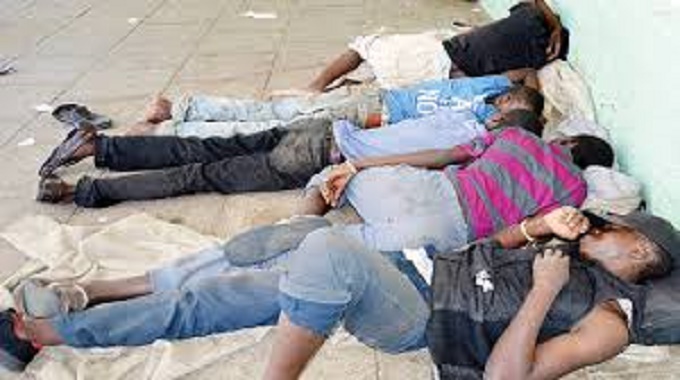
Gibson Mhaka
A pile of boys all in ragged clothes, curled on top of each other like corpses while in deep sleep in the sun, some barefooted, others in worn-out shoes, is a scene that greets one who passes through a city building situated along 10th Avenue and Robert Mugabe Way in Bulawayo.
People hurriedly walk past them as if they didn’t exist. In tattered clothes, dirt smeared, they spend their days looking for food from the dust bins and refuse dumps.
According to a report from the Ministry of the Public Service, Labour and Social Welfare published in 2017, Zimbabwe has an estimated 4 701 children living and working on the streets of the country’s major cities- Harare, Bulawayo and Mutare among other urban centres.
These children end up living and working on the streets for a plethora of reasons, including death of parents, breakdown of families, family violence, natural disasters, economic hardships, and drug and alcohol abuse. In order to survive, these children often beg and scavenge.
Another report estimates that 16 000 children are living on the streets countrywide, through wind and rain, hot summer nights and chilly winters. Most of these hapless children are severely undernourished and fight pitched battles on a daily basis, with dogs and cats over crumbs of food in dust bins.
With lockdown under way across the country, the situation of street children in the country has become more miserable due to lack of food and shelter.
The President declared a total lockdown on the country on Friday last week to contain the spread of COVID-19 which has infected more than half a million people worldwide.
Since the World Health Organisation (WHO) declared COVID-19 a global pandemic, many countries have adopted restrictive measures including orders to self-isolate at home, curfews, quarantines and lockdowns, and some have even officially proclaimed a state of emergency in their efforts to control transmission of the virus.
Personal hygiene, social distancing, washing of hands regularly with running water, avoiding touching nose and mouth as well as avoiding of crowds are key in combating the spread of the deadly global pandemic.
But for street children, who start and end their days on the streets such directives might be hard to follow.
A snap survey conducted by B-Metro around the city to find out how street children were coping with the Government’s lockdown directive revealed a desperate situation as a majority of them were scared and hungry.
They also seemed to be ignorant on the deadly Covid-19 that has swept across the globe.
One street child who identified himself as Nyasha was ill-informed of the deadly pandemic saying it was better to get it (coronavirus) while looking for food.
“I heard about it (coronavirus) a bit but I don’t know how I am supposed to protect myself from the disease. We are already ruined and so for us it’s better to get the disease while looking for food,” Nyasha said to loud approval from other street children.
He further said they were finding it difficult to survive since most of the dust bins they usually get food from were empty.
“We are also unable to survive in the present situation and how can I feed myself when there are no people in town. The Good Samaritans, who usually give us food and small jobs to earn money are locked at home,” he said.
It is important to note that street children are more prone to transmission of the virus as they lack awareness and hygiene as evidenced by their casual approach in terms of embracing key elements of combating its spread.
For example social distancing is pushed aside in the struggle to obtain food and shelter.
“We practically all live together. If one of us falls sick, we all will. If I also have bread, I will not eat it by myself, but I will share it with my friends. Likewise, if I am not with them and they have food, they will wait for me before eating. That’s how we are surviving,” said another one who identified himself as James.
An official from the Ministry of the Public Service, Labour and Social Welfare who requested anonymity for professional reasons acknowledged that street children already lived alongside the deadly pandemic.
He said the vulnerabilities to COVID-19 were immense to street dwellers adding that if control measures were poorly executed they could also have deep negative impacts.
“But in the meantime, we need to consider how COVID-19 could impact people living in the streets and also unsanitary environments like squatter camps and what could mitigate the worst of these impacts. This is challenging as the health and social needs of these populations are often invisible.
“Clear information and advice is needed. They should be informed about COVID-19, how it is different from other diseases and why the response asked of them for COVID-19 may be different. Of late, street children have been stigmatised, blamed, and subject to rules and regulations which are unaffordable or unfeasible to adhere to,” said the official.
Bulawayo City Council director of health services Dr Edwin Sibanda said street children were also part and parcel of the city system and once they started rolling out their community service programmes they would include them.
“We don’t have community service programmes as yet to sanitise people but as soon as we start providing them obviously we have a plan for those vulnerable groups such as street children, squatter camps, vendors and commuter omnibus drivers,” said Dr Sibanda.



 Bongani Ndlovu
 Online Reporter