
Kuda Bwititi
Politics, Foreign Affairs and Opinions Editor
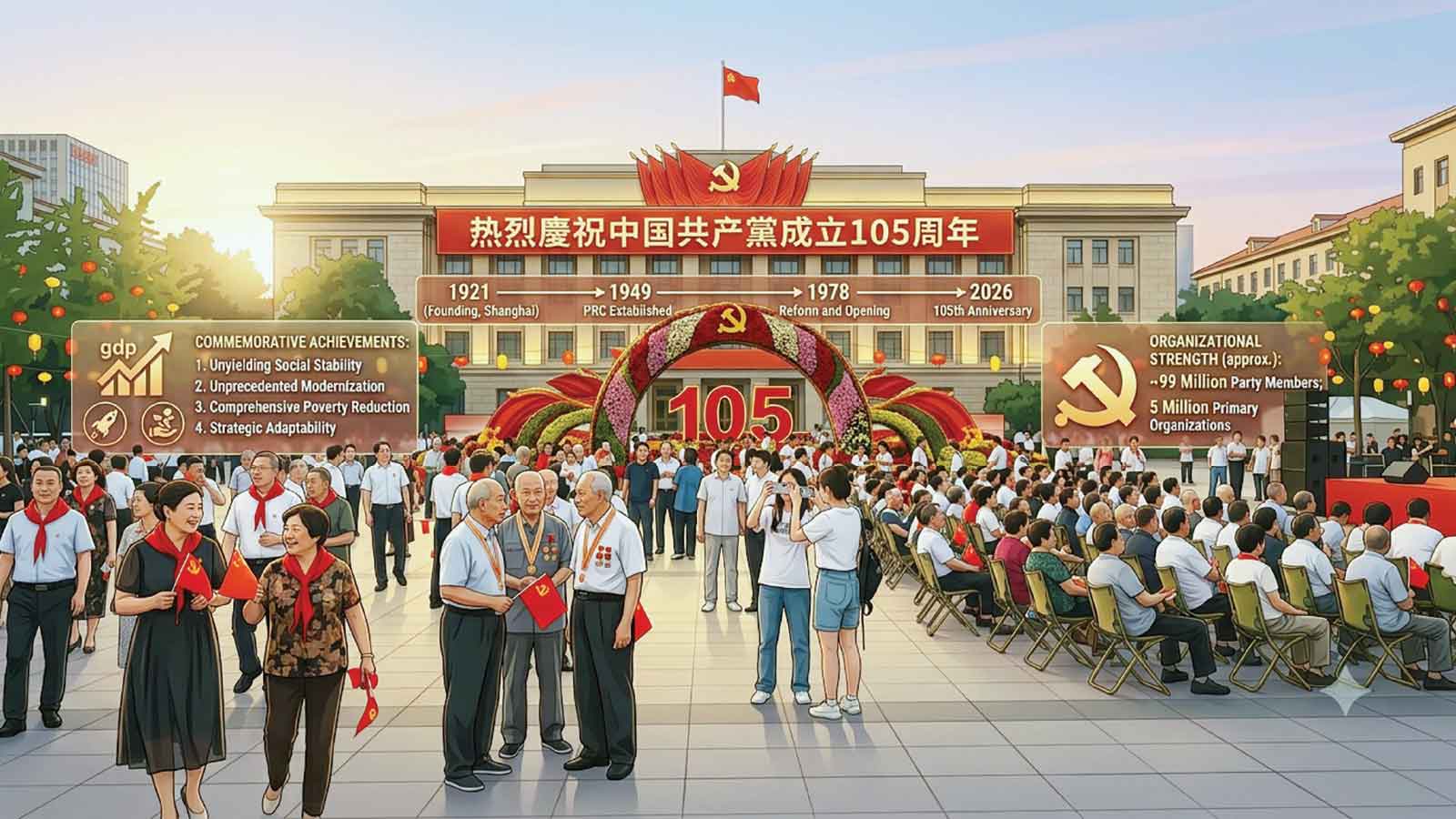
ON Wednesday, July 1, the Communist Party of China (CPC) marks its 105th anniversary — a rare and resonant milestone in modern statecraft.
To traverse more than a century is not merely to endure time, but to withstand the gale-force winds of geopolitical upheaval, internal transformation and global uncertainty.
Through civil war, isolation, famine, reform and reintegration into the world order, the CPC has stood as a colossal, adaptive force —tested by many pressures, yet it has remained unyielding in its structural core.
What makes this centenary-plus-five particularly striking is the sheer velocity of the nation’s metamorphosis. Under the party’s stewardship, China has vaulted from agrarian subsistence to the world’s second-largest economy.
In the past few decades, over 800 million people have been lifted from extreme poverty, with the country creating a middle class that is now exceeding the entire population of the United States.
To add to this, China’s modern physical infrastructure, characterised by high-speed rail, ports, and 5G networks, in many cases, surpasses that of any advanced nation.
Yet the full weight of this achievement is best grasped through the lens of recent memory.
To some young, it seems almost mythological that just over 30 years ago — in the early 1990s — China was still a struggling developing country, its per-capita GDP languishing below that of sub-Saharan Africa, its cities shadowed by air pollution, its rural hinterlands reliant on manual ploughing and kerosene lamps. In 1990, fewer than 1 percent of Chinese households owned a telephone. Yet, today, nearly every citizen carries a supercomputer in their pocket. That thirty-year arc — from aid recipient to global creditor, from factory floor to innovation frontier — constitutes one of the most compressed and consequential economic metamorphoses in human history.
Internationally, the anniversary arrives at a moment of acute scrutiny. The CPC now presides over a nation that is simultaneously a trade engine for half the globe, a climate-policy pivot player and a technological challenger in AI, quantum computing and space exploration. Its Belt and Road Initiative has rewired logistics across Eurasia and Africa.
China’s diplomatic posture has become increasingly assertive and influential under the leadership of President Xi Jinping, giving rise to the term “Xiplomacy”, which describes his distinctive approach to foreign policy.
Party supremacy over government
The concept of “party superiority” over the government is central to understanding China’s political system. It is not a competition between two equal branches but a foundational principle where the party leads and the state administers.
In China’s “party-state” system, the CPC is the dominant political institution, exercising “overall leadership over all areas of endeavour in every part of the country,” while the government is tasked with administration. This relationship is structured so that party rank takes precedence over government rank at every level and in every institution, ensuring the party’s control over all aspects of political life.
The party is described as the policy-maker that leads and determines major policies, while the state acts as the policy enforcer and administrative agency that carries out efficient management. This division of labour is intended to combine strategic direction with administrative execution.
14 Principles of Xi Jinping Thought on Party Building
Since taking office in 2013, President Xi Jinping has exercised decisive leadership that has helped advance the country’s prosperity, reinforce discipline and strengthen national governance.
The 14 Principles of Xi Jinping Thought on Party Building provide a comprehensive framework for strengthening the CPC and ensuring its long-term leadership. They address the fundamental question of what kind of Marxist governing party should be built and how it should be governed in the new era.
At the core of these principles is the affirmation that party leadership is the defining feature of socialism with Chinese characteristics. The party’s centralised and unified leadership is regarded as essential for national development, policy implementation and achieving China’s goal of national rejuvenation.
The principles emphasise full and rigorous self-governance of the party through continuous self-reform, strict discipline and comprehensive anti-corruption efforts. Party members are expected to remain committed to the party’s founding mission of serving the people and promoting national prosperity while maintaining strong political ideals, loyalty and integrity.
The principles also stress improving work conduct by combating bureaucracy, formalism, and unhealthy practices while maintaining close ties with the public. Strict party discipline, reinforced by institutional rules and regulations, ensures accountability and consistent implementation of party policies.
A major focus is the integrated fight against corruption through severe punishment, stronger institutional safeguards and moral education to ensure officials do not dare, cannot, and will not engage in corrupt practices. This is why several former CPC leaders or military generals have been sent to jail, or handed harsh sentences including the death penalty. There is zero tolerance for ill-discipline.
Also, party leaders at all levels are held politically responsible for enforcing strict party governance, with clear accountability mechanisms to ensure effective implementation.
Together, these 14 principles form a systematic theoretical framework for strengthening party leadership, improving governance, maintaining discipline and integrity and ensuring the Communist Party’s long-term capacity to lead China’s development in the new era.
A personal experience with the CPC
In March this year, I was privileged to attend the Two Sessions meeting in Beijing, which is China’s biggest political convention of the year.
As July 1 approaches, I find myself reflecting on lessons learned from covering the CPC’s political rituals and the deep resonance they hold for we Zimbabweans who share a long-standing historical friendship with this great Asian nation.
This year’s Two Sessions in 2026 carried an even greater weight as they launched China’s 15th Five-Year Plan (2026–2030), a blueprint that is fundamentally reshaping the global economic landscape and, significantly, offering new pathways for nations of the Global South like Zimbabwe. This evolution from solidarity to tangible economic integration was a recurring theme during the sessions. The discussions around the 15th Five-Year Plan confirmed that China is accelerating its transition from an export-led model to one driven by innovation in humanoid robots, quantum computing, and artificial intelligence. But crucially, for us in Harare, it means that Chinese investment is pivoting toward value addition.
But the history between our two nations runs much deeper than economic policy. It is a history forged in the crucible of liberation and cemented by mutual respect.
This was starkly brought home to me during my attendance at the 80th anniversary commemorations of the War Against Japan and the Second World War in Beijing in September 2025. Standing at Tiananmen Square in Beijing, one could not help but draw parallels between China’s struggle against imperial aggression and our own Chimurenga.
The resolve displayed by the Chinese people in the face of occupation is a testament to the spirit that the CPC has nurtured for over a century. It is a spirit of resilience and sovereignty that resonates deeply with Zimbabweans.
We understand the cost of freedom because we paid a similar price. The solidarity that China extended to us during our liberation struggle was born of a shared understanding of what it means to fight for one’s own destiny. The CPC’s journey is a testament that a people, guided by a strong and visionary party, can overcome any obstacle to build a nation that commands respect on the world stage.
The CPC’s 105th anniversary is therefore not just a Chinese celebration but a milestone for global solidarity. It represents a commitment to multilateralism and a vision of a world where the Global South can rise together.
For Zimbabwe, it reaffirms a future where our agricultural exports—from citrus to blueberries — can find a massive market in China, and where our minerals will no longer just be exported raw but processed locally, creating jobs and transforming our economy.
The CPC has not only survived for 105 years. It has thrived, evolving into a global powerhouse that now serves as a beacon of development.
As it marks 105 years, the CPC remains a towering giant in global politics, its influence felt in capitals, boardrooms and international institutions around the world.