Chronicle Editor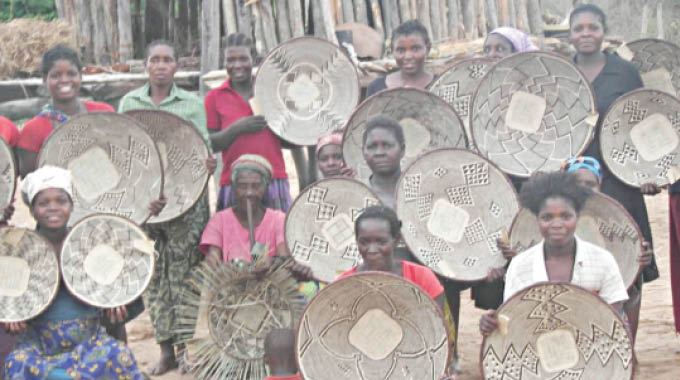
Leonard Ncube, Victoria Falls Reporter
CRAFTSMEN and women in Binga District are set to benefit from the resuscitation of Binga Craft Centre, which had become defunct due to operational challenges.
Established in 1985, the centre at some point had about 4 000 members drawn from across Binga District and would produce about 3 000 baskets per month. As production slowed membership also fell to about 1 000 at the height of economic challenges.
Government chipped in to renovate the facility and re-train members. Production is now picking up, with membership having risen to 2 000 while production is now at 500 baskets per month. Binga Craft Centre manager, Mr Matabbeki Mudenda, said efforts were being made to resuscitate the centre.
“At some point we had about 3 000 members but collapsed due to the economic challenges in the country. Things are now picking up after Government chipped in to resuscitate the centre by renovating buildings,” he said.
“We have about 2 000 weavers and about 100 wood carvers and producing about 500 baskets per month. What we do is that we only collect from people when there are orders unlike before when we would receive stocks at any time because the market was wide,” said Mr Mudenda.
Drawn from all corners of Binga District, the members work from home or in groups in their wards and approach the centre for market.
“Our production is not only limited to traditional baskets and stools. There are cooking sticks, laundry baskets, lazy chairs and other artifacts,” he said.
Mr Mudenda said the centre was grateful to ZimTrade and Government for training rendered to members and other forms of help.
“We sell locally at art galleries and national handicrafts as well as in Europe and America. We were so lucky that we travelled to art exhibitions around the world such as New Mexico, which happens every July, Frankfurt and the Morocco world summit for women-led groups. We also market on social media and as such our production levels are picking up.
“We now make 500 baskets per month but we are still limiting people from bringing more so that we get market first than to take people’s stuff and struggle to pay them because we would not have secured market,” he said.
Mr Mudenda said operational costs such as phone, water and electricity bills had ballooned to a combined $14 000 but they have cleared the arrears as business is picking up. He said the major challenge faced by the centre and its members was transport from their respective areas in the district to Binga centre as well as going to Zambezi River where they get raw materials.
“The ilala palm tree is found along Zambezi River, which means that every member should travel to the river to get it. As a solution and to remain sustainable, we planted 20 000 palm seeds with help from Netherlands government but unfortunately it didn’t rain. It is our wish to establish a plantation so that members have a sustainable source of the raw material,” said Mr Mudenda.
The centre is led by a board of eight and employs four people and aims to improve the standards of living and the economic status of the whole district through the production and sale of craft and art work where members produce sustainable crafts using natural resources. With significant financial support, the centre has potential to grow into a small-scale industrial operation, which together with fisheries can sustain Binga district whose economy revolves around fishing. — @ncubeleon.


 Online Reporter