Online Reporter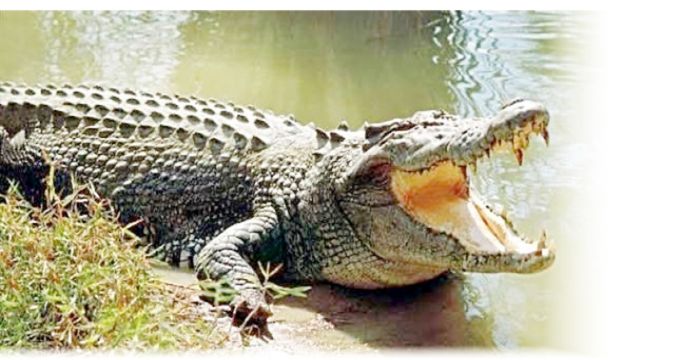
Bruce Ndlovu Sunday Life Reporter
WHEN a crocodile crawled onto Victoria Falls’ A’Zambezi River Lodge last month, it instantly became a worldwide phenomenon.
The sight of the 13-foot-long reptile casually strolling towards the buffet counter at the lodge quickly went viral on social media, with people from across the globe marvelling at the sight of one of nature’s most powerful predators making itself comfortable in unfamiliar surroundings.
Seemingly tired of its diet in the wild, the giant reptile appeared determined to treat itself to some gourmet meals prepared by top chefs at one of the resort city’s premier establishments.
The conversations that followed the sudden appearance of the water-dwelling beast were largely light-hearted, with many marvelling at its sheer size and, after its evacuation, the expert manner in which the country’s wildlife authorities handled the situation.
Barely two weeks later, crocodiles were back in the headlines. This time, however, their appearance sparked genuine fear and terror among the public.
A Bulawayo man was feared to have been attacked by a crocodile at Mpopoma Dam in Matobo National Park. The man, whose remains are yet to be found, had reportedly been fishing before he was savagely dragged into the water by the reptile.
The two incidents, one humorous and the other tragic, highlighted the dual nature of Zimbabwe’s growing human-wildlife conflict.
While the fruitful rainy season, which saw water levels rise across most of the country’s water bodies, brought relief to many communities, it has also coincided with an increase in crocodile attacks.
Last Friday, a woman from Kwekwe, identified as Rumbidzai Musekiwa, survived a crocodile attack while crossing the Mbembeswana River. The incident left her with a severe leg fracture and resulted in her emergency transfer to hospital, where a specialised surgical team at the trauma camp successfully performed an orthopaedic procedure.
This was not the first time this year that the Mbembeswana River had claimed a victim. In February, a Kwekwe man, Tichaona Muguti, went missing for more than a week after being attacked by a crocodile while crossing the river.
The attacks are not unique to Zimbabwe. As water levels rise across sub-Saharan Africa, crocodile attacks have become increasingly frequent.
Last Friday, a fishing trip turned tragic in Binga after a woman was attacked and killed by a crocodile while fishing in the Zambezi River. The incident occurred at a fishing spot popularly known as Ambush Alley. Sources close to the matter said the woman had been fishing with a neighbour in shallow water when the crocodile suddenly emerged, attacked her and dragged her into deeper waters.
Earlier this month, the remains of a Portuguese citizen were recovered from the stomach of a crocodile in South Africa.
Gabriel Batista(59), was reportedly seized by the animal after being swept away in his vehicle while attempting to cross a partially submerged bridge over the Komati River.
The mystery surrounding Batista’s disappearance had grown for days after he vanished on 27 April. After locating the vehicle on the riverbank, investigators reportedly noticed a crocodile nearby that appeared swollen and struggled to move.
Attacks on people living along Lake Turkana in north-western Kenya have also become increasingly common in recent years, as rising water levels shift the habitats of Nile crocodiles closer to human settlements. The predators can grow up to six metres long and weigh as much as 900 kilogrammes.
Elijah Chege, county warden for Turkana at the Kenya Wildlife Service (KWS), told The Guardian that the overflow had brought crocodiles closer to human settlements. The animals have established new nesting and hunting grounds along the altered shorelines, increasing the likelihood of attacks on nearby communities, he said.
Traditional fishing practices, such as the use of logs as boats, have also exposed communities to greater danger, Chege added.
He said KWS relocates “problematic” crocodiles and, in extreme cases, kills them. Despite these efforts, the attacks persist. In the past year alone, KWS recorded seven deaths and 15 injuries linked to crocodile attacks, according to Chege.
According to Luckmore Safuli, the Public Relations Manager for the Zimbabwe Parks and Wildlife Management Authority (ZimParks), there has been a marked increase in crocodile attacks due to the growing proximity between human activity and wildlife habitats.
“The current data indicates that areas surrounding water bodies and wildlife interfaces, particularly Kariba, Binga and Mbire, continue to experience a high prevalence of human-wildlife conflict incidents. These are largely attributed to increased human activity in wildlife zones, competition for water resources and habitat encroachment.
“ZimParks continues to implement mitigation measures aimed at reducing these incidents, including strengthening community awareness programmes on wildlife safety, enhancing rapid response teams in hotspot areas, promoting the construction of protective barriers and safe water access points, and working closely with local authorities and communities to improve reporting and response mechanisms,” he said.
Safuli advised members of the public to avoid swimming, bathing or wading in water bodies known to contain crocodiles.
He also urged communities to barricade water collection points with thorny bushes and avoid fishing close to the water’s edge, particularly during the early morning, evening and night hours when crocodiles are most active.
“Members of the public, particularly those in high-risk areas, are urged to exercise caution when near wildlife habitats, especially water bodies where dangerous animals such as crocodiles and hippos are prevalent. ZimParks remains committed to safeguarding both human life and wildlife through collaborative and sustainable conservation efforts,” he said.
However, despite repeated warnings from authorities about the dangers lurking in these water bodies, some communities have found it difficult to resist waters that remain central to their livelihoods.
Mervis Mpala of Dick Village, whose son lost a leg in a crocodile attack at Kalope Dam in 2021, said villagers continued to flock to the dam despite the ever-present danger.
“Our livelihoods are in that dam and we cannot abandon it completely.
“We wish there were no crocodiles and no danger but, at the end of the day, fishing is our life. We have to provide for our families because hunger will kill you before a crocodile does,” she said.