Online Reporter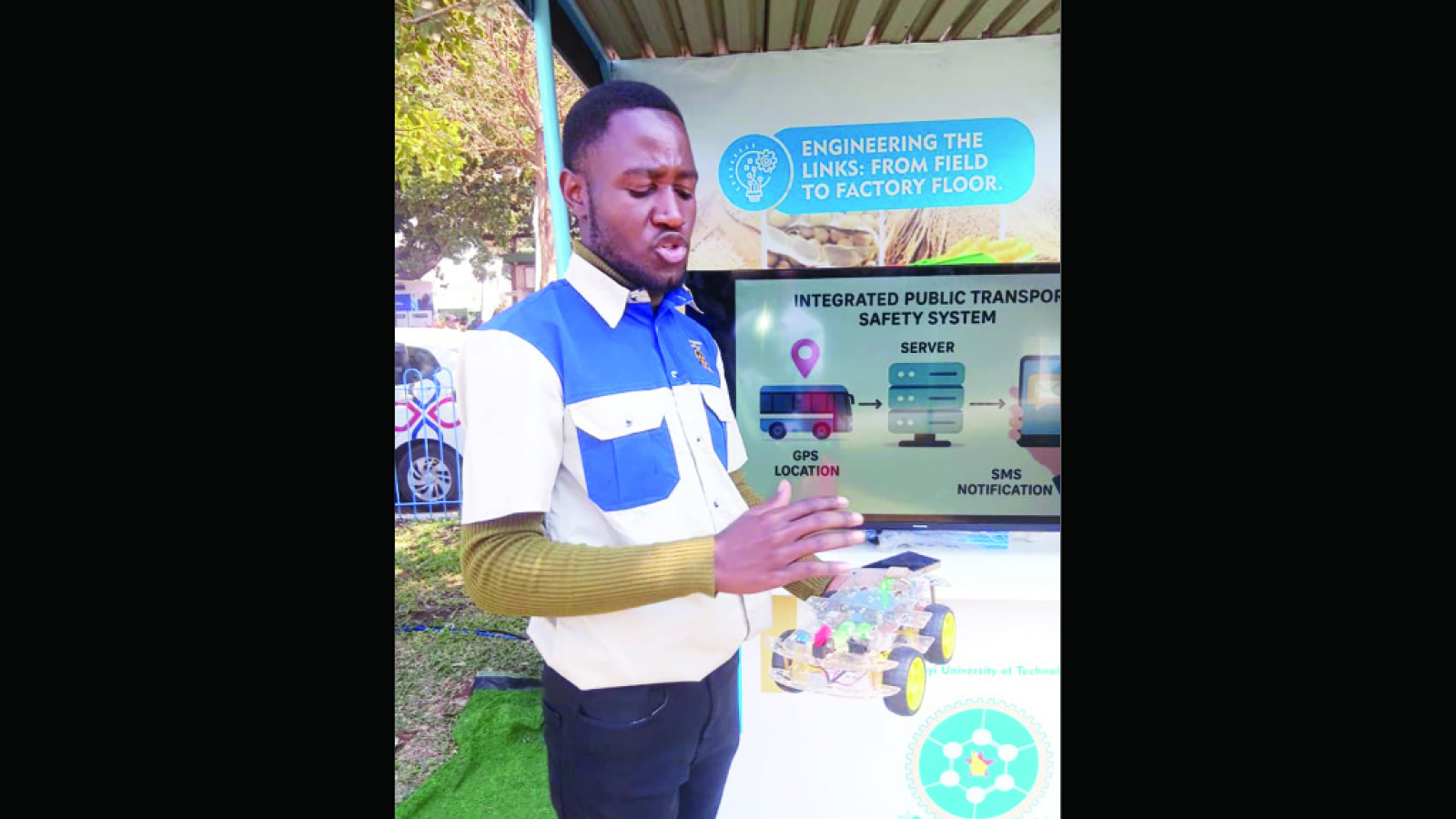
Trust Freddy
Herald Correspondent
IN the blink of an eye, a routine drive can turn into a life-or-death situation.
Road accidents are a harsh reality, and timely emergency response can be the difference.
Now, Chinhoyi University of Technology (CUT) is changing the game with an innovative accident detection device that can be installed in vehicles, promising to revolutionise road safety and emergency response.
The Automatic Accident Detection system, developed by a team of computer engineering students, is designed to recognise when a vehicle has been involved in a serious car crash.
Within seconds, it sends an emergency alert to designated mobile phones, ensuring a swift response and potentially saving lives. This cutting-edge technology can detect various types of collisions, including head-on and side-swipe impacts, making it an invaluable tool for vehicle owners and fleet managers.
“We developed an accident detection and notification system, designed to facilitate a rapid response to accidents,” a Chinhoyi University software Engineer Daniel Chinyama (24) told The Herald on Saturday while exhibiting at the Harare Agricultural Show.
“This system can benefit both public and private transport. For instance, if you are driving alone in your car, we can link the system to your wife or a relative’s phone. In the event of an accident, the system immediately sends a notification – an SMS showing the exact location accompanied by a sound alert – to your wife’s phone.”
The project, according to Eng Chinyama, is already being piloted in Chinhoyi with a kombi fleet owner, having installed the devices.
“We conceived this idea after realising that precious lives were being lost due to delayed alerts to emergency response teams following accidents.
“We have already installed these devices in Chinhoyi on the kombis of a transport businessman’s fleet. If any of his vehicles are involved in an accident, the system immediately alerts him, providing the vehicle’s number plate and location. This way, there will be no excuses for delayed emergency responses, and lives can be saved.”
He added that the system would also help companies track drivers who crash vehicles and repair them covertly.
“Companies often face issues with drivers secretly fixing damaged vehicles without informing them. This system allows transport departments to monitor vehicles closely. If a driver is involved in an accident during a solo delivery, the company will be alerted and can respond promptly.”
Eng Chinyama expressed optimism that the system would reduce fatalities by detecting impacts to the entire vehicle.
“Our sensors detect impact to the entire vehicle, not just the front. Whether the car is hit from the back, side, or any other angle, the system detects it.
“We are confident that with full support, our nation can reduce the number of deaths caused by delayed emergency responses.”
The system can also be linked to emergency services such as police command centres, fire departments, hospitals and ambulance providers, ensuring a swift and coordinated response.
What sets this device apart is its ability to be installed directly in vehicles, making it a more accessible and reliable solution for the country.
Unlike smartphone-based accident detection systems, such as those found in certain iPhone and Apple Watch models, Google Pixel phones, and some Xiaomi models, this device does not rely on a phone’s sensors. In developed countries like the United States, Canada, Australia, Japan and several European nations, these smartphone features can detect car crashes and send emergency alerts.
However, these systems have limitations, as they can be triggered by false alarms – for instance, iPhone owners have reported accidental emergency calls while skiing due to the phone’s sensors misinterpreting the motion.
In contrast, this locally developed detector is tailored to meet the specific needs of Zimbabwe’s transport industry.
Since it is installed directly in vehicles, it can detect accidents even if the driver or passengers don’t have their phones with them.
This development comes at a time when motorists are calling for quicker emergency responses to accidents.
In remote rural areas, especially along highways, it is not uncommon for an hour or more to pass without seeing another vehicle.
If an accident occurs, it could take a significant amount of time for the person to receive assistance.
However, with this new system, an alert can be sent quickly to emergency services, potentially saving lives.
This development comes at a critical time when Zimbabwe is grappling with an alarming rise in road traffic accidents.
According to the Traffic Safety Council of Zimbabwe (TSCZ), road traffic accidents increased by 8 percent during the first eight months of 2024 compared to the same period in 2023.
This tragic trend has resulted in numerous families mourning their loved ones, including breadwinners, while some victims have suffered life- altering injuries.
Last year was marked by a significant number of severe road traffi c accidents.
At least 39 461 road traffic accidents were recorded from January to September 2024, compared to 36 628 over the same period the previous year.
During that period, 1 532 people were killed compared to 1 373 the previous year, leaving 7 438 and 6 789 injured, respectively.
With 20 072 accidents recorded in Harare, the capital had the highest number, followed by Bulawayo (3310) and Mashonaland West ( 2 593).
The trend also continued into this year with police reporting, a sharp rise in road traffic accidents during the 2025 Heroes and Defence Forces holidays, with fatalities and injuries significantly higher than last year.
Statistics released by the police show that between 11 and 13 August 2025, a total of 196 road traffic accidents were recorded, up from 149 in 2024.
Fatal accidents increased from eight to 13, while the death toll climbed from 16 to 24.
The nation was last month plunged into mourning following a horrific crash at Manyame Bridge, near St Mary’s Police Station, which claimed 17 lives.
The collision between a fully-loaded city-bound 30-tonne haulage truck and a commuter omnibus heading to Chitungwiza left blood, twisted metal, shattered glass and heartbreak in its wake.
At the accident scene, one of the major concerns were the delay in coming of emergency response team and with this new system it is expected that it greatly improve.
The frequencyof these accidents has left many searching for answers and Chinhoyi University of Technology to search for the lasting solution in line with the Second Republic’s vision to modernise the education system, with the shift from Education 3.0 to Education 5.0 driving innovation and entrepreneurship, and leading to the establishment of new industries and start-ups.
This shift emphasises that, in addition to providing students with a strong theoretical foundation and enabling research staff to advance knowledge, it is equally crucial to apply that knowledge and drive innovation in practical applications.
The alarming rise in road traffic accidents in country has prompted innovative solutions, such as the latest accident detection system developed by Chinhoyi University of Technology.
This system aligns with the Government’s Education 5.0 initiative, which focuses on practical applications of knowledge to drive innovation and entrepreneurship