admin
admin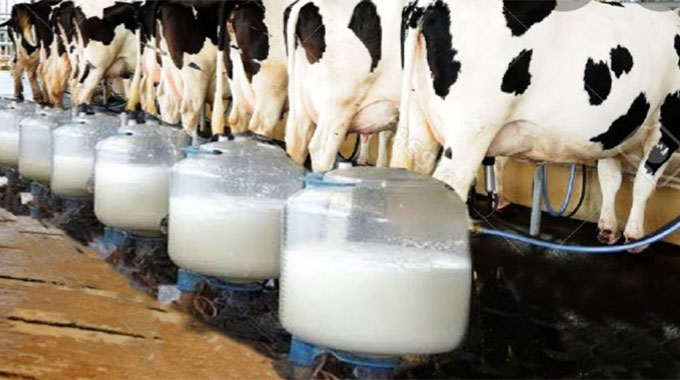
Edgar Vhera Agriculture Specialist Writer
GOVERNMENT-INITIATED and private sector led interventions are beginning to pay off for the dairy sector with milk output rising from 83 million litres in 2022 to 90 million last year, as the country moves to close the gap between local demand and supply in line with the push to substitute imports with local products.
The country requires about 131 million litres of raw milk annually for self-sufficiency with imports filling the difference.
The Zimbabwe Association of Dairy Farmers (ZADF) national chairperson Mr Edward Warambwa said the country will be milk self-sufficient by 2025 with surplus for export.
“We anticipate 2023 to end with a total production of slightly over 100 million litres, a figure above last year’s 91 million. Expensive feed, low milk-in-cow population, low support and unavailability of proper finance through a tailor-made dairy financing model are among the challenges bedevilling the sector,” he said.
The availability of properly structured finance will allow the import of superior genetics and breeds through serviced semen, he said.
Short duration loans of three-year gestation period are not suitable for the sector as profitability only comes after the second calving, which allows incurred costs from inception to be recovered. The country currently has about 30 000 milk-in-cow and targeting 50 000 by 2025.
Transforming Zimbabwe’s Dairy Value Chain for the Future (TranZDVC) project coordinator Dr Edison Chifamba recently said milk production by year end would be between 100 and 105 million litres to surpass last year’s 91 million.
“We are optimistic that our national raw milk production will be between 100 and 105 million litres by year end, while in 2024 we hope to reach 120 million with the 2025 target of 150 million,” he said.
If the country achieves the above set targets it will have managed about 15 percent growth this year, 15 percent next year and 25 percent in 2025.
In spite of the challenges bedevilling the dairy sector such as high feed cost, Dr Chifamba was optimistic that the country would meet its local raw milk needs by 2025, most farmers had been importing their dairy herds, which would come into production in the coming months.
Dairy Processors Association of Zimbabwe (DPAZ) secretary general Mrs Tendayi Clementine Marecha shared the same view recently saying raw milk production was expected to increase to about 103 million litres by year end.
She said capacity utilisation at processing level had increased from 40 percent in 2020 to the current 55 percent while milk productivity had increased 15 percent from 13 litres per cow per day in 2020 to the current 15.
Mrs Marecha lamented the lack of one stop shops to process import and export documentation, pre-shipping inspections as well as taxation of raw materials that tend to increase cost of production resulting in uncompetitive products on the shelf that will fail to compete with imported cheap finished products.
Since 2017 local milk production has been on an upward trajectory from 66 million litres to 91,4 million in 2022.
Statistics from Dairy Services Unit (DSU) show that there had been a nine percent increase in total milk production over the period January to November from 83 025 599 litres in 2022 to 90 311 809 over the corresponding period in 2023.
There has been a 15 percent increase in milk production for the month of November from 8 595 258 litres in 2022 to 9 323 464 in the comparable month last year.
Monthly milk production figures over the period January to November last year have been eclipsing 2022 values by percentages of between two and 15.



 Online Reporter