Online Reporter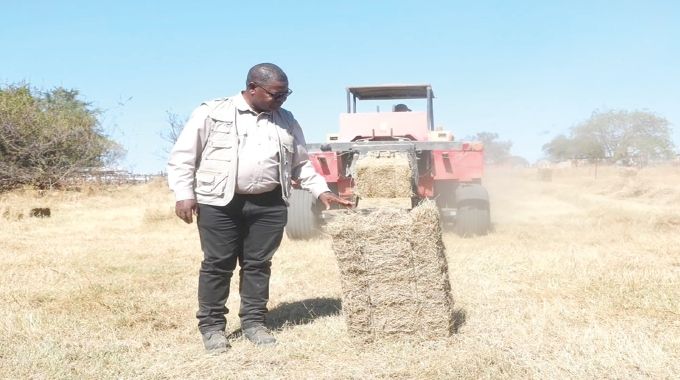
Judith Phiri [email protected]
THE BJ Ellerman and Sons Farm in Matabeleland South has emerged as a model for Government’s “Dam as an Economy” strategy after harnessing a nearby dam to boost irrigation, livestock production, fisheries and the livelihoods of surrounding communities.
The farm in Ward 11, Mangwe District, is among practical examples of how water bodies are being leveraged to stimulate agricultural production, create employment and strengthen food security under the Agriculture Food Systems and Rural Transformation Strategy 2 (AFSRTS2) (2026-2030).
Speaking during a tour of the farm at the weekend, Permanent Secretary for Lands, Agriculture, Fisheries, Water and Rural Development, Professor Obert Jiri, said the initiative demonstrates the type of integrated development Government wants to replicate across the country.
The strategy is anchored on Zimbabwe’s vast water resources, with more than 12 000 dams providing enormous potential for irrigation, fisheries, livestock production, hydropower generation and domestic water supply.
Giving an overview of operations at the farm, owner Mr Paul Ellerman said the dam has become the backbone of production.
“There are some fish inside this dam and we basically use it when we need to pump water either for the cattle if our boreholes are giving us trouble or if we want to plant maize when the rains are not enough, so we can always add to the drip irrigation system,” he said.
“We also plant tomatoes using water from the dam, so it’s a backup for us, which keeps us going, while playing an important role during the dry season by providing water for livestock on our farm and neighbouring farmers.”
Prof Jiri said the model perfectly aligns with the Government’s vision of turning every dam into an economic hub.
“For us to put it into perspective, we have more than 10 600 water bodies. A lot of these are actually large dams with the capacity to irrigate more than two million hectares,” he said.
“If you look at Tugwi-Mukosi Dam, it has the capacity to irrigate over 40 000 hectares, Marovanyati Dam can irrigate more than 5 000 hectares and Gwayi-Shangani Dam, which is coming up, can irrigate up to 10 000 hectares.”
Prof Jiri said Zimbabwe needs at least 350 000 hectares under irrigation for cereal production alone if it is to guarantee national food security.
“Constructing the dam wall is the easier part. The important thing is converting every water body into an economy that supports irrigation development, fisheries, hydropower generation, livestock production and water reticulation for surrounding communities,” he said.
“If we do that, we improve livelihoods around the dam. We develop industries around the dam and create centres of economic activity, employment and prosperity.”
The “Dam as an Economy” concept is one of President Mnangagwa’s flagship rural industrialisation and climate resilience initiatives under the Second Republic. It seeks to ensure that every major dam becomes a catalyst for socio-economic development by supporting irrigation schemes, fisheries, tourism, livestock production, agro-processing industries, renewable energy generation and domestic water supply.
The programme complements the Rural Development 8.0 model, which promotes integrated rural transformation through infrastructure development, value addition, industrialisation and improved livelihoods.
It is also aligned to the National Development Strategy 2 (NDS2) and Vision 2030, which identify irrigation expansion and climate-smart agriculture as key pillars for achieving an upper-middle-income economy.
Government has already invested heavily in dam construction and rehabilitation through projects such as Gwayi-Shangani, Tugwi-Mukosi, Marovanyati, Lake Mutirikwi and other strategic water infrastructure, to expand irrigated agriculture, enhancing food security, supporting rural industries and reducing the impact of climate change on agricultural production.
Agriculture remains one of Zimbabwe’s key economic sectors, contributing about 12 percent to Gross Domestic Product, supplying raw materials for about 60 percent of the manufacturing sector, employing nearly 70 percent of the population and generating around 30 percent of export earnings in favourable agricultural seasons.
These factors make irrigation-led agricultural transformation central to the Government’s economic development agenda.