admin
admin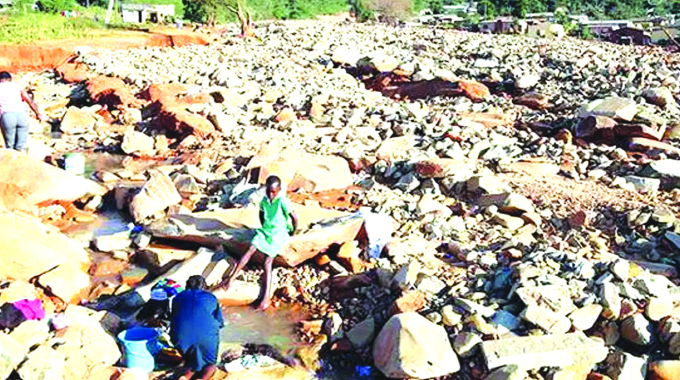
Cliff Chiduku
Climate change affects all spheres of life, particularly those aspects that depend on the environment.
Farming communities are a case in point.
Agriculture is the backbone of country’s economy as Zimbabweans derive their livelihoods mostly from farming.
Most farming communities especially smallholder farmers are in the rural areas.
Since agriculture in Zimbabwe is largely rain-fed, it automatically means that rural communities are vulnerable to the vagaries of climate change.
Zimbabwe regards climate change as a threat which has the potential to undermine strides made in meeting the country’s development targets.
Both climate change and policies to minimise its effects have enormous socio- economic and environmental implications.
In response to the weather phenomena, Government in 2017 adopted the National Climate Policy, which is aimed at mainstreaming climate change in all sectors of the economy.
The effects of climate change are usually classified into two categories — economic and non-economic.
The economic effects are losses that can be quantified or measured in monetary terms.
Non-economic effects
Non-economic effects are losses that cannot be quantified or measured in monetary terms. Examples include loss of indigenous knowledge, cultural heritage and sense of place and belonging.
Imagine the following scenario: villagers in Ngangu in Chimanimani were forced to make-do with makeshift shelter at Garikai after their homes were swept away by Cyclone Idai in March 2019.
Cyclone Idai hit the eastern parts of Zimbabwe in March 2019, killing 341 people. Their lives were turned upside down in a flash of a second. They lost belongings, land, crops and livestock; ancestral graveyards were abandoned and income opportunities were lost.
The community was resettled at a safer area while others migrated to urban areas. Government and development partners made sure the villagers had income opportunities after diversifying their skills and earnings.
Assuming that they are now earning a living, and some of them are thriving in those new surroundings.
Comparing per capita income before and after the relocation may show the latter’s beneficial effects. Things look good.
Accounting for non-economic and damage based on the aforementioned case changes the perspective: the Chimanimani villagers did not only lose arable land, but also landscapes. Not only were livestock lost, but also traditions and cultural artefacts. New ways of income generation have to be learnt, and traditional ways of knowing and relating to the environment were obviously lost. The task of adapting to new realities at Ngangu caused stress, a sense of loss and disorientation. When villagers were dislocated from their lands, what happens to their identity? Is that lost, too?
Non-economic loses manifest through material and non-material aspects of human lives and societies.
Loss of cultural heritage, traditional knowledge systems or place identity usually leave communities disconnected from their sense of self and each other.
Such losses are felt at the individual and communal levels. While non-economic losses due to climate change considers material and non-material dimensions, they are nearly impossible to quantify or monetise, but are still deemed valuable by people who are faced with such losses.
By so doing, interventions instituted by the Government and non-governmental organisations have focused on understanding and addressing the economic effects of climate change. Yes, less so the non-economic aspects. This has resulted in policy failure or the emergence of “wicked problems”.
The understanding on non-economic issues will no doubt have an implication on climate change adaptation strategies and policies that we are likely to implement. For example, it is now difficult for farmers to predict rainfall patterns.
There was a time when rains were constant during specific months of the year, which enabled them to plan and organise themselves for their yearly farming activities, as they were able to predict rains and start of the farming season.
Some traditional leaders have confirmed that it is now difficult for them to hold the rain making ceremonies because of these changing weather patterns.
Social consequences
Another consequence of erratic rainfall patterns is the death of communal value system.
In the past, communities would come together, socialise and exchange labour in a system called nhimbe or humwe.
This is often based on the principle of helping one another on the farm as a way of building social bonds. Nhimbe (communal labour) was largely practised at any time of the rainy and farming seasons — during land preparation, planting and harvesting.
But this is now a thing of the past because the season are now unpredictable while the rains have been erratic affecting production.
In some cases, there is no longer need for community labour. But the variable nature of the rains had distorted the farming seasons and organisation of community labour.
Instead, communities are now relying on nuclear families or hired labour. This reflected a much more individualist — as opposed to a communal — approach to farming.
There is no doubt that climate change had left mental scars on rural communities.
This is because unpredictable rainfall patterns and weather-related incidents such as Cyclone Idai usually leave villagers anxious, depressed, grief, helpless, hopeless and sad.
Policy makers need to consider non-economic effects of climate change in their programming and offering psychological support to victims should high on the agenda.
Psychosocial support are services offered to victims of climate change to facilitate their resilience by respecting the independence, dignity and coping mechanisms.
Psycho-social support promotes the restoration of social cohesion and infrastructure.
Global efforts are underway to curb carbon emissions. Nevertheless, changing weather patterns, drought and storm conditions continue to pose both economic and non- economic effects on vulnerable people.
Policy interventions should include non-economic aspects of climate change to reduce the negative effects of the phenomenon especially for the smallholder farmers.
This gap needs to be filled so that appropriate conventional and local adaptation strategies and policies can be designed to address the effects of climate change holistically.
Zimbabwe is for us all; it is everyone’s responsibility to make it habitable.
Cliff Chiduku is a communication, public policy and governance expert with interests in agriculture and environmental issues.
Feedback: [email protected] or Call/App+263775716517.



 Online Reporter