Online Reporter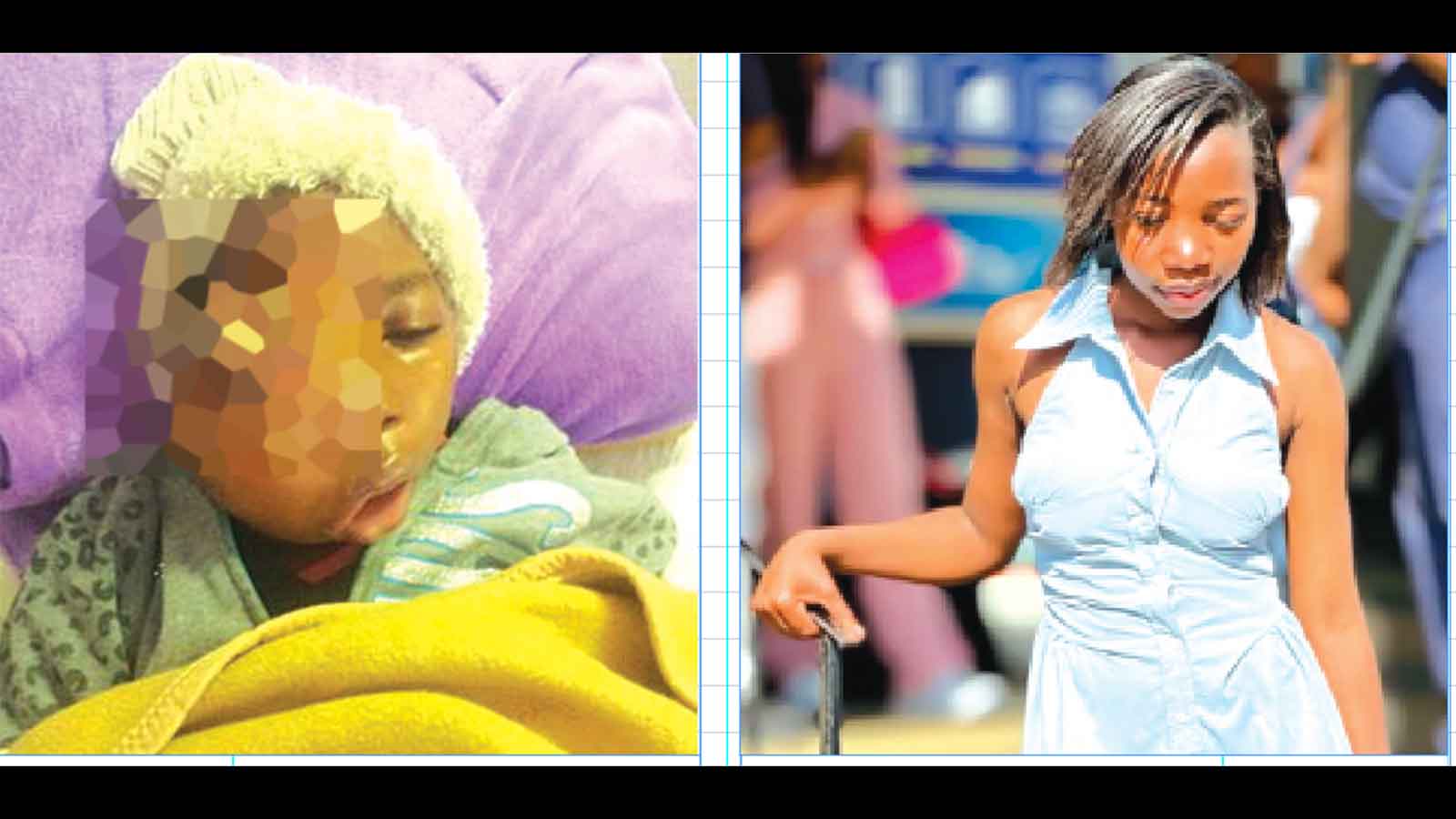
Trust Freddy
Herald Correspondent
The community did not see a 13-year-old girl, anymore. All they saw was a symbol of a quintessential curse.
When Tanaka Kungarangadza walked in her neighbourhood in Chitungwiza back in 2018, people did not greet her, but turned their heads, cringed and flinched.
One needed to be courageous to give her a second look, and in many instances, strangers shivered, shielded their eyes, and ducked into doorways. Whispers of dark magic and ancient witchcraft followed in her wake. And so did her family suffer vicarious liability.
Today, she is exactly the opposite, recovered and standing up tall among other girls as a paragon of beauty.
A huge cloudy lump had taken over the right side of Tanaka’s face, in a swell, giving her a ghostly look.
“Those of a nervous disposition could not afford to look at her. They would frown and shudder and look aside,” her mother Trish Kundiona (43) says.
She was, to everyone who looked at her, a walking grave. It had started like swollen gums when she enrolled for Form 1 at St Mary’s High.
An X-ray done at Parirenyatwa Group of Hospitals showed her teeth were perfect.
Rather, there was something in her cheek.
A biopsy was done on a Wednesday.
On Friday the mother collected results. She was directed to Ward A4.
At the booking desk she was asked to return August 1. It was March.
“I opened the results and took a photo and sent it to my brother. I was the last person to know that my child had cancer. I did not understand the results,” Ms Kundiona said.
Her cousin called to comfort her: “Others survive cancer.” That’s how she knew.
As they waited for the August appointment, she spent everything on herbalists.
The mass grew from 13cm x14cm to 23cmx24cm in a week. Her eye popped out. In June she was rushed to Sekuru Kaguvi Eye Hospital, who referred her to an Eye-Nose-Throat specialist and on June 6 she was taken straight to Ward A4.
There, Dr Loyce Hlatshwayo — one of only four Paediatric Oncologists in Zimbabwe — together with Professor Inam Chitsike and other doctors, refused to let Tanaka become another statistic.
“When a patient comes with a mass, we take a sample and look under microscope. If not clear, we do immunohistochemistry. For her we sent the sample to Lancet Zimbabwe, some stains went to South Africa, diagnosis was Burkitt’s lymphoma,” Dr Hlatshwayo says.
Pediatric cancers in children, Dr Hlatshwayo says, are genetically driven, unlike adult cancers linked to lifestyle.
According to the World Health Organization (WHO), 400 000 children develop cancer annually worldwide—ranging from leukemias (28%) and brain tumors (26%) to lymphomas like Burkitt (8%) and Wilms kidney tumours.
While survival exceeds 80 percent in rich nations, it drops to 15 to 30 percent in developing nations due to late diagnosis and stigma
After the tests, they drafted a protocol and gave first chemotherapy on June 15, 2018.
What happened next felt like a miracle.
“I remember it was on June 15, and she started to receive first chemotherapy. The following day she woke up and we were seeing some changes, and the swollen cheek was gradually going back to normal. And she said her cheek was no longer heavy,” Ms Kundiona says.
Funds had run dry.
“I had used my last cent for the X-ray because I had used my money trying herbalists. Fortunately, when she was admitted, we were introduced to KidzCan….They started to assist us with buying drugs, chemotherapy, CT scans — almost everything — and even psychosocial support.”
It was Stage 4 Burkitt Lymphoma, Dr Hlatshwayo confirms. It grows fast, but fortunately it responds fast.
“It grows fast, but it really responds to treatment. They can come with massive lymph nodes and they look so grotesque, so big. And a lot of people think once it has spread there is no hope. But with children, they respond very well to chemotherapy. Eighty percent can be cured if you get early diagnosis,” she says.
From June to October 2018, nine cycles of chemotherapy were conducted.
On October 30, the mass had disappeared. Cancer cured — in Zimbabwe, by Zimbabwean doctors.
Tanaka, born September 4, 2004 and now 21, missed the whole year, repeated Form 1 in 2019 and finished Form 4 in 2022.
“Chemotherapy has side effects so sometimes I would vomit, but I was responding well. I would like to thank doctors for the work well executed,” she says.
Tanaka’s school, St. Mary’s High School supported efforts for her treatment.
The administration and students raised money for medication and welcomed her back free of charge during her chemotherapy break in November 2018 just so she could spend time with her peers.
“In 2022, I only managed to pass three subjects, but I have plans to supplement with two more. Maybe I will become a teacher, but I hope one day I shall become a chef. I love tourism and hospitality and I am now fit.”
For her mother, the cost was almost her life.
A single mother working as a maid for an envoy, she spent a year in hospital, lost her job, and was in a maze half the time.
“It was not an easy journey because she didn’t want to see me crying and whenever she asked me why I was crying it was so difficult for me to tell her that I was afraid she would die any time. I almost got run over by a car three times because my mind was numb,” she says.
She survived by vending until KidzCan employed her in 2023 at its halfway home.
And today, they are still saving lives.
Tanaka is not an isolated miracle.
In Ward A4 special today, the same story is playing out — and the reason children survive is a partnership that went beyond HIV and TB.
In Dangamvura, Mutare, 13-year-old Alice Fombe’s (not her real name) stomach swelled in 2024.
A guest at Victoria Chitepo Hospital for almost a year, Alice’s health did not improve. By August 2025 she had deteriorated.
Neighbours said it either was pregnancy, or she had been bewitched. Relatives demanded a tsikamutanda cleansing ceremony and warned hospitalisation would kill her. Her father left.
Her mother Beatrice Mavhunga packed Alice’s clothes into a white sack as if she was headed to the grinding mill, but secretly returned to hospital. She told her son: “If anyone asks, say I have gone to Mutendi ZCC gathering.”
Doctors referred her to Parirenyatwa. Diagnosis: Wilms tumour, a kidney cancer.
“I had no money, but KidzCan took care of everything. That was on April 15, last year. The following day everything was paid for and my child went to theatre,” Beatrice says. Drugs quoted at US$2 000, US$50 scans, bus fare to Mutare, EcoCash for check-ups — all paid. She stays free at KidzCan’s Rainbow Children’s Village in Belgravia.
In Zaka, Masvingo, Blantina Mafundikwa’s 4-year-old son had the same swelling. From Zaka, she was referred to Masvingo General and to Harare. Same diagnosis. No relatives in Harare.
“My relatives had nothing. If it wasn’t for KidzCan, my son would have died,” she says.
KidzCan Zimbabwe is the only PVO for childhood cancer, working under an MoU with Ministry of Health across Parirenyatwa A4, Sekuru Kaguvi Eye Hospital, Sally Mugabe and Mpilo in Bulawayo.
Behind it is the National AIDS Council.
In 2019, KidzCan told NAC the burden was no longer just HIV and TB.
NAC CEO Dr Bernard Madzima, who had done rounds in A4, agreed.
“As of last year, cumulatively NAC had donated nearly US$500 000 towards childhood cancer treatment. With their donation coming again this year, we are going to surpass the half-a-million mark,” says Executive Director Daniel McKenzie.
Last year alone NAC committed US$109 000.
That money pays for chemo, scans and awareness at ZITF every year under the NAC stand.
WHO estimates Zimbabwe should see between 800 and 1 000 cases annually, meaning many children are still being missed.
But more children are presenting earlier.
Dr Hlatshwayo says Government is backing the 60 percent survival target by 2030 by training surgeons and maintaining radiotherapy machines, with help from the sugar levy.
But stigma still kills.
“It is so true. Culturally, there is a need for awareness. Our community needs to know that children can get cancer,” she says.
Tanaka is proof.
The girl once called a walking grave now walks tall — living proof that in Zimbabwe, childhood cancer can be cured.