Theseus Mauruki Shambare-Features Writer
THIS month is Pink October, a season dedicated to raising awareness about breast cancer, promoting early detection and supporting women affected by the disease.
But beyond the conversations about women’s health lies another reality worth acknowledging: the silent sacrifices women make in holding families together when life takes an unexpected and devastating turn.
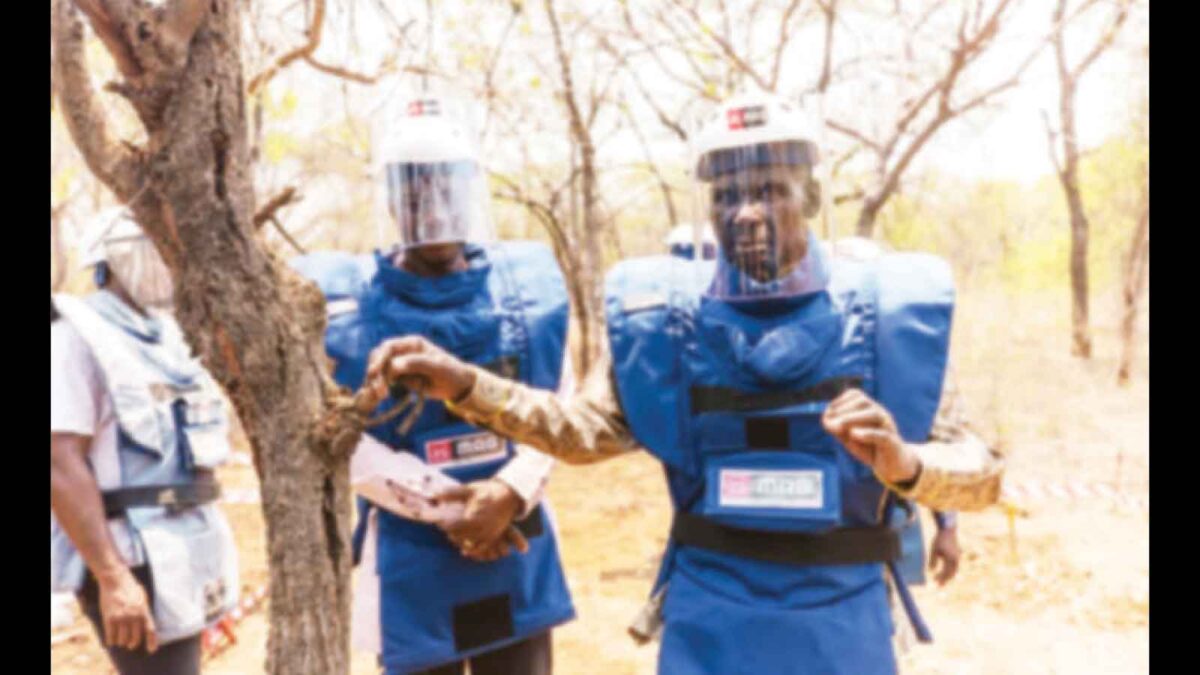
The testimonies emerged during a high-level field mission under Project RECLAIM in Mudzi District, Mashonaland East Province, on Tuesday, where Government officials, development partners and mine-action organisations visited communities affected by landmines to assess progress in clearing contaminated land and restoring livelihoods.
Bringing together survivors, deminers and community members, the mission offered a sobering glimpse into the human cost of Zimbabwe’s decades-old landmine crisis, revealing wounds that extend far beyond the physical injuries sustained in explosions.
In Mudzi, some women have become the unseen pillars of families forever altered by landmines.
They have watched their husbands lose limbs, livelihoods and, in some cases, the independence that once defined their lives as providers and heads of households.
As the men struggle to come to terms with their injuries, the women have had to shoulder the burden of care-giving, household responsibilities and the struggle to keep food on the table.
Behind every survivor’s scar, there is often a woman nursing wounds she never sustained, carrying responsibilities she never anticipated and making sacrifices that rarely find their way into public conversations.
For 83-year-old Mr Kennias Chihumo, the trauma of surviving two landmine explosions is compounded by a painful loss: the ability to provide for his family and fulfil the role he once took pride in.
“Imagine, I am the one being looked after by my wife,” he said.
The words carry the weight of a life turned upside down.
Mr Chihumo, from Chirambadewo under Chief Goronga, was first injured in 1988.
“I was injured in 1988 by landmines which were carried along the Mudzi River. I was treated in Ruwangwe, then later in Bulawayo,” he said.
Thirteen years later, in 2001, another explosion tore through his life. While going to his field, he stepped on another landmine in the same river, injuring his other leg. He was later treated at Harare Central Hospital (now Sally Mugabe Central Hospital).
Both his legs were amputated at knee level. Today, he moves on crutches, carrying the physical consequences of two separate encounters with explosives that have outlived the war in which they were planted.
“Since the injury, my life has never been the same. It has been a life of struggle,” he said.
The struggle has not been his alone. His wife raised their children and, after they established their own homes, remained his companion and provider. She now cultivates a garden and sells vegetables to keep their household going.
For a man who once expected to look after his family, depending on his wife is an emotional burden on its own. His gratitude is unmistakable, but so is his longing to reclaim some measure of independence.
Mr Chihumo believes the Government has to create income-generating opportunities for people with disabilities, allowing them to provide for their families, instead of them remaining dependent on assistance.
“My wish is that the Government should make something available specifically for people like me to do, so that we can control our earnings and be able to look after our families,” he said. “We used to survive on social welfare handouts but they have since stopped,” he said.
For Mr Daniel Kutsakatika, 39, of Joromani Village, the moment that turned his life upside-down came on August 18, 2018.
He was returning home from the grazing lands where he had gone to fetch cattle when he stepped on a landmine while crossing a road. He was carrying a baby.
The explosion brought him down, but amid the shock and confusion, his first concern was the child.
“I did not feel anything, I just found myself on the ground. Fortunately, I managed to put the child down safely,” he said.
His companion was terrified. Mr Kutsakatika, injured and unable to walk, began crawling and pleaded for help to get home.
His friend, Mr Eliot Ndlovu, later assisted him and ferried him to Kotwa District Hospital, from where he was subsequently referred to Parirenyatwa Group of Hospitals in Harare.
The consequences have followed him into every part of his life.
“Since then, my life drastically changed. I am no longer able to do some of the work I would normally do back then,” he said.
Mr Ndlovu now uses an artificial left leg, but the prosthesis is badly damaged and needs replacement.
The injury has also complicated the responsibility of raising four children, who still need school fees and other essentials.
Three of them — two boys and a girl — were enrolled in the Basic Education Assistance Module after a female teacher helped secure their places.
His youngest son is expected to start Grade One next year. The assistance has eased one burden, but it has not restored the life Mr Kutsakatika had before the explosion.
Still, he sees hope in the clearance of the minefields that continue to threaten communities.
“We are happy with this de-mining programme. We are happy that even our children will be safe going forward,” he said.
Behind these accounts are families forced to adjust to losses that cannot be measured only in amputated limbs. An injured breadwinner may mean lost income, abandoned work, interrupted education and a new, often unpaid, burden of care.
At Chihumo’s homestead, that burden is visible in the garden his wife cultivates and the vegetables she sells.
Her work keeps the household afloat, while the husband she once relied on now depends on her.
Zimbabwe’s landmine crisis dates back to the liberation war.
Between 1976 and 1979, the former Rhodesian regime laid minefields along the country’s borders. At Independence in 1980, Zimbabwe inherited an estimated three million anti-personnel mines across eight minefields covering about 850 kilometres.
In Mudzi, the explosives have restricted access to ancestral land, water, grazing areas, trade routes and schools.
Mines Advisory Group (MAG) country director Peter Avenell said the organisation had worked in Mudzi since 2018, after being designated to operate in the district by the Zimbabwe Mine Action Centre (ZIMAC).
“To date, we have removed over 12 000 anti-personnel mines, and released around 3,5 million square metres of land back to the community,” he said.
Minefields have prevented residents from crossing into Mozambique to visit relatives and trade, while denying them access to farmland.
“They have not been able to cross through these minefields into Mozambique, where their relatives are, where sometimes other services are, and for trade. They are not able to use the land for agriculture either,” Avenell said.
Released ancestral land allows families to farm and access water, firewood, building poles, honey and baobab seeds.
Minefields have also blocked direct routes to schools.
“In some areas, schoolchildren walk about seven kilometres through the bush to get to the nearest schools, because they have to go around the minefields,” he said.
Project RECLAIM complements the clearance effort.
It is a Government and UNDP initiative funded by Japan and implemented in collaboration with the Ministry of Defence, ZIMAC, MAG and the HALO Trust.
UNDP country representative Dr Ayodele Odusola said substantial progress had been made, although work remained before the 2030 target.
“Today, more than 96 percent of the land that was once affected has been cleared,” he said.
The project has recorded progress in Mutoko and Rushinga.
Since clearance operations began in 2026, more than 173 000 square metres have been made safe and more than 2 500 mines destroyed across the two districts, according to UNDP.
Dr Odusola said clearance alone would not address the needs of communities that had lived with the restrictions for decades.
“Clearing the mines is only the first step. Safe land must also become productive land so that it feeds families, creates jobs, brings incomes to these communities,” he said.
The next phase will support climate-resilient agriculture and irrigation.
UNDP is also surveying survivors to establish their locations and needs.
“This will help the Government and partners design policies and programmes that are made for them,” Dr Odusola said.
Deputy Minister of Defence Levy Mayihlome said landmines continued to threaten lives, restrict access to productive land and undermine livelihoods.
“Government will, therefore, continue to mobilise resources to accelerate mine clearance and promote inclusive development,” he said.
Launched in August 2025, Project RECLAIM runs until December 2028, combining clearance with efforts to strengthen community resilience and improve agricultural infrastructure and livelihoods.
Deputy Minister Mayihlome said Zimbabwe still required US$68,3 million to complete its mine-action programme. US$15,52 million had been secured, leaving a funding gap of US$52,78 million.
He said the Government’s post-clearance priorities included assisting survivors, improving livelihoods and releasing land for agriculture.
For survivors, clearance will not automatically end the struggle. The burden does not end when a survivor leaves hospital or rehabilitation.
Mr Chihumo wants an opportunity to earn an income and support his household. Mr Kutsakatika needs a replacement prosthetic limb.
Their experiences underline the need for rehabilitation, healthcare, social protection and economic opportunities.
For Mr Chihumo’s wife, the legacy of the landmine is measured in the garden she tends and the vegetables she sells to keep their household going. Her husband, who once provided for her, now depends on her care.
Zimbabwe may eventually remove the last landmine from its soil. However, the task of helping survivors and their families rebuild their lives should continue long after the explosives are gone.