admin
admin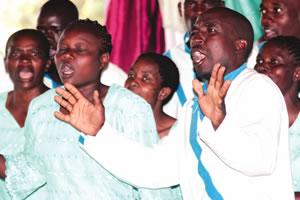
Fellowship of Zimbabwe (PFZ) premises along Beatrice Road in Harare.
Fifty-six inmates are singing different songs and the melodies come out through the truck’s tiny, highly placed meshed windows and louvered vents. The music seems to override the engine sound of the huge green and gold striped truck.
It is laden with convicts coming to a special anniversary meant to reunite them with long-forgotten relatives and friends, all at once.
Female inmates are donning green African attires and men are in gray and crème outfits.
The truck finally halts in front of the crowd and queues of inmates of both sexes jostle out hoping to give hugs to relatives and friends who they believe are waiting for them outside.
“Amai vangu muripi, mukoma mauya navo here? (mum where are you, did you come with my brother),” an inmate shouts as he disembarks from the truck.
But to their surprise, only two relatives are standing near the truck and they are the only ones who have made it to the venue.
Are all the 56 incarcerated people all related to the two visitors?
The two visitors disappear between the inmates and start looking for their relatives.
At the same time some prisoners gaze around hoping to see their relatives emerging from the lavatories or from the corners of the few buildings within the premises.
But the sad reality is that only two relatives of the prisoners have come to the anniversary while many other people in attendance are good Samaritans who want to worship with them at the “halfway house”. The prisoners are left with unanswered questions of why those they are closest to have shunned them.
Do the convicts, some of whom have rehabilitated, really deserve such emotional “punishment”? Will their families who have ignored this special meeting give them accommodation and food. The inmates believe that what they have seen is just a fore test of what they should expect when they complete their jail-terms?
Others who had been through the same road took some time to comfort them.
A woman who identified herself only as Martha gave a testimony of how she ended up in prison and how her family disowned her. Martha said she married a youthful husband who moved from the rural areas to Harare to look for a job.
While in Harare, her husband was hypnotised by the urban beauties thereby forgetting to support her and their child.
“This prompted me to follow my husband and I found out that he had a mistress and that is where he was spending all his money. I was so angry and my first reaction was to pick up a log that was close-by and hit him in the legs until when he could not walk. This paralysed his legs.
“I was sentenced to an effective eight months in prison and was extensively counselled. I also went for anger management lessons and am reformed though some people still do not trust me,” she said.
She says the moment she was released from prison her family was not comfortable being around her and she had to rebuild her life alone. However, with time, some of her brothers started visiting and seem to be getting along with her.
“During that time none of my relatives visited me, including my in-laws. Surprisingly, my husband was willing to forgive me, but his relatives were against our reunion. My husband’s relatives openly said they feared I would kill their son,” she said.
The Herald also spoke with Martin Sora who was sentenced to 10 years imprisonment in 1999 for armed robbery. He was classified as a class D prisoner, meaning he was a notorious criminal.
Time flew and he went to class C, B, A and was eventually was released a born again Christian.
He got counselling from the PFZ before his release.
“The problem now is that the community sees me as this big monster that can pounce on them yet I have reformed. I thin there is need to teach society that prison reforms people, making them better,” he said.
Jack Moyo (not his real name) testified that he defrauded one of the local companies when he was the accounting manager.
“I was given an effective 10-year sentence after I made the wrong choice and stole huge amounts of money between 1997 and 2000.”
“The time I got out, my son had just written O’ Level examinations. The economy was also in doldrums and many of my relatives died while I was in prison.
“My wife left me and went to South Africa,” Moyo said. He said his family neglected his minor children saying they had thieving blood in them.
Jack received proper counselling and has reunited with his wife. However, the business community still shuns him whenever he tables a profitable business idea because they fear he will get back to his old tricks. But the support from his wife gives him strength each day. A counsellor at the PFZ, Mrs Edith Mavhoko said the Prison Fellowship Zimbabwe centre for reformation, invited inmates, ex-inmates, church institutions and members of the society including spouses and relatives of prisoners to commemorate the institution’s 17 years of existence.
She noted that it is sad that that a few relatives and friends turned up to meet the inmates because of varying reasons, chief amongst them stigma. Mrs Mavhako said such stigma should be buried in the past as people reform when in prison.
“Most of the people in the country’s jails either come from broken families or are orphans. When they grow up parental guidance lack and they are mistreated which mutates them into criminals. The society and family is to blame for all the criminal activities.
“We have to embrace and give them a second chance once they are back into the society. All I can say is there is no exoneration when it comes to imprisonment. Let’s support each other especially when one has reformed,” Mrs Mavhoko added. Others are of the perception that convicts are sent to jail for rehabilitation but do not get much support. They say they should be adequately prepared to face the world in the event they have to re-integrate with society. Others say prisoners have to be punished at all costs since they are unpredictable.
“Some families and friends rarely come to see the convicted individual. They might do so in the first few days but as time flies no one even thinks of them.
“For this reason we find that pauper’s burials are accorded to inmates who die in custody and no relative comes forth to claim their body,” said Mrs Nancy Madzima of Hatfield.
Some fear that some criminals may not take seriously the help they get in jails. A typical example could be that of ‘unrepentant’ criminals who after being released tend to revert to criminal activities before they are resent to jail.
Of course some people could be termed habitual criminals but there could be underlying circumstances that might force them to stick to the criminal habits. Some convicts say prison is better because they receive various skills so that they can assist themselves once they step out of the correctional institutions. This is because there has to be rectification of what they lacked in society or they did not access.
They involve motor mechanics, carpentry, tailoring and farming.The arts industry has also boomed in that we have seen the emanation of the Chikurubi farm choir, the Professional Dance, Drama and Comedy group and the Divine touch choral group that sings gospel music.
Apart from that there could be citing of notable figures in our society who managed to study various honours degrees when they were sent to jail under different circumstances. These include Hebert Chitepo, Joshua Nkomo and even Nelson Mandela who studied when he was convicted with a life sentence for leading the revolutionary movements Africa. The prison garb we see mostly referred to as “makhaki”, gowns that are donned by magistrates and the military green uniforms worn by prison guards are sewn by prisoners in the prison’s sewing section.
With these skills, it is very possible for the ex-convicts to be employed and perform like any other individual as long they are given a second chance.


 Online Reporter