admin
admin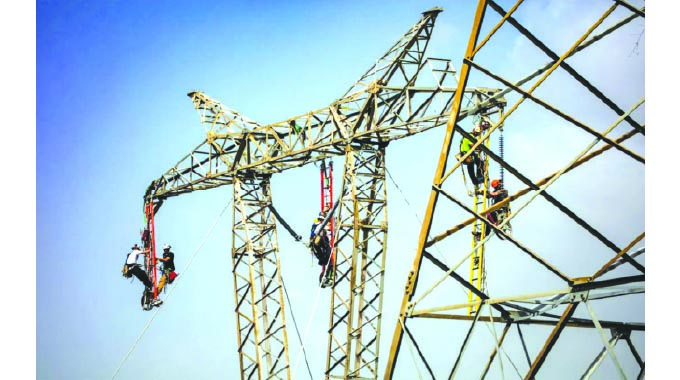
Oliver Kazunga-Senior Business Reporter
DINSON Iron and Steel Company has completed constructing its 88 kilovolts transmission line from Sherwood substation in Kwekwe to Manhize to allow the firm, which requires 100MW under the first phase of its projects, to start production.
Under the US$1,5 billion steel plant, Dinson plans to construct a 330kV connection from Sherwood to the project site to reinforce electricity supplies to other industries in Manhize and surrounding areas.
The plant, which is touted to be Africa’s biggest integrated steelworks, recently conducted test runs that were successful paving way for the commencement of the scheduled production next month.
The test runs were conducted on five key components of the plant that were found to be in sound condition and ready for production.
In a recent interview, Dinson project director Mr Wilfred Motsi said: “We have completed constructing an 88kV transmission line which will enable us to start production under the first phase and as you might be aware, we are looking forward to constructing a 330kV power line from Sherwood to Manhize to facilitate our electricity requirements.”
Dinson Iron and Steel Company is one of the three local subsidiaries of China’s Tsingshan Holdings Limited.
Locally, the group’s other subsidiaries are Afrochine Smelting in Selous, Mashonaland West Province and Dinson Colliery in Hwange, Matabeleland North Province.
The Cabinet has reported this week that the Dinson steel plant is now 95 percent complete, with the raw materials complex and the sintering plant 100 percent complete.
The blast furnace is 90 percent complete while the steel mill is at 60 percent completion and the coke oven battery 90 percent complete.
Dinson is projected to produce 600 000 tonnes of products in the first phase, rising to 1,2 million tonnes in the second phase.
In the early stages of production, Dinson intends to produce pig iron, followed by steel billets and steel bars before the end of the year.
Production is anticipated to rise to 3,2 million tonnes in the third phase and subsequently five million tonnes annually in the final phase with at least 500MW required to power the plant that will supply a wide range of steel products to the local market while employing over 10 000 people directly. Meanwhile, Zimbabwe Institute of Foundries (ZIF) chief operating officer Mr Dosman Mangisi has said they are already warming up for Dinson’s first steel production.
“The commencement of operations at the steel plant will definitely yield a major impact and change to the local industry, which at the moment is grappling with shortage of raw materials and the knock-on effect has depressed production by companies in engineering, iron and steel sector including foundries.
“A proclamation has already been made that the Manhize steel plant constriction in terms of the blast furnace is complete and as players in the foundry sector we are geared to tap into the opportunities presented by the operationalisation of that plant.
“Commencement of production at the Dinson’s steel plant will see all sectors particularly those in engineering, iron and steel industry improving their production levels as raw materials will be easily accessible and competitively- unlike the current scenario where most of our players are importing,” he said.
Before the closure of once Zimbabwe’s largest integrated steel plant north of Limpopo, Zisco in 2008, at the height of hyperinflation, local industry was accessing raw materials relatively at a cheaper cost unlike presently millions of foreign currency are being spent importing steel and related products.
At its peak in the 1990s, Zisco produced over one million tonnes of steel per annum employing more than 5 000 people directly.
Mr Mangisi said his organisation, with over 200 members, anticipates to see its membership growing rapidly as a result of the commencement of production at Dinson.
“We are also readying ourselves to see a significant increase in the number of our membership to emerge from new investments into the sector attracted by the Dinson project,” he said.


 Online Reporter