Online Reporter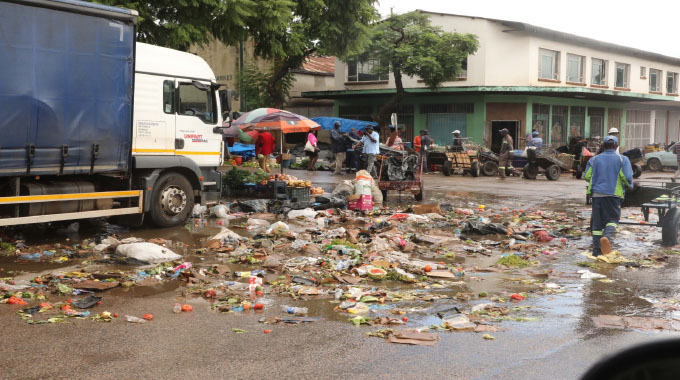
Peter Matika and Raymond Jaravaza, Chronicle Writers
FOR many years, Bulawayo was widely regarded as Zimbabwe’s cleanest and best-managed city. Clean streets, orderly traffic, well-maintained public spaces and respect for municipal by-laws became part of the city’s identity.
Visitors often spoke highly of its neat appearance, while residents took pride in living in a city known for discipline, organisation and civic responsibility.
That reputation earned Bulawayo admiration both nationally and beyond the country’s borders. It became a benchmark against which other urban centres were measured. Today, however, many residents fear that the city is losing some of the qualities that once set it apart.
Across parts of the central business district and several residential areas, concerns are growing over litter, illegal dumping, deteriorating public spaces and the increasing number of vendors operating outside designated trading areas. While the challenges facing the city are not unique, many residents believe they are becoming more visible and more difficult to ignore.
The issue has sparked concern among residents, business owners, community leaders and Government officials, all of whom agree that urgent action is needed if Bulawayo is to reclaim and maintain the standards for which it was once famous.
Speaking yesterday, Bulawayo Provincial Affairs and Devolution Minister Judith Ncube said the current situation poses a threat to the city’s image and future development.
“Bulawayo is a city with a rich history, a proud industrial heritage and immense potential, but we cannot allow disorder, lawlessness and environmental neglect to erode its status. The growing chaos on our streets, particularly the proliferation of illegal vending activities and the disregard for designated trading spaces, requires urgent and decisive action from the local authority,” said Minister Ncube.
Her remarks reflect concerns shared by many long-time residents who remember a city where public spaces were respected, municipal by-laws were enforced and cleanliness was considered everyone’s responsibility.
Over the years, economic challenges have pushed increasing numbers of people into the informal sector. For many families, vending has become an important source of income and a way of putting food on the table. However, the rapid growth of informal trading has also created challenges relating to congestion, waste management and the use of spaces not designated for commercial activities.
Minister Ncube acknowledged the importance of protecting livelihoods but stressed that economic activity must not come at the expense of public order and health.
“Council must move with speed to restore sanity and ensure that streets, pavements and public spaces serve their intended purpose. While Government remains committed to supporting livelihoods and promoting economic opportunities for citizens, this cannot come at the expense of public health, safety, sanitation and urban order,” said Minister Ncube.
She called for a balanced approach that protects traders while also safeguarding the interests of residents, businesses and visitors.
“We are calling upon the City of Bulawayo to act firmly but humanely, engaging all stakeholders while implementing sustainable solutions that protect both traders and the broader interests of residents and businesses. Bulawayo must reclaim its status as one of the cleanest and best-managed cities in the region,” she said.
The concerns raised by Minister Ncube come shortly after strong remarks by the Minister of Local Government and Public Works, Cde Daniel Garwe, who expressed dissatisfaction with the performance of some of the country’s largest urban local authorities.
Last week, Minister Garwe said Bulawayo, Harare and Chitungwiza had effectively been placed in “intensive care” because of service delivery shortcomings.
“Chitungwiza, Harare and Bulawayo have been put into the intensive care and we all know what happens when one is in the ICU. It’s either they battle for survival or they go. I’m not referring to the cities themselves but the leadership who are negligent and not focused on service delivery.
“Government is saying this is the time for service delivery and development towards 2030 and political manoeuvring must come to an end. The agenda for everyone must be attainment of Vision 2030 and not political positions,” said Minister Garwe.
The concerns expressed by Government are also acknowledged by the city’s leadership.
Bulawayo Town Clerk Mr Christopher Dube admitted that maintaining cleanliness in some parts of the city has become a significant challenge.
“The state of cleanliness in some parts of the city is a matter of serious concern. There is no denying that Bulawayo has become extremely dirty in certain areas due to a combination of illegal vending activities, indiscriminate dumping of waste and the increasing pressure on municipal services,” he said.
His comments paint a picture of a city struggling to cope with the pressures of urban growth, economic hardship and increasing demands on municipal resources.
Mr Dube said the local authority was committed to addressing the problem but required support from central Government to strengthen enforcement and improve service delivery.
“We require the necessary policy backing and authority to implement measures aimed at restoring cleanliness, order and compliance within the city. The situation calls for immediate action and collaboration among all stakeholders, including Government, residents, businesses and informal traders. With the support of Government, we are confident that we can implement sustainable interventions that will address the challenges facing the city and restore Bulawayo’s reputation,” said Mr Dube.
For many residents, however, the issue goes beyond uncollected refuse or illegal vending. It is about preserving the identity of a city that has long prided itself on order, cleanliness and efficient administration. Many believe restoring Bulawayo’s reputation will require more than enforcement. It will demand a renewed sense of civic pride, responsibility and partnership between residents and local authorities.
The concerns are supported by findings contained in the Ministry of Local Government and Public Works Annual Performance Feedback Report for 2025. The report rated Bulawayo, Harare and Chitungwiza among local authorities in urgent need of transformation due to shortcomings in meeting Government minimum service delivery standards.
The standards cover key areas such as water supply, sanitation, waste management, health services and housing.
“Major cities are not leading by example. Harare (3.77), Bulawayo (3.72, and Chitungwiza (3.29) – the country’s largest urban centres are not driving national excellence and are therefore a political and economic risk. Without decisive, targeted intervention, underperforming local authorities risk prolonged stagnation that progressively weakens service delivery and undermines national development goals,” reads the ministry report.
In a separate interview with The Chronicle, Ministry of Local Government and Public Works Director of Communications and Advocacy Mr Gabriel Masvora said Minister Garwe recently met councils that were identified as underperforming in the 2025 performance assessment.
He said the affected councils had been directed to submit comprehensive turnaround strategies within 14 days, effective from 22 June 2026.
“Minister Garwe expressed serious concern over the performance of some of the country’s major urban local authorities, particularly Harare, Chitungwiza and Bulawayo, noting that the councils were effectively in ‘intensive care’ due to persistent service delivery shortcomings. The minister warned that failure to improve service delivery may result in decisive measures, including the sanctioning of council leadership where necessary,” said Mr Masvora.
Residents say some of the challenges are felt most acutely in water supply and refuse collection.
Nketa residents’ chairperson Mr Noble Hlongwane said the city must improve the management of water supplies, a challenge that continues to affect households across Bulawayo.
Waste collection is another major concern. Residents say delayed refuse collection often leads to illegal dumping, creating health and environmental hazards in communities.
Ms Nobuhle Sibindi, a residents’ association leader in Emakhandeni, said when refuse goes uncollected for two or more weeks, many residents are left with little choice but to dispose of waste at undesignated sites.
As Bulawayo confronts these challenges, many believe the city stands at a crossroads. The qualities that once made it a model city have not disappeared entirely, but they require protection and renewal.
For residents, the hope is not simply for cleaner streets or stricter enforcement. It is for the restoration of a culture that once made Bulawayo a source of pride — a city known for order, cleanliness, efficiency and respect for public spaces.
Whether that reputation can be fully restored will depend on the collective efforts of Government, council, businesses, traders and residents themselves. What remains clear is that many people believe the time to act is now.