Andrew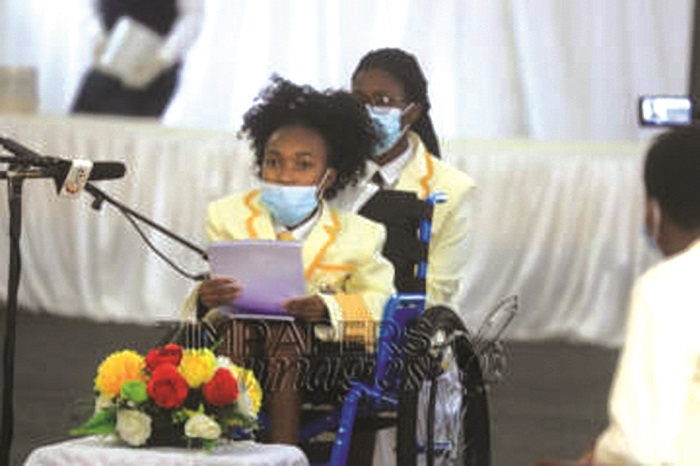
Disability Issues
Dr Christine Peta
DISABILITY was thrust into the limelight at the official opening of the 29th Session of the Junior Parliament of Zimbabwe, by President Mnangagwa, on December 20, 2021 at State House.
The event was attended by Ministers, senior Government officials, UNICEF Country Representative, junior parliamentarians, and officials from the Zimbabwe Youth Council among other stakeholders.
The Session saw the historic inauguration of a student with disability, Hazel Mandaza as the Child President.
Hazel is in Form 5 at Mahusekwa High School, in Mashonaland East Province. In her winning campaign speech, she in part, highlighted that disability is not inability:
“I believe in my abilities, I am capable of being a leader, I am a leader myself, I have always wondered why since the establishment of Junior Parliament there has never been a Child President with disability?
Is it because we do not possess the qualities of being one, or it’s because people always sympathise with us, believing it’s too hard for us. I am here to change the mind sets of people…”
The above quote directs us to shift our mindsets from the outdated charity model of disability which regards persons with disabilities as good for nothing people, who always need help and pity. The charity model of disability also regards persons with disabilities as people that just sit around and wait for donations.
The above quote is also directing us to shift from the outdated medical model of disability, under which persons with disabilities are regarded as passive people who are permanently sick and who need an “army” of medical doctors to cure them of “disability”, yet disability does not mean permanent illness.
In his speech at the official opening of the 29th Session of the Junior Parliament, President Mnangagwa highlighted the commitment of the Ministry of Youth, Sport, Arts and Recreation and the Zimbabwe Youth Council towards creating platforms that ensure that young people from all walks of life [including young persons with disabilities] can participate in all spheres of life.
The inauguration of Hazel Mandaza as Child President demonstrates Government’s commitment towards embracing difference and pushing forward the agenda of inclusivity including in relation to disability and gender, in a scenario where government creates opportunities for all children and youths, including children and youths with disabilities.
Beyond mainstream programs, the Government of Zimbabwe also works in partnership with UNICEF, to support children and adolescents to reach their maximum potential. UNICEF seeks to save children’s lives, defend their rights, and to help them fulfil their potential, from early childhood through adolescence.
Thus in his speech at the same occassion the UNICEF-Zimbabwe Country Representative Dr. Tajudeen Oyewale noted the Government of Zimbabwe’s commitment towards fulfilling, promoting, protecting, and respecting the rights of persons with disabilities, including the rights of children with disabilities.
Dr Tajudeen Oyewale said: “The first official event that I attended when I landed in Zimbabwe to take up the post of Country Representative at UNICEF, was the official launch of the National Disability Policy [2021], by His Excellency the President of the Republic of Zimbabwe, thus showing government’s high level commitment to the disability agenda. UNICEF is committed to working with the Government of Zimbabwe to ensure implementation of the National Disability Policy.
It is great to see that children can now understand the meaning and importance of this Policy and the reason behind this Policy.”
Immediately after the event, Dr Oyewale took time to interact with the Child President and other young persons who were in attendance. Zimbabwe ratified the United Nations Convention on the Rights of Persons with Disabilities (UNCRPD) in September, 2013.
Preamble (g) of the UNCRPD emphasises the importance of mainstreaming disability issues as an integral part of relevant strategies of sustainable development.
The mainstreaming of disability in Junior Parliament in Zimbabwe, therefore symbolises Government’s commitment towards upholding the principle of the SDGs-Agenda 2030 of leaving no one behind.
Preamble (O) of the UNCRPD, states that persons with disabilities should have the opportunity to be actively involved in decision-making processes about policies and programmes, including those directly concerning them.
As such, the Child President outlined her key priority areas of focus and topping the list is:
“Eradication of drug and substance abuse, which robs us of youth that have great potential both boys and girls, including boys and girls with disabilities], establishment of additional drug rehabilitation facilities, awareness raising on drug abuse among parents so they gain knowledge on how to address the drug abuse problem and its associated social ills, early marriages and teenage pregnancies.”
The leadership of Hazel, under her role as Child President, provides an opportunity for her to be actively involved in decision-making processes about policies and programmes, including those that concern persons with disabilities.
Her appointment also resonates with Section 3.27 of the National Disability Policy of Zimbabwe [2021], as well as Article 29 of the UNCRPD which broadly directs States Parties to ensure that: “persons with disabilities can effectively and fully participate in political and public life on an equal basis with others, directly or through freely chosen representatives, including the right and opportunity for persons with disabilities to vote and be elected . . .”
Representing the voice of young persons, Mr Brian Sithole, a Board Member of the Zimbabwe Youth Council said:
“We as the Zimbabwe Youth Council take pride in the processes that led to the election of the Child President, Hazel Mandaza, we are happy to be the custodians of Junior Parliament, as one of our main thrusts in ensuring that all voices are heard. Hazel was selected out of 210 Child Members of Parliament, and then later on out of a shortlist of 10 Child Ministers of State from all the 10 provinces of Zimbabwe.”
Way forward
The principles of the National Disability Policy of Zimbabwe [2021] that are outlined in Section 1.9 include but are not limited to:
“Non-discrimination, full and effective participation and inclusion in society, respect for difference and acceptance of persons with disabilities as part of human diversity and humanity, equal opportunity, respect for the evolving capacities of children with disabilities, collaboration between persons with disabilities and persons without disabilities.”
I call upon all of us to uphold the above principles, in an effort to among other things, support the role of our Child President, Hazel Mandaza, to enable her to achieve success in the execution of her duties, thus making a positive difference in the lives of children and adolescents including children and adolescents with disabilities and their families in Zimbabwe.
In any case, Article 17 of the UNCRPD as well as Section 3.21 of the National Disability Policy, directs us to respect both the physical and mental integrity of persons with disabilities on an equal basis with others.
Dr Christine Peta is the National Director of Disability Affairs in Zimbabwe — she can be contacted on: [email protected]


 Online Reporter