Siphakeme .Mnindwa
Raymond Jaravaza, [email protected]
VILLAGERS in Bulilima District, Matabeleland South Province, a hotspot for mopane worms harvesting, say the yield of the popular delicacy was low this season despite good rains recorded across the region and the rest of the country.
Matabeleland region received good rains in December and the greater part of January bringing relief to farmers as crops and livestock improved significantly.
The good rains, which saw some places receiving rainfall almost on a daily basis, turned out to be not a blessing at least as far as mopane worm harvesting is concerned, villagers in Mopane and Mbonqane villages lamented yesterday.
“This time, I harvested just two buckets, which are equivalent to two 20kg bags, compared to previous seasons when we made a lot of money from selling amacimbi that we would have harvested.
“I will keep this season’s harvest for my family only, I can’t afford to sell any as the harvest was not very good,” said a Mbonqane villager, Mrs Atallia Mhlanga.
“We received a lot of rain at a time when we expected to start harvesting amacimbi. So, we did not get ample time to go into the wild to harvest.
“Amacimbi grow so fast that if you don’t harvest them while they are still feeding on tree leaves, they burrow into the ground and disappear.”
She said villagers are hopeful the next mopane worms harvest season expected sometime in April will be much better.
Mrs Evelyn Ngwenya, another villager said this time around locals did not witness an influx of people from other regions rushing into Bulilima District in search of the delicacy.
Amacimbi harvesting has in the past been a source of conflict between locals and dealers from other provinces.
In the past, traditional leaders in Matabeleland South province have expressed concern over rampant deforestation caused by people harvesting mopane worms in the area.
“In less than three weeks, amacimbi were gone and I think by the time the outsiders learned that the harvesting season had started there was nothing in the wild to harvest. The difference between locals and outsiders is how we harvest amacimbi.
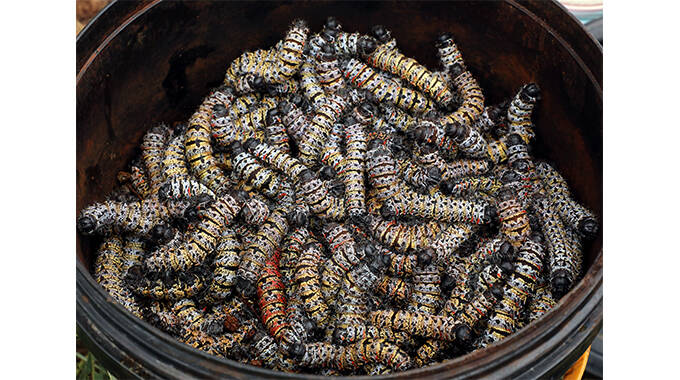
“We simply pick them from the trees or the ground while they cut down trees and do not care about the destruction that they leave behind,” said Mrs Ngwenya.
She showed The Chronicle part of the 20kg of amacimbi that she harvested in early January.
“It rained so heavily in this area that it was difficult to harvest amacimbi and by the time the skies opened up, they were gone,”
A villager from Mopane village, Mr Aleck Siziba, said a few people in his area harvested the delicacy.
“We had hoped to have a good amacimbi harvest since the vegetation is in a good state but surprisingly few people managed to get a good harvest.
“Amacimbi season comes in two stages, so we hope in April when rainfall is expected to be minimal, there will be plenty of them for villagers to harvest and keep for their families,” said Mr Siziba.
In 2023, the Bulilima Rural District Council took practical steps to control the harvesting of amacimbi after noting that the delicacy was facing a high risk of extinction in the wild due to over-harvesting and deforestation.
Since time immemorial, amacimbi widely consumed in Zimbabwe, Namibia, Botswana, South Africa and Zambia, has provided food at low cost and generated income for locals helping to fight hunger and poverty.
Amacimbi constitute one of the cheapest sources of protein for locals.
For a long time, locals in the Matabeleland region have collected amacimbi from the wild and partly traded them to earn money to buy other needs.
In recent years, there have been growing concerns over unsustainable harvesting practices that have decimated amacimbi species in areas bordering Botswana and South Africa.
Under Bulilma by laws, persons harvesting amacimbi will be required to pay a certain amount of money to the council, which would then be ploughed back into the community.
Botswana banned the harvesting of amacimbi after the government and conservation experts agreed that taking drastic measures would allow the popular delicacy to pupate or burrow into the ground and become stock for the next season to increase the severely depleted amacimbi population.
Authorities in that country have stopped issuing harvesting permits to amacimbi dealers who trade the delicacy both locally and in neighbouring countries.
Zimbabwe is yet to ban the harvesting of amacimbi for commercial purposes.



 Online Reporter