admin
admin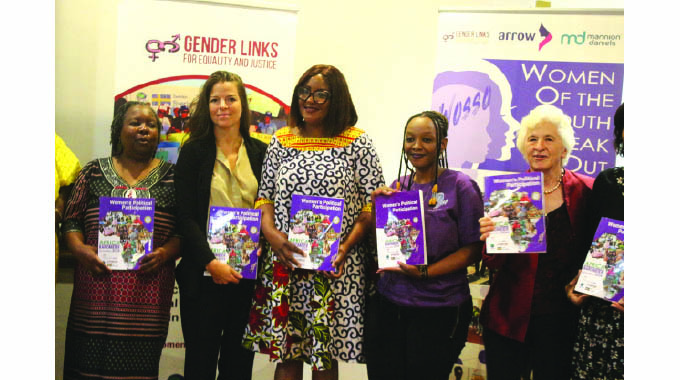
Trust Freddy
Herald Correspondent
African nations must intensify efforts to tackle barriers that hinder women’s progress towards achieving gender parity in political representation, Women’s Affairs, Community, Small and Medium Enterprises Development Minister Senator Monica Mutsvangwa has said.
She was launching the second edition of the Women’s Political Participation Africa Barometer 2024, a comprehensive report that provides critical insights into the state of women’s political representation and participation across the African continent, shining a spotlight on the progress made and the challenges that remain.
In her speech, delivered by the Ministry’s director for gender policy planning and programme management Mrs Lillian Matsika on Thursday, Sen Mutsvangwa emphasised that “more work still needs to be done” to address the gender gap in political participation.
“Despite some progress in recent years, women remain significantly under-represented in political institutions and leadership roles throughout the region and the findings make it clear that much work remains to be done to achieve gender parity in African politics.
“With only six years remaining before 2030 many African countries are most unlikely to reach the SDG targets with an average of 26 percent women in the lower houses, and 21 percent in the upper houses of parliament. Africa also has the highest and lowest women’s political participation in lower houses, ranging 61 percent MPs in Rwanda to Nigeria, where women comprise 4 percent of the parliamentarians.
“In Zimbabwe, in some instances, there has been regression and as a country we are yet to achieve the 50-50 target provided in the Constitution with our upper house standing at 43,7 percent and lower house at 31,4 percent women’s representation.”
For Africa to achieve gender parity in political representation, Sen Mutsvangwa said the continent should redouble its efforts towards that goal.
“As we mark the launch of the Women Political Participation Africa Barometer today, let us recommit ourselves to this vital work. Let us draw inspiration from the progress that has been achieved, while also redoubling our efforts to address the stubborn barriers that still hold women back.
“Together, I believe we can build a future where women in Africa are empowered to lead, to shape the policies that affect their lives, and to play an equal role in steering the continent toward a more prosperous and equitable tomorrow.”
The Africa Barometer 2024 also explores the deep-rooted structural causes of women’s exclusion from political decision-making, including patriarchy, social, cultural, and religious influences that perpetuate gender inequality.
The report highlights the need for sustained efforts to address these barriers and create an enabling environment for women’s political participation.
The launch was attended by stakeholders from the SADC region, including chair of the Southern Africa Gender Protocol Alliance Emma Kaliya, chair of the Gender Links Board Emily Brown, and Emma Borgnas from the Embassy of Sweden in Zimbabwe.
Ms Borgnas said it would be difficult to realise the goal of poverty reduction and enhancing the wellbeing of human beings overall without addressing gender inequalities.
“The Women Political Participation Africa Barometer programme is especially important in that we believe it will contribute to achieving women empowerment in leadership positions.
“The launch of WPP Barometer and the dialogues with a broad set of stakeholders including local authorities, civil society and academia will be important to identify ways to continue building the conducive environment for women to participate in politics.”
Speaking on the sidelines of the event, Ms Kaliya, expressed satisfaction with the current progress, saying the SADC region in particular was in the right direction.
“Looking at where we are coming from, I can say there is progress compared to other countries that have done literally nothing. The SADC region has made some progress, with Namibia, Mozambique, and South Africa topping the list,” she said.
While acknowledging several obstacles, special advisor at Gender Links Colleen Lowe Morna said many African nations can emulate Zimbabwe in adopting the women quota system.
“While there are deeply rooted issues related to culture, region, and other aspects that will take time to change, there is a clear correlation between electoral systems, temporary measures, and gender representation.
“Zimbabwe serves as a good example, where the introduction of a quota for women in Parliament and local government has led to a significant increase in their numbers at both levels, demonstrating the positive impact of such measures.”
According to the second Africa Barometer 2024, women constitute just a quarter of the 13 057 parliamentarians in Africa with 26 percent in the lower houses, and 21 percent in the upper houses of parliament.


 Online Reporter