Chronicle Editor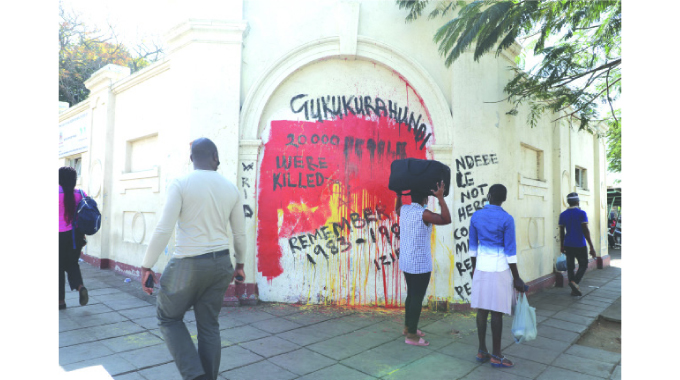
Nqobile Tshili, Chronicle Reporter
CITIZENS who want to communicate issues relating to Gukurahundi have been urged to take advantage of available platforms instead of writing graffiti on public premises which might land them in trouble.
On Sunday, Bulawayo woke up to Gukurahundi graffiti which was inscribed at the Bulawayo City Council toilets used by curio vendors.
The local authority erased the graffiti later in the day.
This is not the first time council has had to get rid of graffiti at the same place.
In January, an artist illegally put up a mural of King Lobengula and Mbuya Nehanda at the same place.
National Peace and Reconciliation Commission (NPRC) chairperson Retired Justice Selo Nare yesterday said there is nothing amiss with communicating on Gukurahundi, but members of the public should not do so illegally.
He said that type of communication is not solution driven, but will only raise emotions.
“The Government has opened up discussions on Gukurahundi, so I don’t think it is necessary for members of the public to be secretly making graffiti as they are platforms that can be used to handle the matter.
Government has given chiefs a mandate to handle the Gukurahundi issue. I encourage members of the public who may have something to communicate relating to the issue to engage chiefs or even the commission,” said Rtd Justice Nare.
NPRC has offices at the First Mutual building at the corner of 9th Avenue and Joshua Mqabuko Street in Bulawayo.
Following President Mnangagwa’s rise to power, citizens have been encouraged to openly speak about Gukurahundi as the President said the nation needs to confront its dark past.
President Mnangagwa said he has made it part of his mission to resolve issues that may arise following the Gukurahundi which affected people in Matabeleland and Midlands regions between 1983 and 1987.
He has instructed the Civil Registry Department to do away with bottlenecks that had led to some citizens failing to obtain birth certificates.
The President also assigned chiefs to handle the Gukurahundi issues and come up with solutions.
While chiefs are taking a leading role in resolving the 1980s Gukurahundi emotive issue, the programme has also received buy-in from conflict resolution donors who are now also partly funding the training exercise.
Gukurahundi has been blamed for the under-development of Matabeleland and Government is tackling it through the devolution policy.
Chiefs in March resolved to establish inclusive panels consisting of chiefs, traditionalists, pastors, counsellors, women, men and youth to conduct Gukurahundi public hearings.
In an interview recently, National Council of Chiefs deputy president Chief Mtshana Khumalo said while it might seem as if nothing is being done, there is a lot of work being done behind the scenes.
“We have not moved much from the last meeting where we set a panel but this does not mean nothing has been happening. We are in the process of training trainers on how the hearings will be conducted.
So, we have been training some of the chiefs who will then come to ground to teach other chiefs how the public hearings will be conducted,” said Chief Mtshana.
He said it was not just the traditional leaders being trained, but the rapporteurs who will also do the notes taking.
Chief Mtshana said while traditional leaders have anticipated that the pre-hearings processes were not going to be long, they have observed that there is a need to be more meticulous before commencing the public hearings.
“We had hoped that we would start conducting hearings earlier but what we have observed is that there is more work that needs to be done before we can actually conduct public hearings. So far, Government and donors are assisting us in conducting the training workshops,” said Chief Mtshana.
Matabeleland North Provincial Chiefs Council chairperson Chief Shana said the training of chiefs will enable them to have a collective approach as they start conducting public hearings.
“Already the people know what happened. What is needed is the chiefs to have a uniform approach in handling the public hearings because if everyone decides to come up with their approach the outcomes of the hearings will be problematic. We don’t need different approaches in conducting public hearings,” Chief Shana.
Centre for Mediation in Africa conflict resolution expert Ms Nontando Ndhlovu said capacity building was important for traditional leaders as most of them are not experts in the field.
“Every traditional and cultural context has its own unique mechanism for resolving conflicts and mediating peace. However, it is also important for the capacity of traditional leaders to be increased through additional training in conflict resolution,” said Ms Ndhlovu.
“They can expand their knowledge on how to identify, analyse and engage in settling disputes and bringing resolution. In this way, they can work in harmony with the authorities in countries and play a pivotal role in mitigating conflicts and managing them. Moreover, this will help them better perform their duties.” — @nqotshili


 Online Reporter