Online Reporter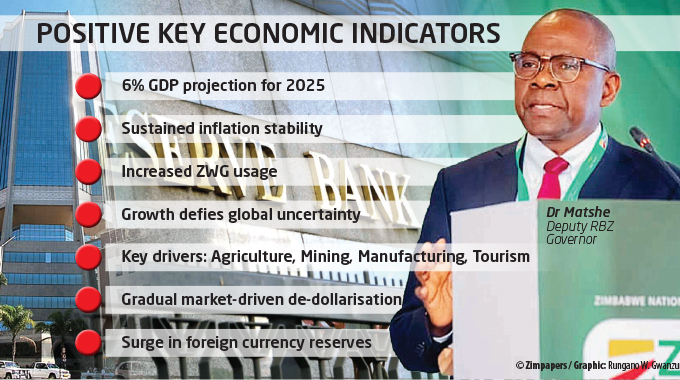
Rutendo Nyeve, Victoria Falls Reporter
THE Reserve Bank of Zimbabwe (RBZ) expects the country’s economy to grow six percent this year, spurred by domestic production growth in key sectors and monetary policy gains amid subdued global growth linked to geopolitical uncertainty.
The Central Bank has reported a significant milestone in its monetary stability journey, with the use of the local currency, ZWG, in transactions rising from 26 percent in April 2024 to above 40 percent in May 2025.
This has been complemented by solid growth in domestic output, mainly driven by the mining, agriculture, manufacturing and tourism sectors.
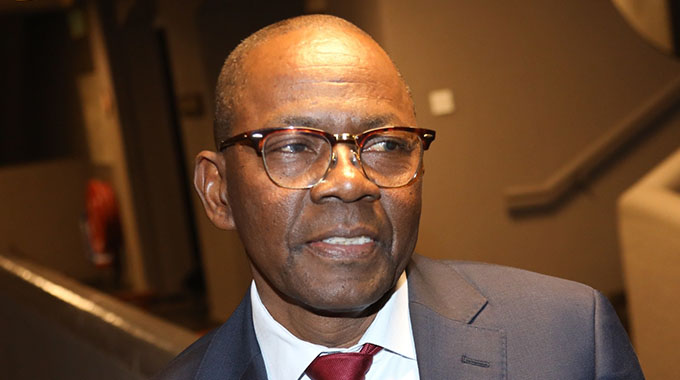
RBZ Deputy Governor, Dr Innocent Matshe, told delegates during the recent Zimbabwe National Chamber of Commerce (ZNCC) Annual Congress here that the Zimbabwean economy was exhibiting commendable resilience amid global headwinds.
He outlined the policy measures adopted to consolidate stability, leading to increased adoption of the ZWG, which augurs well with the long-term de-dollarisation framework.
“The global economy is characterised by greater uncertainty due to heightened geopolitical tensions, protectionist policies, and economic uncertainty, with significant implications on global supply chains and business and consumer sentiment,” he said.
He made reference to the International Monetary Fund (IMF)’s revised global growth projections, which were downgraded to 2,8 percent in 2025 and three percent in 2026, reflecting slower economic activity.
Despite these challenges, Dr Matshe said Zimbabwe’s economy has remained resilient, with a projected growth rate of six percent in 2025, driven by robust performances in agriculture, tourism, mining and manufacturing.
He said the continued stabilisation of the country’s structured currency, the ZWG, which was introduced in April 2024, was a huge milestone for Zimbabwe.
This has resulted in monthly growth in the ZWG component of money usage, with supply consistent with inflation and Gross Domestic Product (GDP) growth expectations.
“Money supply growth is largely consistent with expected inflation and GDP growth. Low money supply growth has anchored the current exchange rate and monetary stability,” said Dr Matshe.
He also said ZWG market liquidity has averaged ZWG2 billion since the beginning of 2025, supported by prudent liquidity management.
Furthermore, foreign currency reserves have surged by more than 200 percent, from US$285 million in April 2025 to approximately US$700 million in June 2025.
“These reserves fully cover ZWG reserve money and deposits, reinforcing confidence in the currency. The rise in local currency transactions from 26 percent to over 40 percent within a year reflects deliberate policy interventions,” said Dr Matshe.
He attributed this growth to several factors, including Government-led demand for ZWG.
“Government and RBZ are putting initiatives in place to increase the use of the local currency,” said Dr Matshe.
“Government increased the proportion of taxes paid in ZWG to increase demand for the local currency.”
This move has incentivised businesses and individuals to hold and transact in ZWG. Dr Matshe said there has also been an expansion of digital payments, with the rollout of Point-of-Sale (POS) machines and other digital payment solutions facilitating seamless ZWG transactions, reducing reliance on cash and foreign currencies.
He said the exchange rate stability has also been pivotal, as the ZWG has remained stable against the US dollar, trading at an average of ZWG26,99 per dollar as of June 20, 2025.
He said the narrowing parallel market premium and a sustained current account surplus, projected at US$600 million in 2025, have further bolstered confidence in the local currency.
Looking ahead, Dr Matshe outlined critical policy measures to anchor macro-economic stability that include sound monetary fundamentals.
“Sound monetary and economic fundamentals persist while maintaining disciplined fiscal and monetary policies,” he said.
Dr Matshe said the continued tight monetary stance will ensure inflation expectations remain anchored.
This comes as monthly ZWG ,inflation has averaged 0,5 percent from February to May 2025, though annual figures reflect base effects from past spikes.
Dr Matshe said the gradual shift towards ZWG is being driven by market forces, with the Government avoiding coercive measures.
“The gradual market-driven de-dollarisation process is aimed at supporting increased and wider use of domestic currency in the economy,” he said.
Enhancing the interbank market will improve price discovery and enable businesses to price goods and services viably.
The RBZ Deputy Governor said the Central Bank is committed to maintaining a clean balance sheet to underpin long-term credibility.
“The strong performance in foreign currency receipts has supported the narrowing of the parallel market premium and the stability of the exchange rate,” he said.
With ZWG’s acceptance on the rise, the nation can look forward to a more stable and predictable economic environment, one where the local currency plays an increasingly central role in everyday transactions.
The ZNCC congress was attended by policymakers, business leaders and economists. The event provided a platform to reflect on the country’s macro-economic progress and chart the way forward.