admin
admin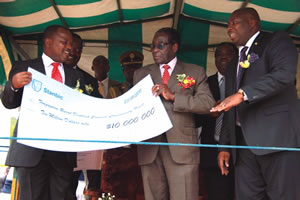
The Trust is the first-ever to be implemented by a manufacturing company after two community ownership trusts were launched at Zimplats and Unki Mine recently.
Under the Schweppes Share Ownership Trust, workers own 51 percent stake while Delta, the parent company, retains 49 percent.
The share ownership scheme saw 31 percent of the firm’s equity going to the workers and 20 percent to management.
Indigenisation, especially in the beverages industry, has been attributed to the increase in capacity utilisation from 34 percent in 2009 to the current 57,2 percent.
President Mugabe said Zimbabwe achieved political independence in 1980 and there was need to pursue other dimensions.
“Are we under the political independence umbrella and in charge of our resources? If our economy is in the hands of other people, we are not a sovereign State,” he said.
The President said there was need for Zimbabweans to take ownership of their resources through indigenisation.
“That should not frighten us who need total sovereignty and those of us in Zimbabwe who were CEOs (chief executive officers), we are not diminishing your powers . . . but enhancing your position from just being executives in your own businesses . . .”
He said claims of human rights violations do not hold water in Zimbabwe as the Government was redressing colonial imbalances.
“We respect them (human rights), but we had the worst human rights abuses during the colonial era.
ALSO SEE
“There has been great injustice in equity in relation to the workers and their employers over the years,” he said.
President Mugabe said the West had raised their voices on human rights issues when they engaged in the war against sovereign and independent states. He said the empowerment programme started in 1980 when Zimbabwe attained independence and Government was improving it.
“The issue of human rights should not be one-sided, but should look at both sides.”
President Mugabe castigated violence that has erupted around the country, saying political parties should convince voters during elections.
“Kana tichigarisana nemhuka dzemusango, sei tichirovana? Vamwe vanoti kana tichida kuvhoterwa dai matsvaga mari titenge vanhu, mumwe anoti unganidzai matombo nemiseve tibaye . . . others would refuse and decide to talk to the people.
“Why beat up people? If your own gospel and policies have substance, the people would want to be with you because hatidi matombo muno muna2012. Veduwe hatidi violence!”
The President said the indigenisa-tion and empowerment policy has brought about an era of economic ties between employers and employees.
“The policy seeks to directly involve the majority indigenous workers in ownership of shares in the mainstream economy.” He encouraged more non-indigenously owned companies to follow the Schweppes example.
“It is our vision to see partnerships develop between employers and employees so that we are guaranteed of participation by indigenous Zimbabwean employees in the running and operation of our companies.”
President Mugabe encouraged Schweppes employees to seek further investment in the parent company.
“The latest development has opened doors to more sharing opportunities. If they are our partners here in our country, what can stop us from sharing in their country?”
Meanwhile, President Mugabe says the media should desist from interfering with people’s lives as Zimbabwe do-es not have laws that bar people from having as many wives as they want.
In an apparent reference to PM Morgan Tsvangirai’s alleged marriage to Ms Locadia Karimatsenga Tembo, the President said anyone can marry as long as it is allowed within tradition.
“I am a Catholic and I am only allowed to have one wife. Hapana kwazvinorambidzwa kuti munhu aroore kwaanoda asi vemapepanhau vakuti nanga-nanga naye. Munhu ngaaite zvaanokwanisa kana zvichiita,” he said.


 Online Reporter