admin
admin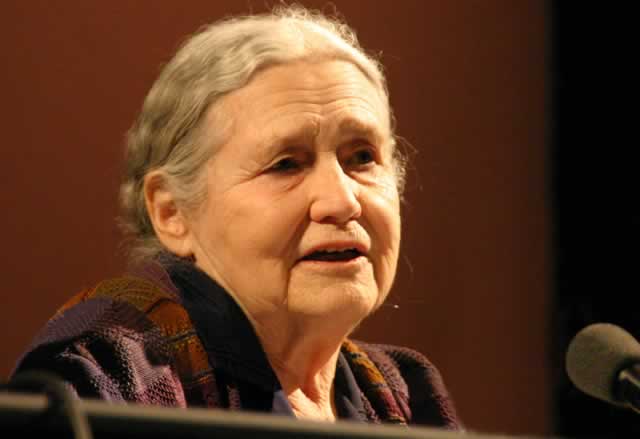
Doris Lessing, who has died aged 94, was one of the major fiction writers of the second half of the 20th century and one of the most vividly representative literary figures of our times. She was not a committee woman of letters – far from it – but she stood for what it meant to be a writer throughout that long, noisy “now”.
She lived through some momentous transformations of her own vocation, from communist social realist to reluctant feminist, to Sufi seeker, to Cassandra, to self-appointed cosmic anthropologist. Her broad brow and steady gaze graced thousands of interviews and profiles. She talked with shrewd mockery about our fascination with artists’ lives – “they are our alter egos, because they are seen as free ‘Oh, for the life of a gypsy, Oh!’”. But then again (in a 1987 polemic, Prisons We Choose to Live Inside), she wrote : “I see writers generally in every country, as a unity, almost like an organism, which has been evolved by society as a means of examining itself.”
And anyway Lessing was a nomad, a tent-dweller. She did seem free, she allowed herself to be inconsistent – obsessive, humble, brilliant, banal, serene, truthful, teasing by turns. In the mid-1980s she perpetrated a hoax on her publishers Jonathan Cape, submitting a manuscript under the name Jane Somers, which they promptly rejected (The Diary of a Good Neighbour by Jane Somers was eventually published by Michael Joseph, Lessing’s first publisher). This, she argued, showed what’s in a name. Unknowns could not get a fair share of attention.
But in fact, one could read this characteristically maverick gesture in quite another way – that Lessing spoke compulsively by now in tongues, in other people’s voices, and it was the dialogue among them that was the most fascinating thing. Splitting off one voice, the old-fashioned realist one, would no longer do the trick.
This restless power of self-invention may prove to have been her most distinctive quality. She was from the beginning a short-story writer and novelist of formidable originality – The Grass Is Singing (1950), the Children of Violence sequence (1952-69), many of the short stories set in Africa (This Was the Old Chief’s Country, 1951) and above all The Golden Notebook (1962) are 20th-century classics.
The science-fiction series Canopus in Argos (1979–83) was a post-imperial allegory with disconcertingly timely mental maps. One-offs such as The Memoirs of a Survivor (1974), The Good Terrorist (1985) and Love, Again (1996), so different from each other, and from the books belonging to schemes and series, revealed her enduring fascination with literary experiment.
And yet the story behind Lessing’s oeuvre remained riveting. She herself seemed open to change in a new way – not only creating characters to populate the times with symbols, but being one herself, as if the very business of putting pen to paper had become a confidence trick for conjuring a future. She was always losing old readers, gaining new ones, regaining others. Even her talent for demolition and her habit of cutting her losses were not to be relied upon. She was adept at tracing sly signs of continuity where that particular path through the narrative woods had been overgrown and bypassed time out of mind – not least by Lessing.
When she came to write her autobiography, in the 90s, she was walking a tightrope: “We’re all made up of different souls, but one person writes this book . . . somebody standing back, amused or appalled, but it’s the same voice.” Some critics felt they had at last caught her out, particularly members of the left she had left behind.
Born Doris Tayler in Tehran, the capital of what is now Iran, she had a lot of practice in moving on. Her father, a captain in the first world war, had met her mother while she was a nurse and he was recovering from having a leg amputated; he then became a clerk with the Imperial Bank of Persia. In Alfred and Emily (2008), Doris imagined different outcomes for them. In the event, when she was five, after the family had returned to Britain they set off to farm maize in Southern Rhodesia (now Zimbabwe), “a society more short-lived than most”. This supplied her with a “myth country” – not a place she could possess, and therefore one that possessed her all the more powerfully.
She wrote marvellously about their mud house, which was meant to serve for five years and lasted 20, about her father’s dreams, her mother’s deluded expectations of elegant living. Mother was the practical, ambitious one, and it was in order to disappoint her that Doris left school at 14, went off to the capital Salisbury (now Harare) and married young in 1939. But when suddenly, with the second world war, British servicemen and European refugees turned up, she discovered a world she had known only through books.
Lessing and her first husband, Frank Wisdom, were divorced in 1943 (their children, John and Jean, stayed with their father) and, fired with political passion, she became a member of a communist group whose leading light, a German-Jewish refugee, Gottfried Lessing, she married in 1945. In 1949 they too divorced, and she left for London with their son, Peter. “The horizon conquerors now set sail . . . for England,” the empire was about to implode.
Contemporary English writing, she announced coolly to an interviewer, was “small, well-shaped and with too much left out”. The books pages greeted The Grass Is Singing and its author with excitement and respect. She had brought colour to grey, postwar London in more senses than one, for the colour-bar in Africa was topical; she was a reporter from that front line – and also, thanks to her self-education in communist circles, a bold realist with a grand narrative about oppression, modelled on the epic novelists of the 19th century. The Daily Graphic chose her as their first “book find of the month” – “£20 in her handbag – and a manuscript in her suitcase” – and described her as “a dark, placid young woman of 30, of slow grace and deliberation”, as though the glamour of black Africa had rubbed off.
Lessing, for her part, fell hungrily on the theatre, music, museums, but in other ways found London frighteningly flattened, people’s energies leeched away by rationing and having to cope. She would later (In Pursuit of the English, 1960) describe it as a shaken, see-through city – “as the trains went past . . . shock after shock came up through brick and plaster, so that the solid walls had the fluidity of dancing atoms”. The flats and houses in which she lived were stopping-off points for fellow members of CND, black African political exiles, wandering ex-communists. And she would soon find herself playing “house-mother to teenagers looking for alternative families” (one of them grew up to be the novelist Jenny Diski).
The pivotal literary event of the end of the 50s was writing The Golden Notebook, the most formally compelling novel she would ever produce and the book that chronicled her personal cultural revolution. Instead of living stoically and ironically with her “contradictions”, she broke ranks to explore the creative possibilities of disintegration: mental illness, political apostasy, the sex war, and the cold war between generations. She was, initially, deeply disappointed that different groups of readers only “saw” one of the books in the book – generally the one about women, or the one about madness – when she had so inventively battered them into unity. Some were appalled by her new nakedness. In Vogue, Siriol Hugh-Jones deplored the way women novelists were deserting discretion and good humour. Iris Murdoch and Muriel Spark were bad enough, but Lessing was the worst. The Golden Notebook was “dismal, drab, embarrassing, sodden with a particularly useless form of self-pity . . . the sort of book which seriously sets the tide of female emancipation, if you care about the thing at all back a good long way”. Hugh-Jones was certain that women should reconcile themselves to the real world, keep their dignity and obey the rules about plausible plotting and round characters. However, in the 60s Lessing became a bestseller throughout the English-speaking world precisely because she cracked the glaze. She had exposed her private self – her love affair with the Czech ex-communist she calls “Jack” in the autobiography, a psychiatrist at the Maudsley hospital in south London whose family had died in the gas chambers and her shared excursion into craziness with the American writer Clancy Sigal.
But there was continuity, too. She never left Africa behind. The space-odyssey is about taking apart colonialism’s mind-set. African Laughter (1992) revisited
Zimbabwe and her intransigent family. She was not adopted as a tribal “mother” like her old friend Naomi Mitchison – she had become too elusive for that. Her love for the country had a no-entry sign against it: no going back in time.
Her two sons predeceased her, and she is survived by Jean and two granddaughters. — The Guardian.



 Online Reporter