Bongani Ndlovu, Online Reporter
Late Vice-President Dr Joshua Nkomo was a mythical figure to his children as they hardly saw him when they grew up because it was dangerous to be around Father Zimbabwe since the colonial government was baying for his blood.
The late Father Zimbabwe was a man of the people. He was an ever present colossus in the liberation struggle that inspired thousands of sons and daughters of the soil to stand up for their rights against extreme cruelty by the settler regime.
His was the voice that empathised, sympathised and propelled freedom fighters to go beyond their limits to bring independence to the country.
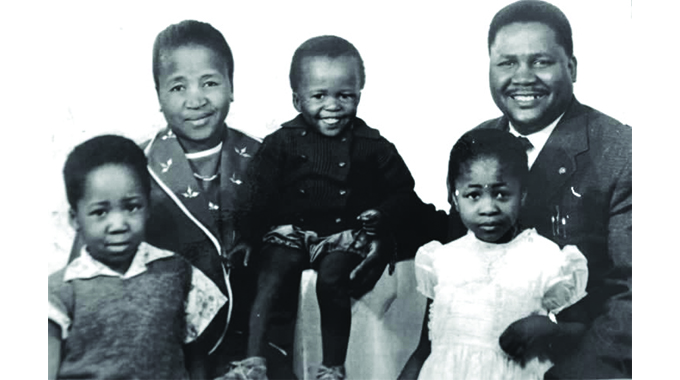
In short, he was there for every Zimbabwean, except his family. This was revealed by his first born, Thandiwe, as she reflected on his life and his limited interaction with his family. Dr Nkomo and his wife the late national heroine, Johanna Fuyane, had four children, Thandiwe, Thuthani Earnest (late), Sibangilizwe Michael and Sehlule Louise.
The late Vice-President, died on July 1, 1999 and his family and all Zimbabweans continue to celebrate his life 22 years after he breathed his last. Thandiwe gave insight into the man who had immense love for his family but was prevented by circumstance from expressing it.
A distant look comes into her eyes as she recalls one of the the first encounters that showed that being around her father was dangerous.

She says Dr Nkomo made one of his rare visits to their Pelandaba home in Bulawayo when she was 10 years old and the authorities teargassed the house, in a typical display of colonial brutality and wanton disregard of the safety of native children and women.
“None of us remember him being a father in the house because really, it was too dangerous to be around him. So, to protect the family, he would not live with us in the house. He would sometimes stop by the house. But one time when he did so at Pelandaba we were teargassed and we were sick and we had to live elsewhere. And I was only 10 years old,” said Thandiwe.
The struggle for liberation lasted for close to 30 years and in those years, Thandiwe and her siblings grew up with only an image of their father, whom she says was a “mythical” being.
The children grew up on a steady diet of larger than life stories of their late father.
Their mother, MaFuyane, assumed the role of their father and made sure his memory never faded from their minds.
“What we knew is what our mother told us about him, where she would say that the work he was doing was not a profession, but it was a calling; a much higher responsibility than being a father and we accepted it.
“We had this positive image but we didn’t really know him, he was a mystical figure to us because everyone was calling him Father of the Nation. And we didn’t understand how he was a father to everyone. When you are a child, you kind of make up your own fantasies of what you want to make of it. All we knew was that he was always in a plane to an extent that when any plane flew past, we would say, ‘bye bye Baba!’,” Thandiwe recalls with nostalgia.
Another memory of her father was when Dr Nkomo was incarcerated at Gonakudzingwa in 1964 when she was still 10 years old.

Thandiwe says she remembers vividly that the only communication with her father was when he would ask for their school work whenever their mother would visit him in prison.
“Where we came to know him was mostly when he was at Gonakudzingwa. He would ask us to send our homework; all our school work. We would do it and my mother would give him, maybe it would be marked by the teacher, he would look at it, even mark it, make his comments and send it back.
“He always told us that he wanted us to be educated because he would say, ‘what we are doing now is to free the country, when the country is free it will be your turn to come in and develop it’.”
The idea of empowering young people to lead in the future was a central theme in Dr Nkomo’s quest for Zimbabwe’s independence.
Thandiwe continued: “He put so much value in education, to the extent that after independence I graduated in New York and I did International Affairs and I was working for the UN. After independence, before Gukurahundi, he said, ‘No no Thandi you people cannot do that, we need you, all educated young people, that is why we sent you there’. So that’s the kind of belief that he had in this country.”
After independence, Dr Nkomo, according to Thandiwe, was a person who loved to be surrounded by people.
“One thing even after independence, my father just attracted a lot of people, shouting his name, Nkomo, Nkomo! Whenever the car would stop and there were people around, he would address them,” she said.
She revealed a side of the liberation icon that most people overlook. The bittersweet struggle of a revolutionary with a higher calling, who has to juggle between family and country.
– Follow on Twitter
@bonganinkunzi