admin
admin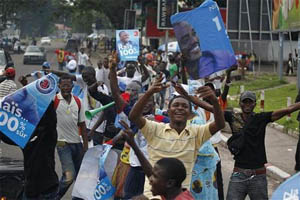
Official figures showed turnout and support for Kabila running at 100 percent in some areas, while results from nearly 5 000 polling stations, most in the opposition stronghold of Kinshasa, have gone missing.
On Tuesday the electoral commission (CENI) rejected comments by the influential archbishop of Kinshasa Laurent Mosengwo, who said that the results reflected neither truth nor justice. It said the figures referred to by Mosengwo were false.
“CENI invites the population to be wary and to refrain from all manipulation of the election results,” said CENI spokesman Mathieu Mpita.
In eastern Congo four opposition leaders, including the local head of Tshisekedi’s UDPS party, faced trial accused of inciting civil disobedience after being arrested trying to demonstrate earlier in the week, according to the deputy chief prosecutor of North Kivu province.
The main opposition party has called for mass protests to “protect” the victory it claims to have won in last month’s disputed presidential election.
Jacquemin Shabani, secretary general of the Union for Democracy and Social Progress (UDSP), made the call for “peaceful and democratic demonstrations” on Wednesday, without giving a time or place.
Etienne Tshisekedi, the UDSP leader, was incumbent president Kabila’s main rival in the November 28 vote, in which Kabila was declared the winner with 49 percent of votes while Tshisekedi took 32 percent, according to the Independent National Electoral Commission (CENI).
Tshisekedi has rejected those results, with the European Union, the non-profit Carter Centre and other election monitors voicing concern about the credibility of the polls. They cited problems in the vote count and the loss of huge numbers of ballots.
The United States said on Wednesday that the elections were “seriously flawed”, though it was unclear whether the “irregularities” changed the outcome.
“We encourage the relevant Congolese authorities to closely review these cited irregularities and proceed with maximum openness and transparency,” Victoria Nuland, a state department spokeswoman, said in a statement.
“We believe that the management and technical execution of these elections were seriously flawed, lacked transparency and did not measure up to the democratic gains we have seen in recent African elections,” she said.
The call for protests comes amid a widening crackdown on opposition protests, including one on Wednesday in which demonstrators reported multiple injuries.
On Wednesday, the Red Cross Society of the Democratic Republic of the Congo, reported that a volunteer who had been injured on 28 November when an identified assailant attacked a first post during the pre-election violence in the capital, had died of his injuries in a hospital on 7 December.
The Red Cross Society strongly condemned the “violence used against a person carrying out the purely humanitarian activity of assisting wounded people”. It said there was a lack of respect for its emergency services.
Police on Tuesday stopped opposition supporters from marching in the eastern cities of Bukavu and Goma, whose mayors had banned protests.
In Lubumbashi, the country’s second-largest city, the elite presidential guard dispersed a protest on Wednesday, injuring several people.
About 30 local leaders from the the UDSP were marching towards the main courthouse to protest the closure of their headquarters.
After local residents joined the march and numbers swelled to about 250, members of the presidential guard intervened, according to UDSP member Fabien Mutomb.
“It was a peaceful march,” Mutomb said. “We were surprised to see a military arsenal deployed in front of us. The presidential guard intervened violently.”
Meanwhile, the results were seriously flawed and lacked transparency, the US ambassador to the central African country James Entwistle said.
“The United States believes that the management and technical execution of these elections were seriously flawed,” Entwistle said in an emailed statement said.
“They lacked transparency and did not measure up to the positive democratic gains we have seen in recent African elections.”
The elections are the first Congolese-organised polls since the end of a devastating war in 2003 which left millions dead. An earlier poll in 2006 was organised under the auspices of the United Nations. The United States and other Western donors are offering technical assistance to the Congolese to review irregularities identified by observer missions, and Congo’s prime minister has already welcomed the offer, according to Entwistle.
“It’s important that friends of the Congolese people do not find fault. Therefore we are encouraging the Congolese authorities to closely review the identified irregularities.”
The election process has faced growing criticism from both in and outside the country. The European Union observer mission has said witnesses were prevented from following crucial steps of the process. — Al Jazeera.


 Online Reporter