admin
admin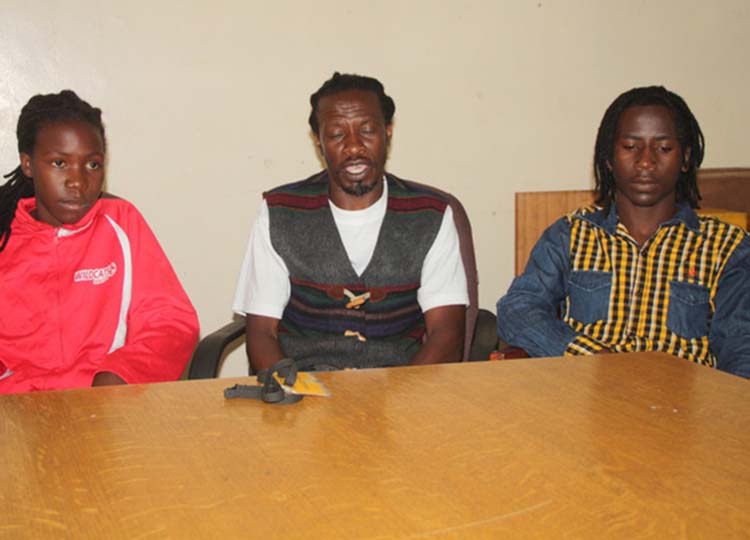
Harmony Agere
IT’S two days before schools open for the first term of 2017 but 13-year-old Eliah Jnr Bafulemu is yet to secure a Form One place. Although the teenage boy who lives in Old Tafara with his parents managed to score 28 units during the Grade Seven examinations, this is not the reason why he is failing to get a place.“Eliah Jnr cannot get a Form One place because he wears dreadlocks,” his father Eliah Bafulemu Senior (46) says. “We have been to Tafara High 2, Foundation College and other private colleges looking for a place but they said they will only admit him if we cut his dreadlocks.”
The dreadlocked Mr Bafulemu who has been avidly following the Rastafarian principles his adult life says cutting his son’s locks will be giving up his beliefs.
“I accept that my boy came out badly at Grade Seven but that is not the reason they won’t give him a place, the reason is he has dreads,” he said.
“Someone looks at him and judges that because he has locks he is a nuisance and he will influence other children but that’s absolutely not the case. So you can see that even if he is to get the place he will be stigmatised.”
Mr Bafulemu who earns a living from making dreadlocks says his anger is compounded by the fact that his son attended primary wearing dreadlocks without a problem.
“The teachers at Tafara Primary school where he went never had a problem with him,” he said. “They were, in fact, very supportive and my family felt accepted because they knew our way of life. Even my other children who are older than Eliah never had this problem. I am surprised why it is now an issue with him. If it is a law you then ask why there is disparity in applying it.”
Mr Bafulemu’s steadfastness in keeping his child’s locks is inspired by a 2012 landmark ruling which determined that barring dreadlocked children from school will be interfering with their right to education.
“Dreads for me are not just fashion, they are spiritual, even the job that earns me a living is about dreadlocks, I work in a saloon doing dreadlocks.”
Progressive Teachers Union of Zimbabwe president, Dr Takavafira Zhou, said the headmasters who are denying the boy entry into the school are misinformed as this issue was dealt with in the courts years back.
“It is being misinformed on part of the headmasters to do that because this is an issue that has been contested and won in court,” he said.
“Some people do it as part of their religion and culture and it will be discriminatory to deny one the right to education because of their religious beliefs. As teachers and staff we went to court with a similar issue in 2004 because teachers were being barred from wearing locks.”
Dr Zhou said Mr Bafulemu could get assistance from his organisation or other human rights organs.
Secretary for Primary and Secondary Education, Dr Sylvia Utete-Masango, said the schools could have been spelling out their expected standards and rules but not necessarily barring the child from school.
“We do not have the details of the issue but I am sure the schools will eventually admit him,” she said. “I do not think it is discrimination if you are just spelling out your expected standards and code of conduct.
Let me give you examples of mission schools, depending with the church, these schools have their own rules which they won’t bend to accommodate one child.
“If you send your child there he or she must abide by these rules, if you do not agree with their rules then you take your child elsewhere where your beliefs are accepted. In this case, however, I’m confident that the child will be given a place.”
Dr Utete-Masango said in as much as religion is a constitutional right, there is a thin line when it comes to dreadlocks.
She said if school authorities do not interrogate the matter carefully it could become a problem in schools since some people just wear dreadlocks for style not religion.
“So we are saying the next thing you will have the whole school with dreadlocked children and you wonder if all of them are doing it for religion,” she said.
“Some after the hair they go on to do the beard and they are just students in a classroom. Now just imagine the kind of influence that this will have on the next child. On a counseling point of view you would want to ask the parents what the children will lose if the child’s hair is just cut, why not let them until they are adults to make their own decision?
“Cutting the hair might even be good for the child because going to school with long hair might subject them to discrimination and stigmatisation.”
The admission of dreadlocked students into schools has long been a contentious issue in Zimbabwe.
Parents and teachers have been divided on the issue.
While some parents see no wrong in dreadlocks some think they are not hygienic and are bad influence for children.
In 2012, then High Court judge, Justice Martin Makonese ordered the then headmaster of Masiyephambili Junior School in Bulawayo and the Ministry of Education, Sports and Culture to enroll for lessons a four-year-old child who had been barred from attending school because of dreadlocks.
In his ruling Justice Makonese said there was no lawful basis for the respondents to interfere with the minor child’s right to education based on his long hair that expresses his religious beliefs.
South Africa’s Pretoria High School for Girls management faced furious backlash in August last year after it instructed black school pupils who wore afro to straighten their hair.
While there is a belief that dreadlocks are of Jamaican and Rastafarian origin, research shows that its origins are not quiet clear and that the dreads have been worn for various reasons in different cultures throughout generations.
Some have worn them as an expression of deep religious or spiritual convictions, ethnic pride, as a political statement and in more modern times, as a representation of a free, alternative or natural spirit.
Perhaps the most stereotyped presumption about dreadlocks in Zimbabwe is that they symbolise bad behavior and drug abuse. Yet quite a number of successful businessmen, ministers and mainly successful sports personnel wear dreadlocks.


 Online Reporter