Mbulelo Mpofu [email protected]
FOR Champion “Duchamp” Sibanda, art is not something to be separated from life. It is an extension of the places he inhabits, the people he loves, the memories he carries and the city that continues to shape his creative imagination.
That relationship with Bulawayo, its architecture, everyday surroundings and personal experiences finds expression in, “Dust to Foam”, a solo exhibition curated by Sibanda at the National Gallery of Zimbabwe (NGZ) in Bulawayo, marking a new chapter for the visual artist and curator.
A year after helping curate a pictorial depiction of the City of Kings alongside NGZ Bulawayo curator Doris Kamupira as part of Bulawayo Day celebrations, Sibanda has stepped into a different role, bringing together works that reflect his personal journey, artistic influences and evolving relationship with his environment.
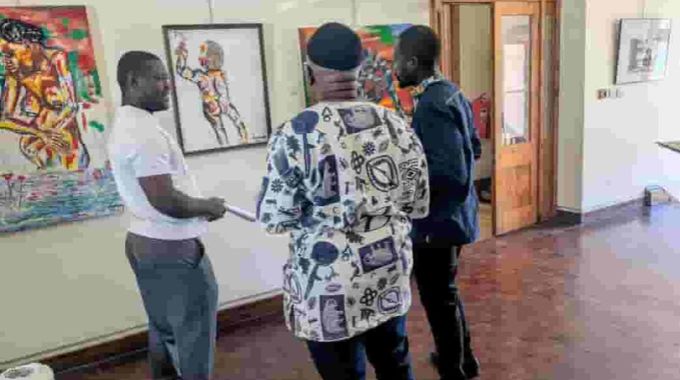
The exhibition was officially opened by former NGZ Bulawayo regional director Voti Thebe and attended by gallery artists, Palmer Institute students and a delegation from Chinhoyi University of Technology’s (CUT) School of Art, including lecturers Victor Dewa, James Gonese and Alois Muketiwa.
In his remarks, Thebe challenged Sibanda to embrace the opportunities presented by the solo exhibition, describing it as the beginning of a new phase in the artist’s professional journey and a chance to expose his creative potential to a wider audience.
He noted that Sibanda’s grounding in visual arts had equipped him to navigate the competitive creative industry, where artists must continually develop their craft while building relationships with promoters, collectors and other stakeholders.
The exhibition, he said, offered an insight into the possibilities of Sibanda’s talent, with the hope that it would open doors and foster mutually beneficial relationships within the arts sector.
He further observed that artists are constantly shaped by their physical, social, intellectual, historical and emotional environments, with the influences of impressionism, expressionism, cubism and abstraction evident in the works on display.
The challenge, however, was for Sibanda to move beyond experimentation and make his mark.
A closer look at “Dust to Foam” reveals an artist deeply invested in Bulawayo, drawing inspiration from its architectural heritage and seemingly ordinary spaces that often escape the attention of those who move through them daily.
The city’s iconic structures, including the National Gallery of Zimbabwe in Bulawayo and City Hall, feature prominently in his visual vocabulary, demonstrating an affection for the urban landscape that goes beyond documentation.
For Sibanda, the city is both subject and home, a place whose textures, buildings and everyday encounters inform his artistic expression.
“I curated Dust to Foam from inside my own life. This is not an exhibition I am standing outside of. I am inside it. Every work here is a piece of my home, my family, my city, my memory. I did not curate it to explain myself. I curated it to invite you in,” he said.
The title itself carries a metaphor for transformation, tracing the movement from what is discarded, overlooked or forgotten towards something renewed, fragile yet capable of holding meaning.
“Dust is what remains when something has been used, forgotten or left behind. Foam is what rises. It is soft, it holds air, it holds weight, protects what is fragile. Between dust and foam is transformation – and that is where I live as an artist,” he said.
This philosophy extends to his choice of materials and mediums, with Sibanda working with discarded paper, transforming it into bowls, flasks and vessels while incorporating photography, painting, charcoal drawings and film into the exhibition.
His photographs capture Bulawayo’s streets, City Hall, the gallery at night and the fountain, reclaiming familiar spaces through a different lens. His paintings and charcoal drawings explore what he describes as the things words cannot adequately carry, while film becomes a vehicle for memories that unfold in fragments, loops and recurring moments.
His artistic identity is also reflected in the name Duchamp, which speaks to his belief that art can emerge from ordinary objects when viewed through a deliberate creative lens.
“I call myself Duchamp because I believe an ordinary object can become art when you look at it with intention. A bowl can become a prayer. A photograph can become a home. Dust can become foam,” he said.
The exhibition unfolds as a journey rather than a chronological account, beginning with “The Artist” and “The Artist’s Dream” before moving through “The Sky Meets The Ground”, “Silence”, “The Evening” and “Moment of Peace.”
The narrative then turns towards family through works such as “Gangster Love”, “The Beginning”, “Way Back”, “She’s Not Heavy, She’s My Sister” and “In My Father’s Shoes”, exploring the weight of relationships and the comfort found in belonging.
“Because family is weight and family is wings,” Sibanda said of the section.
The journey concludes with “Connected” and “Same Time, Same Place”, bringing together the exhibition’s recurring themes of memory, relationships, belonging and the interconnectedness of human experience.
CUT School of Art chairperson Andrew Madzivanzira commended Sibanda’s work ethic, holding him up as an example to young creatives of the value of commitment, discipline and persistence in pursuing their artistic ambitions.
His remarks reinforced the exhibition’s broader significance as both a personal milestone for Sibanda and an opportunity for emerging artists to engage with the possibilities of building a career in the visual arts.
At its core, “Dust to Foam” is an intimate encounter with an artist who refuses to detach himself from the world around him. Bulawayo’s buildings, family ties, discarded materials and fleeting moments are not merely subjects to be painted or photographed, but part of the lived experience from which his art emerges.
In curating the exhibition from within that experience, Sibanda invites audiences to look again at the familiar – and perhaps find beauty, meaning and transformation in what they have long overlooked. – Follow on
X @MbuleloMpofu