

 Chronicle Editor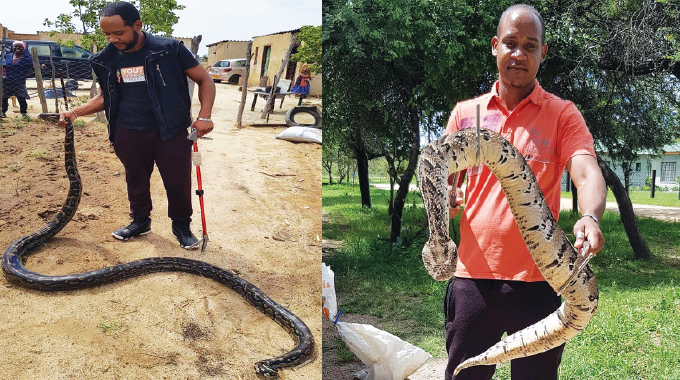
Patrick Chitumba, [email protected]
DYLAN DUBE is not afraid of snakes. In fact, he loves them. He is a snake handler who has caught about 360 snakes in the past six years in and around Gweru. He is known as the “Snake Man” in his Southdowns suburb, where he inspires both fear and respect.
The 30-year-old has a Diploma in Software Engineering from Botswana, but he chose to pursue his passion for snakes instead of a conventional career. He joined Wildlife Junction, an organisation that conserves nature and wildlife through education and hands-on interaction.
“I just fell in love with catching snakes when I was doing my diploma in Software Engineering in Botswana and that was some six years ago. When I got back I went into wildlife under Wildlife Junction. They conserve nature and wildlife through education and hands-on interaction,” he said.
Dube knows that snakes are often misunderstood and hated by many people, who associate them with witchcraft and evil. He wants to change that perception and show people that snakes are an important part of the ecosystem.
He said: “People are very afraid of snakes, just the mention of the word snake sends shivers down some people’s spines but they forget that they are an important part of the ecosystem. Some relate snakes to witchcraft but in my line of work, they are just reptiles which need protection.”
Dube spends his time catching and relocating snakes that pose a threat to humans or vice versa. He also educates the public about the diversity and role of snakes in nature.
“Snakes are found throughout the world on all continents except Antarctica. They have existed on earth for around 100 million years, long before early humans. In nature, snakes are an important part of the environment. They are carnivores that primarily feed on eggs, rodents, insects, other snakes, frogs, tortoises, birds, and other small mammals. The size of prey depends on how large the snake is, although they can consume prey several times their size if they can catch it,” he said.
Dube has done extensive research on reptiles in the Midlands province since he joined Wildlife Junction in 2017.
“Initially it was scary and terrifying as we entered into the field with little theory knowledge and no mentored guidance. However, filled with hope and a good vision; we set out to achieve our targets. Taking every reptile call and working closely with them in captivity was always a learning curb for us,” he said.
Dube has also made an impact on over 10 000 pupils who now have knowledge on snakes. He has caught over 350 snakes of different species, including the deadly black mamba, snouted cobra, spitting cobra, puff adder, python, and boomslang.
“Having grown to become Gweru’s official snake handler, we have caught over 350 snakes to date namely black mamba (rovambira), snouted cobra (mhungu), spitting cobra (mhakure), puff adder (chiva), python (shato), boomslang (kangamiti) and several others,” he said.
Dube advises the general public to be safe and avoid creating habitats for snakes in and around their homes.
“Snakes out in nature are an important type of wildlife. But in or near the home, snakes are pests.
“They make their way into yards looking for food and can find their way into a home through gaps around doors and walls, holes in siding, missing mortar in a brick wall, and pipes — all of which provide enough room for a snake to enter your home. Once inside, they will often retreat to basements or attics but can be found anywhere,” said Dube.
He noted that in addition to rats and poultry, snakes may obtain water from dripping taps.
“It’s always good to know basic first aid for snake bites and be able to identify the snake mentioned above. This helps medical teams to respond with appropriate measures to relieve the patient. On our part after rescuing a snake, we release them back into the wild once we see that they are fit and parasite free,” said Dube.
Equipped with a tube, hook and snake tongs, Dube is prepared to save both the human and snake species.
“Yes, I have multiple assistants and we do it without any juju. Anti-venom can only be administered by medical staff and so we don’t carry it,” he said.



 Online Reporter