Londile Moyo
Theseus Mauruki Shambare
ZIMBABWE and Mozambique are working closely to end the scourge of post-harvest losses and informal cross-border “spiking” through a multi-million-dollar initiative aimed at transforming the regional agricultural landscape.
The two neighbors, in partnership with the Food and Agriculture Organization of the United Nations (FAO) and the Italian Agency for Development Cooperation (AICS), have are rolling out the €3.5 million Zim-Moza Agriculture Value Chain and Trade Facilitation Development Project (ATDP).
The initiative, headlined at a ZITF 2026 side event themed “Formalizing Cross-Border Agricultural Trade: Unlocking Competitiveness in the Macadamia, Sesame, and Tomato Value Chains,” seeks to build the infrastructure necessary to transition smallholder farmers into export-oriented agro-industrial players.

Speaking at the high-level panel, renowned economist Professor Gift Mugano, Executive Director of Africa Economic Development Strategies, highlighted the severity of the infrastructure gap, particularly in the horticulture sector.
“If you look at tomatoes, close to 60 percent of the crop is lost. Clearly, one of the structural reforms that needs to be put in place to address that challenge is the issue of cold chains—infrastructure at the farm,” Prof Mugano said.
He said, while Zimbabwe requires 1.2 million tonnes of tomatoes annually, it only produces 400,000 tonnes, yet over half of that yield is wasted due to a lack of storage.
“There is a gap already in terms of production and demand… of about 800,000 tonnes. That is the business case. You invest into infrastructure, you grow the chains.”
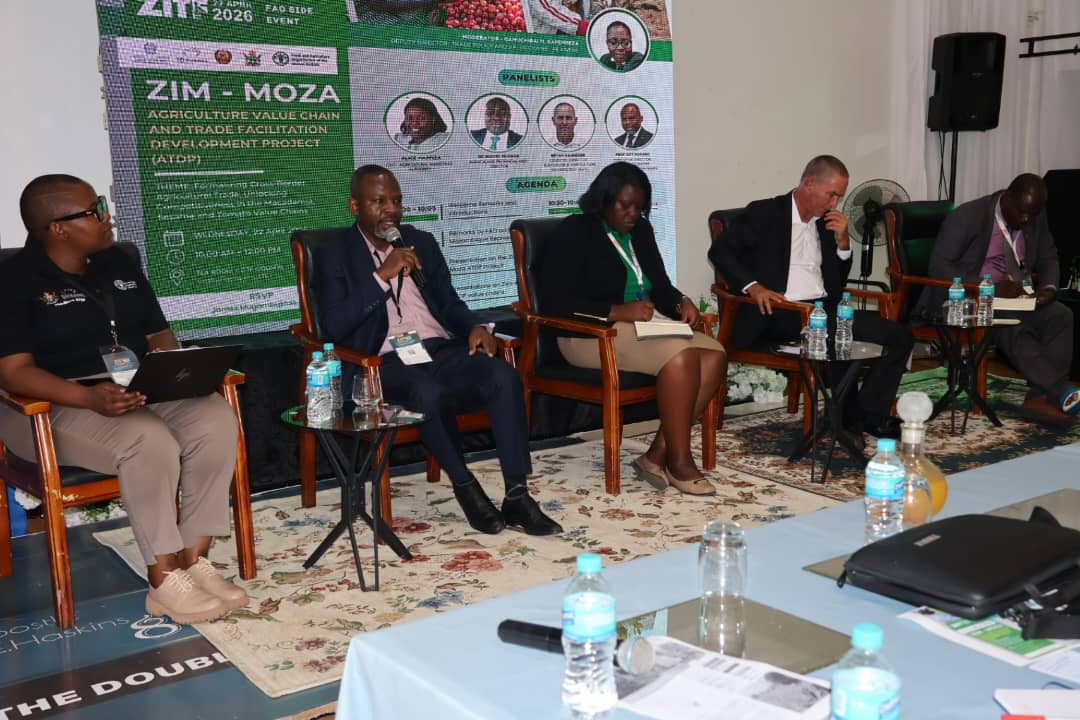
The Agricultural Marketing Authority (AMA) is moving to secure these value chains through a new registration system.
AMA CEO, Alice Mapfiza, revealed that the authority will this year facilitate a “farmer group registered farmer certificate” to eliminate middle-men and “side-marketing.”
“We want all farmers and all players to be registered to make sure that, if there are any [offtake] agreements in place, AMA can come in as an arbitrator,” Ms Mapfiza said.
“For everyone that is coming to buy your commodities, please verify that they are registered with AMA to benefit you.”
In the sesame sector, the project aims to replicate successes in high-standard global markets.
Brian Saunders, Country Director for Sustainable Agriculture Technology (SAT), shared how local farmers have already broken into the Japanese market despite stringent regulations.
“Our first year in 2023, we were able to export 246 tonnes, of which 151 tonnes went to Japan… the most stringent country with regards to regulations,” Mr. Saunders said.
However, he warned that a 19 percent trade tariff in Mozambique is currently pushing Zimbabwean prices down and called for government intervention to curb “sesame spiking” that costs the country foreign currency.
Manicaland Provincial ARDS Director Mr Nhamo Mudada said the loss begins even before the harvest due to poor agronomic practices.
“We are seeing ourselves producing an average of three tonnes [of macadamia] per hectare. The potential for the crop is eight to ten tonnes… we have already lost five tonnes before we even started,” Mr Mudada said.
He called for viable contracts that include agronomic support, rather than buyers who “only come to take what is there.”
With the project officially part of the ZITF 2026 agenda, the focus now shifts to establishing the vital aggregation centers and cold-chain systems discussed at the Tea Room session to ensure the sweat of the Zimbabwean farmer translates into a competitive, science-led economy.



 Online Reporter