Chronicle Editor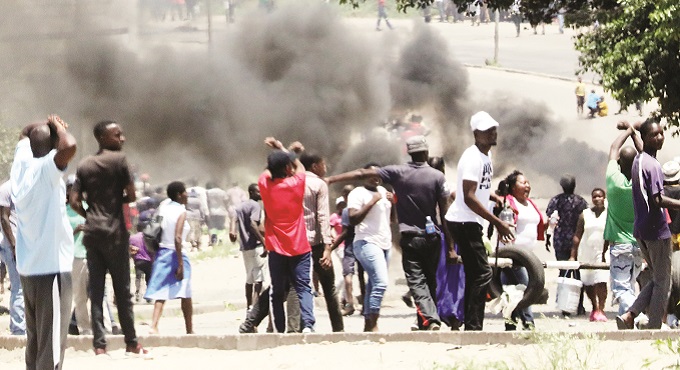
Stephen Mpofu
LAW and order are the bedrock of any democratic governance and a tower of strength to which patriots rush for refuge in the face of economic and political challenges that may at first appear insurmountable.
But when people resort to violence — in the form of looting and destruction of property and human lives — their patriotism becomes inverted and any solution to the economic and political problems they confront remains an ever-receding mirage with disastrous consequences for our nation.
If this discourse does not recapture to right-minded Zimbabweans this week’s shutdown and the diabolic events that went with it, then nothing will, in which case the violence that occurred will beget more violence and its dire consequences.
What this suggests is that the hooligans involved in the barbaric acts of the stay away and their sponsors, both local and foreign, the latter by remote control, will inculcate in future Zimbabwean generations a value system of violence where only the strongest survive.
The economic decline that Zimbabwe is experiencing did not begin yesterday but as way back as 2002 with Western economic sanctions masterminded by the United States of America and Britain as reprisals for the land reform programme. That became the genesis of our economic woes.
The financial and economic embargo meant, among other evils, non-repatriation of revenue from some of Zimbabwe’s exports as a calculated financial squeeze on this nation with traditional international financial institutions becoming too close with their money for Zimbabwe to borrow, among other economic restrictions, all intended by the enemy to effect regime change and in the process kill the land reform programme under which farms were repossessed by the Zanu(PF) government from the minority whites for re-distribution to blacks who needed the land the most.
[The liberation struggle in which sons and daughters sacrificed their lives to recover the motherland from foreigners who occupied the country by force of arms would have remained a facade with the majority blacks trampling on and bruising each other’s toes, crowded on strips of infertile land.]
The imperialist West continues to regard land reform as an unpardonable sinful act and remains unrelenting in its attempts to unseat Zanu(PF) from power and install a regime by imperialist quislings in order for a wholesale plunder of our country’s rich mineral resources to resume while our own people watch with their arms folded.
It is no exaggeration by this pen nor by the powers that be in our country either that a foreign hand or hands using our own people as cats’paws played a big role in the disturbances that resulted in the plunder and destruction of properties as well as the loss of lives, with hundreds of suspects being arrested for their part in the riotous actions.
But the big question that remains unanswered on the stunned lips of peaceful Zimbabweans is why violence of such a large scale, particularly in the metropolises of Harare and Bulawayo, caused such massive losses when security officers, especially the police, could have prevented it or at least the scale at which the disturbances occurred.
Yes, the police or other security agents are not prophets to have foretold the consequences of the fuel price increases announced by President Emmerson Mnangagwa before he went oversees to engage and re-engage friendly countries for help with our country’s economic rebound.
But, well aware of the difficulties commuter and private transport owners experienced with long queues at garages for fuel and the travelling public, particularly workers, suffering as a result, the law enforcement agents ought to have anticipated the boomerang effects of the fuel price hikes and moved out of their comfort zones ready to nip in the offing signs of any violent response to the fuel price hikes.
The announcement of allowances for civil servants on a sliding scale to cushion them against the effects of increased fuel prices, while the general working public must naturally have felt that they were left in the cold, should have prompted security agents to get out of their barracks or camps to patrol the streets of the cities in order to forestall any act of lawlessness until such a time that things returned to normal across the country.
The President’s lieutenants and not ED himself should have taken precautionary measures to safeguard property and human lives.
In the circumstances, will it be entirely wrong for anyone to suggest that the security forces became not responsive but, rather, reactionary to the disturbances that occurred under their very noses?
Finally, it is to be hoped that the courts will mete out sentences that will make the looters and killers of fellow human beings wish they were never born, with potential offenders and their known sponsors being made by the law to dig holes in the ground, spit into them and cover them up with pledges of never again poking the law in the eye with their fingers or spitting at it by their apparent collaborations in the violent acts that occurred.
On the other hand, any security officers deemed by their employer to have been guilty of a laissez-faire response to riotous acts under their very noses must also be made to face the music.
Meanwhile, since Zimbabweans have long gone past the Stone-Age era where communication was snail-like, reports from Harare which must also have reached other urban centres affected by the shutdown suggests that workers — at least some of them — have decided, in spite of things returning to normal, to extend their “holiday” and return to work on Monday, the day after tomorrow.
A fellow communicologist and Sunday News Editor, Limukani Ncube, said in Bulawayo on Thursday that the reported decision by some workers to give themselves an extended holiday would cause enormous production losses at work places, thereby aggravating the already dire economic situation that Zimbabwe faces.
The bottom line in the matter in point here is that no serious business people will take out their hard-earned money to sink in a country that appears to be a lawless jungle, and Zimbabweans across the nation should seriously decide whether theirs is a lawless jungle or a lucrative environment for foreign investment to help with the economy’s rehabilitation.



 derick.khumalo