


 Online Reporter
Ngugi Wa Thiong’o is not dead. Writers do not die. They are immortal.
The literary god just shed his mortal coil and transitioned from this wretched world to the celestial realm from whence he tapped the wisdom he shared with us during his time here on earth.
It is a pity that the demons that he wrestled with most of his life are still with us — haunting, hounding and tormenting us.
Ngugi was among the pantheon of literary gods, including Chinua Achebe and Wole Soyinka, who practised their sorcery in the 50s and 60s, particularly at a time of literary and revolutionary ferment, when African communities began fighting to upend colonialism, which had started to take root in the late 19th century. And Ngugi was especially influential in the 60s when he left the world spellbound by his works, such as “Weep Not, Child” (1964), which was the first major novel in English by an East African; “The River Between” (1965); and “A Grain of Wheat” (1967).
As with most of his contemporaries and peers, his sizzling literary works, both novels and plays, searingly interrogated the contradictions and clashes between Western culture, tradition, religion and practices, and African values and norms.
The disruptions caused by this seeming clash of civilisations, as well as their ramifications to pre- and post-independence polity and social relations, was a running thread in most of his work.
The makings of a god
But to get into the mind of this exceptional Kenyan — nay, African, or world — deity, we have to understand and appreciate his background, as well as the forces that drove and fought him. So, please bear with Bishop Lazarus as he summarises the episodes and experiences that shaped his character, worldview and attitudes. You see, Ngugi was born into a polygamous poor peasant family in the village of Limuru, Kenya, on January 5, 1938.
He was one of his father’s 24 children.
Kenya then was under British colonialism.
However, during that period, resistance against colonialism, led by the Land and Freedom Army (LFA), which was also referred to as the Mau Mau, was growing.
Naturally, as is the situation with and in most families, allegiances were split.
His elder brother, Good Wallace, was a member of the Mau Mau.
Another brother, Kabae, had fought for the British in Myanmar during World War II, while Tumbo was a police informant.
As fate would have it, their family ultimately lost their land to the colonisers, a development that left this huge family in a state of privation.
It was, however, his mother, Wanjiku, who set him on the path of pursuing education, which he fervently embraced and grabbed with both arms.
He was educated at the elite Alliance High School, which was under the influence of white missionaries, who shaped his intellect and nurtured his fledgling and budding interest in writing. His journey led him to Makerere University, considered the literary capital in East Africa, in 1959, where a key event in June 1962 — the African Writers’ Conference, which was the first organised gathering of writers from across the continent — further inflamed his passions and profoundly influenced his art, craft and delivery for years to come.
But this convention, graced by eminent authors such as Chinua Achebe, Wole Soyinka and Ezekiel Mphahlele, among others, was, more by default rather than design, predominantly made up of writers who communicated their work in English.
This attracted the ire of critics such as the Nigerian Obi Wali, who, in a brutal assessment, forcefully asserted that true African literature could only be written in African languages.
African literature that was written in colonial languages, Wali claimed, could only be best described as a minor branch of European literature. Kikikiki.
Turning point
Wali’s cold, hard facts led to the subsequent transfiguration of our dear Kenyan writer.
He consequently dropped his first name, James, and assumed the name Ngugi in the 1970s, but, most importantly, he began using his mother tongue, Gikuyu, as a vehicle to communicate his art to the world.
He wrote the novel “Caitaani Mutharaba-ini” (Devil on the Cross) in Gikuyu, on pieces of toilet paper, in 1977, at Kamiti maximum-security prison, when he was arrested for a play that was considered offensive and unamusing by Daniel arap Moi.
“I can never think of my first novels without thinking of the language issue,” he observed in an interview he had some time in June 2023.
“How could I have these African characters and have them all speaking perfect English?
“When I wrote my first book, I wrote it in a language my mother couldn’t access. I rewarded her for taking me to school by writing in a language she can’t read or write.”
How profound!
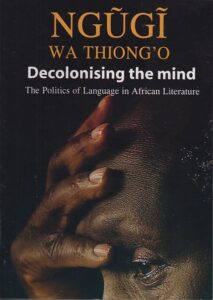
These views are also crystallised in his work, “Decolonising the Mind: The Politics of Language in African Literature”, through which he claims that “unfortunately writers who should have been mapping paths out of that linguistic encirclement of their continent also came to be defined and to define themselves in terms of the languages of imperialist imposition”.
Phenomenon of self-hate
This, folks, lies at the heart of challenges that we — you and me; in fact, most Africans — continue to grapple with to this day.
We somehow believe that mastering Western languages is synonymous with superior intellect. We invest most of our resources and energies to raise our kids into little English, French and Italian ladies and gentlemen.
Even to this day, our little learners, even in remote schools in Binga, continue to be tormented by English as a language of instruction.
Absurd!
The foreign languages that we are today proud of speaking are nothing more than a grotesque manifestation of the self-hate that has been systematically inculcated in our people by the colonial system, which makes them believe that Africans, especially black Africans, inherently and innately neither have the capacity nor agency to accomplish great things.
You should see how our own people, who accomplish huge feats and milestones, are caricatured, pooh-poohed and ridiculed by species of their own kind.
Today, the engineers, artisans and various craftsmen who invested their all to construct the magnificent Trabablas Interchange, which was commissioned on Friday, are following with wonderment and curious amusement as cynics, mainly from opposition political parties, fall over each other to besmirch the fruits of their skill and toil.
Decolonising the mind
This is the demon that Ngugi fought with his sharp pen, which was clearly mightier than the sword, for the better part of his life.
And this is why President ED continues to call for another revolution — Chimurenga Chepfungwa/Umvukela Wengqondo (the liberation of the mind) — to unleash the potential of the African(s).
We are all — black, white, yellow — created equal and in the image of God.
1 Peter 3:3-4 says: “Your beauty should not come from outward adornment, such as elaborate hairstyles and the wearing of gold jewellery or fine clothes. Rather, it should be that of your inner self, the unfading beauty of a gentle and quiet spirit, which is of great worth in God’s sight.”
2 Corinthians 12: 9 -10 also says: “But he said to me, ‘My grace is sufficient for you, for my power is made perfect in weakness.’ Therefore, I will boast all the more gladly about my weaknesses, so that Christ’s power may rest on me. That is why, for Christ’s sake, I delight in weaknesses, in insults, in hardships, in persecutions, in difficulties. For when I am weak, then I am strong.”
Bishop Lazarus feels pity for cynics, for their pathetic behaviour is just but a cover to mask their insecurities, vulnerabilities and fears.
This was aptly captured by former United States president Theodore Roosevelt in his famous speech delivered in Paris in April 1910.
“The poorest way to face life is to face it with a sneer. There are many men who feel a kind of twisted pride in cynicism; there are many who confine themselves to criticism of the way others do what they themselves dare not even attempt,” observed Roosevelt.
“There is no more unhealthy being, no man less worthy of respect, than he who either really holds, or feigns to hold, an attitude of sneering disbelief toward all that is great and lofty, whether in achievement or in that noble effort which, even if it fails, comes second to achievement.
A cynical habit of thought and speech, a readiness to criticise work which the critic himself never tries to perform, an intellectual aloofness which will not accept contact with life’s realities — all these are marks, not as the possessor would fain to think, of superiority, but of weakness.
“They mark the men unfit to bear their part painfully in the stern strife of living, who seek, in the affectation of contempt for the achievement of others, to hide from others and from themselves their own weakness. The role is easy; there is none easier, save only the role of the man who sneers alike at both criticism and performance.”
Roosevelt was not finished.
“It is not the critic who counts; not the man who points out how the strong man stumbles, or where the doer of deeds could have done them better,” he added.
“The credit belongs to the man who is actually in the arena, whose face is marred by dust and sweat and blood; who strives valiantly; who errs, who comes short again and again, because there is no effort without error and shortcoming; but who does actually strive to do the deeds; who knows the great enthusiasms, the great devotions; who spends himself in a worthy cause; who at the best knows in the end the triumph of high achievement, and who at the worst, if he fails, at least fails while daring greatly, so that his place shall never be with those cold and timid souls who neither know victory nor defeat.”
ED is that man in the arena.
Bishop out!



 Online Reporter