


 Online Reporter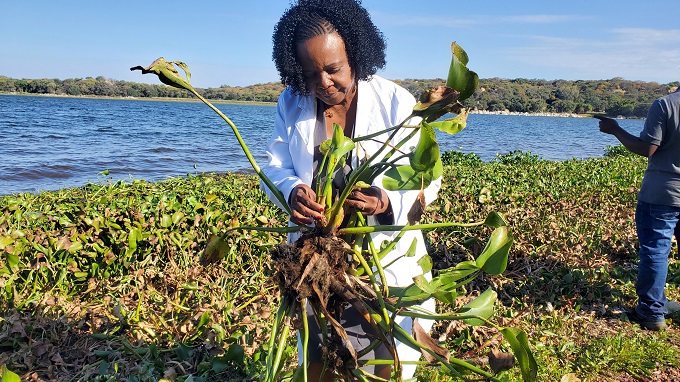
Theseus Shambare
Features Writer
FOR years, the surface of Chinyika Dam in Goromonzi, Mashonaland East province, resembled a vast, unsettling carpet of green.
A thick, impenetrable mat of water hyacinth, dotted with delicate purple flowers, stretched from bank to bank, silently suffocating life beneath.
For Mr George Ngarura of Fish Farmers Associations, whose livelihood and that of others has been inextricably linked to these waters for over three decades, the sight has been heartbreaking.
“Our nets lie idle,” Mr Ngarura sighed, gesturing towards small, weathered dugout canoes stranded by the green mass. “We cannot paddle through this. The fish were disappearing. This weed is a curse sent to drown our lives. We used to cast nets here, feed our families. Now? We saw it grow, helplessly.”
Mr Ngarura’s despair echoes across Zimbabwe, where invasive water weeds like water hyacinth, also known as Eichhornia crassipes, and Kariba weed (Salvinia molesta) have waged a silent but devastating war on the nation’s vital water bodies.
A study by Mitchell and Tur in 1975 revealed that the Kariba weed exhibits an astonishingly rapid growth rate, with its biomass capable of doubling in as little as two to three days under optimal conditions.
Similar research on water hyacinth in Rawapening Lake, Central Java, in 2021 found doubling times ranging from 9,6 to 10,8 days, depending on the site. These remarkable rates of proliferation highlight the immense challenge posed by these invasive species in rapidly overwhelming water bodies and disrupting aquatic ecosystems.
Menace
Invasive weeds severely jeopardised seasoned farmer Mr Fidelis Gweshe’s operations, as his maize, wheat and tobacco crops relied entirely on siphon irrigation dependent on a dam. “These weeds are not just taking over our water source; they are clogging my siphons and making it impossible to get water to my crops,” Mr Gweshe explained.
“If we do not clear them out, my whole enterprise is at risk.”
These alien species, introduced decades ago, have exploded in warmer waters, forming dense, impenetrable mats that block sunlight, deplete oxygen and choke out native aquatic life. From the vital irrigation sources in rural communities to iconic urban reserves like Harare’s Lake Chivero, the impact is profound: disrupted water supply, dying fish stocks, foul odours, increased mosquito breeding and the erosion of recreational spaces.
The pervasive spread of invasive plants, particularly water hyacinth, has significantly hindered recreational activities on Lake Chivero, making boating, fishing and general access to the shoreline increasingly difficult.
In a recent interview with The Sunday Mail, environmental planning and monitoring manager at the Environmental Management Agency (EMA) Mr Maxwell Maturure said: “These invasive species have not only degraded the aesthetic beauty of Lake Chivero but have also directly impacted tourism and local livelihoods by choking off vital recreational spaces and making navigation almost impossible for water-based activities.”
Scientific revolution: Nature vs nature
However, a quiet, scientific revolution is now underway, driven by the Plant Protection Research Institute (PPRI).
The battle is being fought not with harsh chemicals, but with an elegant, natural solution: biological control. Since November 2023, results have already started showing.
“This is about nature fighting nature,” said Mrs Grace Hama, acting head at PPRI. She exhibited her passion as she addressed a group of journalists and other stakeholders during a recent tour of the institute and water bodies.
“For years, we have seen the damage. Chemical controls are expensive, temporary and can harm the environment. Mechanical removal is laborious and often ineffective against such rapid growth,” Mrs Hama emphasised.
“Our solution is sustainable and environmentally friendly.”
Her team focuses on introducing highly specific natural enemies — tiny weevils that have evolved alongside these invasive weeds in their native South American habitats.
For the notorious water hyacinth, the heroes are the Neochetina bruchi, the plant hopper Megamelus scutellaris and weevils like Neochetina eichhorniae. Barely larger than a pinhead, these unassuming insects are voracious eaters. Their larvae tunnel into the plant stems, creating channels that cause the plants to lose buoyancy and sink. Adults feed on the leaves, leaving telltale scars that look like pinpricks.
“They are target-specific,” said Mr Nathan Sangombe, a research officer, holding up a glass jar containing a handful of the tiny weevils.
“This is crucial. They only feed on water hyacinth. They pose no threat to our native plants or crops. We have spent years in rigorous quarantine and testing to ensure their safety and efficacy before mass rearing and releasing them into infested waters.”
Water bodies
The media tour of the water bodies offered firsthand insights into this biological warfare in action. At Chinyika Dam, where Mr Ngarura and others lamented their lost livelihoods, scientists were seen meticulously monitoring quadrats of water hyacinth, assessing the extent of damage by weevils. The successful operation at Chinyika Dam has led to a 100 percent destruction of Kariba weed, offering a beacon of hope for other affected water bodies.
Now, at Lake Chivero, a critical water source for Harare, the first signs of success are quietly emerging. Patches of browning, sinking weed hint at the weevils’ relentless work, signalling a turning point in the battle against invasive aquatic plants. The scale of the challenge at Lake Chivero is immense, but so, too, is the optimism.
Long-term vision
Building on the successes seen at Chinyika Dam, the ongoing efforts at Lake Chivero are a testament to the effectiveness of biological control as a sustainable solution.
Dr Gerald Chikowore, a postdoctoral research fellow at the Centre for Biological Control at Rhodes University, stressed the long-term vision behind these interventions.
“What we are seeing at Chinyika, and now the early signs at Chivero, is not just about clearing weeds. It is about restoring ecological integrity and securing vital water resources for generations to come,” said Dr Chikowore.
“This is not a quick fix with harmful chemicals. It is a strategic, environmentally sound investment in the health of our aquatic ecosystems that empowers communities and ensures sustainable access to clean water.”
Mrs Sarah Tembo, a community health worker from a village bordering Chinyika Dam, spoke of the tangible benefits already being observed.
“Before these efforts, the weeds would block our access points. Fetching water was a struggle, and children often complained of skin rashes from swimming in the stagnant patches,” she said. “Now, where the weevils have been released, you can see clear water returning. The air smells better, and we hope that our dam will breathe again.”
The process is not instant; biological control is a long-term strategy, requiring consistent monitoring and periodic releases.
“It is a marathon, not a sprint,” Dr Chikowore acknowledged, referring to the biological control efforts. But the results are lasting and the cost-benefit analysis is overwhelmingly in favour of this method. We are investing in the long-term health of our aquatic ecosystems.”
This silent war, fought by microscopic armies and guided by dedicated scientists, represents a critical front in Zimbabwe’s broader environmental conservation efforts.
The success of biological control in reclaiming Chinyika Dam, Lake Chivero and other water bodies will not only restore ecological balance but also unlock economic opportunities for communities reliant on these vital resources. As the weevils continue their tireless work, the green blanket of despair is slowly but surely giving way to the shimmering blue of hope, promising a healthier, more prosperous future for all Zimbabweans.



 Online Reporter