Online Reporter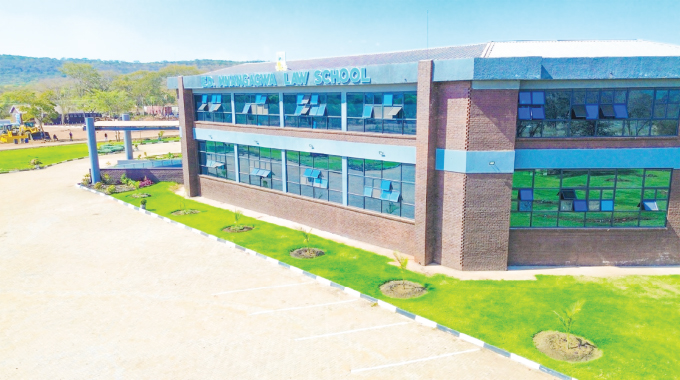
Patrick Chitumba [email protected]
A major transformation is underway across Zimbabwe’s higher and tertiary education sector, with institutions investing heavily in modern infrastructure aimed at supporting the country’s development agenda and growing demand for quality education.
The drive goes beyond expanding enrolment figures. It is centred on creating modern campuses that support research, innovation, industrialisation and skills development in line with Vision 2030 and the Heritage-Based Education 5.0 model.
Under Education 5.0, universities and polytechnics are being repositioned from traditional teaching institutions into centres of production, innovation and problem-solving that contribute directly to national economic growth.
One of the most visible examples of this transformation is the Midlands State University (MSU) Emmerson Dambudzo Mnangagwa Law School in Kwekwe, where significant infrastructure development has taken place over the past year.
The state-of-the-art facility now includes moot court chambers, legal aid clinics and digital research centres designed to enhance practical legal training. The university has also introduced modern programmes such as Space Law and Cyber Law, while Environmental Law has been made a compulsory course in line with National Development Strategy 2 (NDS2) priorities and emerging global trends.
The developments form part of Government’s broader strategy, implemented through the Ministry of Higher and Tertiary Education, Innovation, Science and Technology Development, to improve the relevance and quality of higher education while building a knowledge-based economy.
At the Kwekwe Campus, construction activity continues at pace, with cranes and construction teams working on several projects just a year after the campus was officially commissioned.
MSU Pro Vice-Chancellor for Infrastructure and Campus Development, Dr Gift Manyatera, said the university was harnessing home-grown innovations to support construction and infrastructure development.
“Major transformation has taken place over the last 12 months at the Emmerson Dambudzo Mnangagwa Law School campus in Kwekwe. The shift is clearly visible in the brick-and-mortar developments, including the establishment of new faculties, which are enhancing education and promoting Vision 2030,” he said.
Dr Manyatera said one of the flagship projects under development was a five-kilometre road linking the campus to a point beyond the Amaveni Roundabout.
“The project is a clear example of the Education 5.0 model in practice, where research is converted into tangible solutions for communities,” he said.
The road is being constructed using tar developed through MSU’s own research and innovation initiatives, demonstrating the institution’s commitment to turning academic work into practical solutions.
Dr Manyatera said the university was already moving into the next phase of expansion, which would further increase academic capacity and student support infrastructure.
“Our focus in Phase Two is to further develop the infrastructure, including the establishment of the Faculty of Agriculture. When we first took possession of this site, it was undeveloped land. The transformation so far has been significant, but there is still considerable work ahead as we work towards a world-class campus that meets international standards,” he explained.
He said infrastructure development was being implemented in phases to accommodate growing student numbers and expand the university’s programme offering.
“Phase Two, which is underway, is expected to deliver additional student accommodation and other support facilities to serve the expanding campus community. The hostel project could begin accommodating students within three months, although finishing works would continue until April 2027,” he said.
The student accommodation complex will include a gymnasium and a range of recreational facilities, creating a comprehensive living and learning environment for students.
The Kwekwe Campus currently houses the Faculty of Built Environment, Art and Design, while the planned Faculty of Agriculture is expected to further broaden the institution’s academic footprint.
Permanent Secretary in the Ministry of Higher and Tertiary Education, Innovation, Science and Technology Development, Professor Fanuel Tagwira, said similar infrastructure projects were being rolled out across Zimbabwe’s tertiary institutions.
“Across the country, we are witnessing major investment in infrastructure at our higher and tertiary education institutions. At Manicaland State University, we are constructing student hostels, while at Great Zimbabwe University, new laboratories and innovation facilities are being developed.”
Prof Tagwira said Gwanda State University had also made significant progress in expanding its infrastructure.
He noted that the institution had established a state-of-the-art mining complex while work on an agricultural complex was continuing.
According to Prof Tagwira, the scale of development signals a shift towards institutions that integrate teaching, research, innovation and industrialisation.
“This infrastructure development is taking place across the country at a scale unprecedented since independence, reflecting the rapid transformation of our institutions of higher learning. This is
Heritage-Based Education 5.0 in motion,” he said.
The establishment of the Emmerson Dambudzo Mnangagwa Law School traces its origins to a vision first proposed in 2015 by President Emmerson Mnangagwa and the late national hero Prof Ngwabi Bhebhe, among others.
Its opening represents the fulfilment of a decade-long effort to expand access to legal education in the Midlands Province and strengthen the country’s capacity to train legal professionals.
Government, through Treasury, has so far invested more than ZiG263 million towards the construction of the campus.
The ongoing developments at MSU form part of a wider national programme aimed at modernising Zimbabwe’s higher and tertiary education institutions and positioning them as key drivers of innovation, industrialisation and economic development under the Heritage-Based Education 5.0 framework.