admin
admin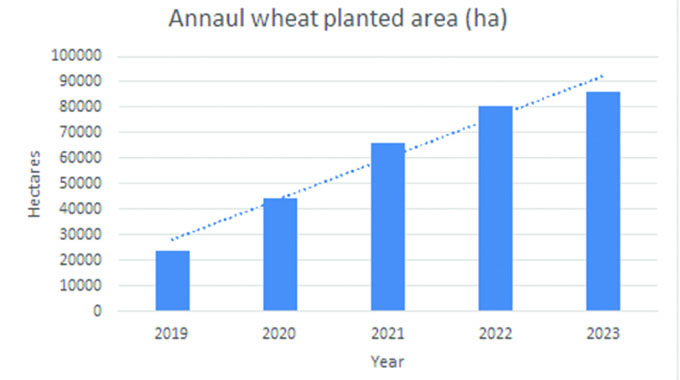
Edgar Vhera
AT the top of its priority list for wheat farming was achieving self-sufficiency, which was successfully done last year. This was followed by the current push to substitute imports with locally produced wheat products. And justifiably, the Second Republic is now on the cusp of getting wheat exports underway to generate foreign currency.
This comes, as the country is targeting an 11 percent increase in wheat production from last year’s 380 000 tonnes from 80 885 hectares to 420 000 tonnes from this year’s 86 000 ha.
To add impetus to its export push, the Government this year availed incentives to encourage production of the cereal and managed to achieve 96 percent of the targeted 90 000ha.
With good agronomic practices (GAP), farmers can score more than 430 000 tonnes of wheat at an average yield of five tonnes per hectare.
The annual national wheat consumption stands around 360 000 tonnes leaving a balance of 50 000 tonnes as excess, which can be exported to regional countries in need.
Annual wheat production in Zimbabwe has been hovering above 50 000 tonnes between 1980 and 2007 and remained around the 50 000 tonnes mark over the period 2008 and 2016. It recorded a 280 percent spike from a low of 100 044 tonnes in 2019 to last year’s 380 000.
Economic importance of wheat
In Zimbabwe wheat is the second most important strategic food security crop after maize. It is mainly used as a human food in the form of bread, paste products, breakfast cereals, cake and many others. Wheat is an active contributor to the country’s gross domestic product (GDP).The immediate wheat products are flour and bran. Flour is the main ingredient for making bread and other confectioneries consumed daily by most people while wheat bran is mainly used in the stockfeed manufacturing sector.
Over the years, demand for wheat has been rising due to increases in population growth, urban populations and changes in consumer tastes and preferences, thereby outstripping supply. This necessitated imports to fill the gap while hard wheat also required to improve the glistening of the local wheat product.
Wheat imports involve the expenditure of foreign currency, hence the call by Government for farmers to increase production as a healthy way of import substitution. The geopolitical developments in Eastern Europe came as a blessing in disguise, as the country became inward looking and achieved self-sufficiency from local production.
What policies have led to increased wheat production?
The Government observed that there would be no wheat revolution without incentivising stakeholders in the wheat value chain.
The wheat value chain can broadly be grouped into five levels comprising input suppliers, producers, traders, processors and end markets consumers.
Presidential Input Scheme
In the 2022 production season, the Presidential Input Scheme initially set to contract 5 500ha of wheat wholly funded by Government to the tune of US$9 293 820 but this was oversubscribed with 10 241 prospective farmers registering to plant the crop. The Government paid attention to the prospective farmers needs and increased the sponsored area to 10 000ha.
The same programme was rolled out again this year with Government targeting 25 000ha.
Setting production target
The Government set a target of 75 000ha for the 2022 winter wheat season as a bold move to achieve wheat self-sufficiency and this eclipsed the previous highest hectarage of 70 585 achieved in 2004. At the end of the season 80 885ha were achieved. This year 86 000ha were planted out of the targeted 90 000ha to mark a success rating of 96 percent.
National Enhanced Agriculture Productivity Scheme (NEAPS)
Commercial wheat production was boosted with farmers accessing funding from CBZ Agro Yield and AFC Land Bank. The Government acquired equipment such as tractors, planters and combine harvesters to be administered through these two institutions.
For the 2022 season CBZ Agro-Yield set a target of 36 550ha, while AFC had 10 000ha.
This current season CBZ Agro-Yield was targeting 20 000ha while AFC Land Bank was looking to contract production on 15 000ha.
Joint venture arrangements
Lands, Agriculture, Fisheries, Water and Rural Development permanent secretary Dr John Basera said the joint venture (JV) policy was also bearing fruit, as engagements between beneficiaries of the land reform and investors contributed to this increased wheat hectarage.
Uninterrupted electricity supply
Government took care of farmers’ load shedding concerns by mandating the Zimbabwe Electricity Supply Authority (ZESA) to ring-fence 120 megawatts of power for wheat production this 2023 winter season.
Electricity supply has since been steadied by increased power generation at Hwange and Kariba stations.
Quelea bird control
Government intensified the control of quelea birds with the department of Migratory Pests and Biosecurity Control further capacitated this year to incorporate the use of drone technology in curbing the threat of quelea birds. The use of aerial technology in the form of calibrating planes will complement the drone technology alongside motorised backpacks on mounted vehicles, traps and nets as part of an elaborated plan to bust the birds.
Pre-planting producer
price setting
The Government has been announcing lucrative pre-planting wheat producer prices to allow farmers to make the right planting decisions. For the 2022 season, Government set a pre-planting wheat floor producer price of $175 741, 86 per tonne for ordinary grade at a 15 percent return on investment while the premium grade was $193 316 per tonne to incentivise farmers to commit more land to winter wheat production.
The price was later reviewed to US$620 per tonne for ordinary grade wheat and US$682 for premium grade with farmers getting US$200 plus $243 680 for the former and US$220 plus 268 048 for the latter come the marketing season. To preserve value, suspension of 20 percent of the compulsory liquidation portion on local nostro transfers for wheat farmers was introduced for both Government and contract-purchased crop. The two percent Intermediate Money Transfer Tax (IMTT) on nostro payments was also suspended for wheat farmers for the 2022 marketing season.
The 2023 winter wheat production season saw the Government announcing a pre-planting producer price of US$520 per tonne.

Wheat trading on the Zimbabwe Mercantile Exchange (ZMX)
platform
Wheat and barley are among the list of 49 commodities that are currently being traded on the ZMX trading platform as a form of price discovery.
Self-financing
Individuals who are taking farming as a serious business are producing wheat for sale to Government, ZMX or other players using their own resources.
Private sector interventions
Government’s call for private players to fund production of 40 percent of their annual raw material needs from local producers through contracting, joint ventures and corporate farming saw farmers under the Food Crop Contractors Association (FCCA) grouping planting wheat on 15 500ha in 2021, 30 000ha in 2022 while currently 25 000ha this winter season.
Success stories for wheat
A beneficiary of the land reform programme Mrs Zivai Memory Samudzimu of Pepsia Farm in Goromonzi in Mashonaland East said in the 2022 winter season she put 40ha under wheat and achieved an average yield of nine tonnes per hectare. With the Government addressing the electricity issue this year through ring-fencing of power supplies for wheat clusters, Pepsia Farm has increased area under winter wheat by 200 percent to 120ha.
“Guaranteed electricity supply by Government has allowed us to triple area under wheat to 120ha this winter season from 40ha last year. I am forecasting the wheat yield to surpass the nine tonnes per hectare I achieved last season,” she said. Zimbabwe National Farmers Union (ZNFU) president Mrs Monica Chinamasa, a beneficiary of the land reform programme on Tsukumai Farm in Headlands said assurances of adequate electricity supplies encouraged her to increase hectarage from 120 last year to 160 this year.
“Last year I planted 120ha but ended up using diesel for power but this year Government has done us a favour by ending power cuts. Our crop is fabulous and high yields are guaranteed,” she said.
A former banker and beneficiary of the land reform programme and current Zimbabwe National Farmers Union (ZNFU) vice president Mr Fidelis Gweshe of Belleview Farm in Goromonzi has been successfully producing wheat since 2021.
“I am mainly a tobacco farmer with 13 years’ experience but over the past two seasons I ventured into wheat farming following the Government’s calls for the country to be inward looking in terms of wheat production.
“In my debut, I was contracted by a miller and grew wheat on 10ha and got unbelievably high yields of 8, 2 tonnes per hectare. I saw that this was another income enhancer and last year I planted 30ha under contract and achieved 8, 1 tonnes per hectare,” said Mr Gweshe.
Mr Gweshe cited Government policy support in terms of producer price, good agronomic practices and contract farming, as the game changer in his farming business.
“My contractor supplies me with all inputs timeously, provides working capital for labour, supplies combine harvesters and technical guidance until the wheat is harvested,” added Mr Gweshe.
Another example of a high performer is A2 farmer, Dr James Chipunza of Mubvakacha Farm in Headlands who started wheat production under the New Dispensation.
“I took hid of the Government’s food security call and started wheat production in 2019 on 16ha scoring average yields of between seven to eight tonnes per hectare. This motivated me to double the hectarage to 32ha in 2020, then 60ha in 2021. I maintained 60ha for 2022 and was considering reducing it this year due to power challenged but Government’s assurance of reliable power supply made me retain the 60ha. My crop is looking good,” Dr Chipunza said.
In a clear testimony of the strength of JV arrangements, Mr Kane York from Mazowe has partnered a beneficiary of the land reform to increase wheat production.
Mr York said he paid attention to Government’s Going4Growth mantra and advise on good agronomic practices as contained under the 4R (right seed, right input, right time and right placement) to plant his crop in the optimum May 1 to 15 period.
“We planted 195ha of wheat and we are targeting yields of seven and a half tonnes per hectare. This year has been the most successful since I started wheat farming. We have had consistent power supplies, which allowed smooth irrigation scheduling,” Mr York said.
An A2 farmer from Farm 9, Chitomborwizi in Mashonaland West province, Mr Penikati Magwada said because of last year’s
unrelenting power cuts, he had been tempted to reduce his hectarage but Government’s assurances of reliable power supplies made him plant 220ha and the crop was looking good.
“Last year, I planted 140ha and got average yields of 4, 9 tonnes per hectare. I have a better crop this and even have a field day scheduled for August 10,” he said.
Mr Mugwada said irregular power cuts last year forced him to do irrigation only at night when he got electricity.
“I now have access to 24-hour electricity supply and can-do irrigation schedules during the day and at night,” said Mr Magwada.
Small-scale farmers from Matabeleland South province’s Arda Antelope Irrigation Scheme who produced very high wheat yields last year also have an exciting story to tell.
Twenty-year-old Brenda Mkwananzi said: “I have been in wheat farming for four years. Last year I got 25 kilogrammes of seed, 12 bags of Compound D and 24 bags of Ammonium Nitrate (AN) for my one-hectare plot under the Presidential Input Scheme (PIS) and harvested 6, 9 tonnes, which I sold to the Grain Marketing Board (GMB).” Another beneficiary, Gogo Senzeni Sibanda said she was given 25 kg of seed, eight bags of basal fertiliser and 12 bags of AN for her one-hectare plot and harvested 6, 5 tonnes of wheat, which she also sold to GMB.



 Online Reporter