admin
admin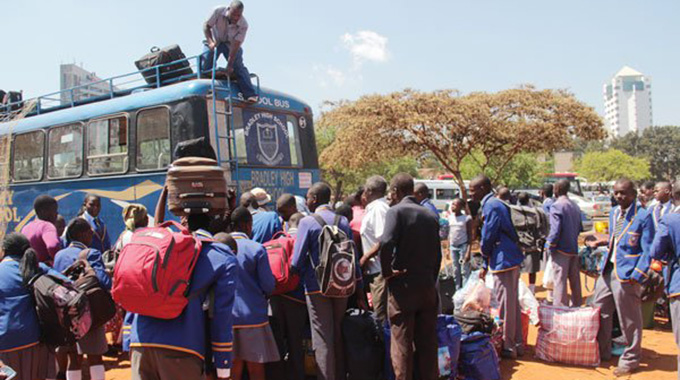
SCHOOLS open next week Monday for the first term of 2023 and it marks the early steps of another annual educational journey for learners in schools and students in colleges and universities.
This week has seen parents and guardians making the final preparations by paying school fees as well as buying uniforms, stationery and tuck. Necessary logistics for smooth opening are also being put in place by the schools.
The opening term is important because it lays a solid foundation for the remainder of the schooling year.
As it is a period of transition from one grade or level to another in education, it is imperative that we kick-off on a sound footing.
Our trust, therefore, is that parents have adequately prepared, with provision and everything else required in place and schools are ready to roll.
Parents and guardians have to be prepared to invest in the education of their children by personally providing for their requirements as well as playing ball when their input is needed at school.
Smooth learning is expected to continue without any disruptions from the Covid-19 safety lockdown measures as well as in those areas in Manicaland like Chimanimani and Chipinge that were hit Cyclone Idai.
We remind the learners, schools and parents that the work to attain high grades at the end of the year begins now.
That success requires collective and concerted efforts from all parties involved.
While teachers will play their role of imparting knowledge to learners in school, parents and guardians at home also have to be actively involved in this process of educating learners by assisting them at home and monitoring their progress.
For those students in colleges and universities, taking the next step of their academic journey, this presents them with an opportunity to undertake the process that promotes specialist skills for industry, commerce and public sector as this leads to increased innovation for industrialisation.
That specialised workforce produced can lead to utilisation of advanced knowledge and technologies, thereby immensely contributing to the country’s economic growth and social transformation.
Zimbabwe is famed for world renowned high standards in its education system that produces competent graduates and we have to maintain and even improve that bar.
Government has been consistent in this regard as the gradual implementation of the State-funded education policy is expected to start when schools open for the first term next week.
Mostly disadvantaged rural schools are expected to be the first beneficiaries of the programme.
Already Government is setting pace towards this initiative by supporting two million disadvantaged learners whose fees are paid for under the Basic Education Assistance Module (BEAM) from the estimated 6,7 million learner population.
Part of the free basic education policy has seen Government subsidising the payment of Zimbabwe School Examinations (ZIMSEC) registration fees up to 55 percent for every learner, while fully paying the fees for those learners under BEAM.
Government, through its deep committed to the sector, is moving to improve access to quality, equitable, inclusive and affordable education.
This has resulted in heavy investment in human capital development and innovation as it is one of the key pillars of National Development Strategy (NDS1)in pursuit of Vision 2030 towards an empowered and prosperous upper middle income society.
The reconfiguration of education from Education 3.0 to Education 5.0 in schools, colleges, universities and training institutions is ample testimony to that.
To lend wind to sails of these initiatives and achieve that end, Government is also heightening its efforts in building new schools and refurbishing existing ones to modern standards.
Government has also embarked on a programme to open computer labs at all schools and connect them to the Internet as well as power them through either solar or electricity.
This will ensure that no learner and no school is left behind which, again, dovetails with the digital economy component of NDS1.


 Online Reporter