admin
admin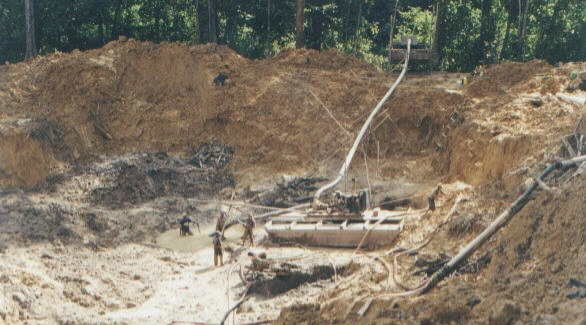
THE ban on alluvial and river bed mining by Cabinet this week followed careful evaluation of the results of the limited permission granted on some river systems from 2011, with more precise regulation in 2018 and 2020, and finding the negative environmental damage far outweighed the positive recovery of minerals.
So the decision was not an arbitrary one made on the spur of the moment, but rather the whole experimental mining operation was conditionally approved and then found to be too damaging to catchments. So we return to the old ban on such mining, but at least after having given the miners a chance.
Miners and farmers have been squabbling for many decades, but the basic legal situation is that miners need very small areas of land to produce very high value, and so long as they do not damage the rest of the land, the overwhelming majority of the land, then farming and mining can co-exist. In this case we seem to have reached a point where miners were damaging a lot of resources far beyond their operations, and that is generally forbidden in mining law.
Lands, Agriculture, Fisheries, Water and Rural Development Minister Dr Anxious Masuka said there had been three groups of alluvial miners: the legal ones who followed the environmental rules that had been set when such mining was allowed, the legal companies who had been given permission but did not follow the rules, and the generality of illegal miners who just turned up and started digging and in many cases panning.
The blanket ban implies that even the legal miners following the original rules were causing too much damage to justify this risky operation, and those not following rules or just digging without permission were obviously making things far worse.
Alluvial and riverbed mining has been done in Zimbabwe for centuries. The curiosity of our geology with thin gold incursions in ordinary rock has meant that as that rock is eroded the gold grains are taken with the sandy fragments and end up in rivers and along their banks. The percentage of gold in these banks is very low, but it can be extracted by shovelling up the sand and panning to find the gold.
The very large amounts of surrounding sand then have to be dumped, and at least at the lowest end of these mining operations they require flowing water to wash away the sand. Panning has always been seen as a seriously polluting activity, and although there was an explosion in illegal panning at the end of the last century, it has never been seen as environmentally safe.
The decision in 2011 to allow controlled panning and then six years ago to grant legal permission under careful control to mining companies was to see if the various ways experts had come up with to minimise the damage did actually work, or at least worked well enough so the mining could continue. Unfortunately, this was not so.
The Environmental Management Agency has reported at least 400 hectares of riverine environment has been ruined. The alluvial mining, even when controlled, produces unacceptable levels of siltation, water pollution, degradation of river channels and destruction of ecosystems.
We do need to use our rivers, to supply water. Many with reasonable flows are being dammed to create storage for irrigation, and sending down a massive flood of silt is not going to keep those dams clear for storage. Even on stretches of river where there are no dams, there are still many other users who need reasonably clear water.
And in any case, as we have been finding, we need to keep our riverine ecological systems functioning, and this includes protecting wetlands. Destroying these systems can dry up the rivers and streams, or else convert them into just open ditches that carry floodwaters, but are not a functioning river or stream.
This does not help us in the two main areas where we need good water supplies, for irrigated farming so we can grow our food, and that includes watering livestock, and in reasonable supplies for our cities, towns and business centres. There is quite a body of law now in place to protect water supplies from contamination, and those include proper sewage processing by urban areas.
So as it now seems impossible to have safe mining with pollution levels below the level where they cause damage, we have to ban such mining, just as we ban the discharge of mining waste into rivers, or industrial waste or urban waste. In fact, a great deal of our water management in coming decades will be on working out ways of processing such waste so that pure water can be returned to rivers and lakes without the pollution or other damage. That way we can use our rather limited water resources to the maximum.
Dr Masuka brought up another point in his remarks after the Cabinet meeting. All Government ministries, departments and agencies responsible for enforcing the new complete ban will require adequate resources to do so.
While we can probably assume the fully legal miners will withdraw, and look for other ways to continue mining, perhaps by prospecting for older sandbanks left after rivers change course over the millennia, the semi-legals and the illegals are going to continue hammering the rivers and their banks. And these are the ones who almost certainly caused the worst pollution; if legal mining produced unacceptable levels then we can imagine what was coming out of illegal operations.
The Minister also thought that penalties needed to be upgraded, his suggestion being some equality with stocktheft penalties where lengthy jail terms are mandatory. Parliament will need to think about this, but the basic premise that enforcing the ban will require resources seems unarguable. The loss will be some mineral output, not a lot but some. The gain will be far cleaner water, dams that are not silting up and river systems that actually work.



 Online Reporter