admin
admin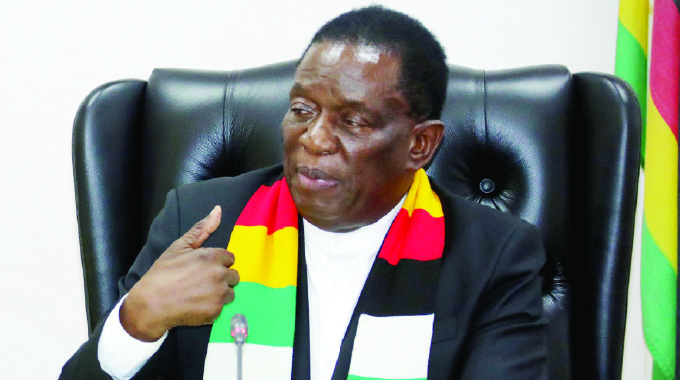
ECONOMIC growth needs to remain central to the Sadc agenda as this is how the region can lift its entire population out of poverty and create the resources that make a lot of the other problems recede into insignificance.
President Mnangagwa in his comments at the start and end of the 44th Summit in Harare where he took over the Sadc chair stressed, as he has stressed in his national role, the need to push as hard as possible in the economic sphere, as building a better life for everyone is, when you come down to it, a fundamental objective for any modern government.
All 16 Sadc members have their strong national plans for growth. They all recognise that building up their industry and trade so that they process raw materials before these are exported is important.
Member countries need to use the raw materials from their own countries and from the neighbours to manufacture a very wide range of products. Businesspeople also need to move out into the region and the world to sell these products.
The 44th Summit in its final communiqué over the weekend in Harare noted that the coming into force late last month of the agreement establishing the Tripartite Free Trade Area combining the Common Market for East and Central Africa, the East Africa Community and Sadc opened a major market of around 20 countries.
This is, in many respects, an interim measure, while the African Continental Free Trade Area is built up and extended and its detailed rules and regulations worked out. But it is an important milestone incorporating so much of the detailed bureaucratic detail that all free trade agreements require, along with a process to resolve disputes.
It now needs to be used to jump start the process, in our region, that will culminate with AfCFTA.
As trade frees up, a lot of the national economies will tend to merge for many purposes into a regional and continental economy, one less geared towards national autarkies as countries try and become industrially self-sufficient and become instead a far larger regional economy. Free trade accelerates economic growth far faster than attempts to build national autarkies, and accelerates that growth in all the national economies that are opened to free trade.
This is not necessarily intuitive to many, and the less efficient are always keen to seek protection from their Governments. But as trade frees, the pressures to become efficient grow, just as the potential markets grow. It is the growth of markets, the growth of efficiency and the increase in spending power in that market as competition works that create the extra economic growth.
While the economic and development agenda is central, there are a lot of other areas where Sadc is a critical regional organisation, coordinating and unifying responses as well as seeking solutions for national problems within the region.
The security problems of the eastern DRC and northeast Mozambique head most lists, but there have been advances.
The special SADC Mission to Mozambique, which saw emergency support for a neighbour in trouble, has been so successful that it has ended. The security threat is still there, but reduced sharply and Mozambican resources built up to cope with any resurgence.
The peace process in the eastern DRC continues with African Union and United Nations support, but the negotiations through the Luanda process are chipping away at the gaps that need to need to be bridged.
Sadc, as the regional community, has the greatest outside stake in a successful process since a DRC fully at peace means a stronger region.
For the same reason, SADC maintains its pressure for the full removal of US and other Western sanctions on Zimbabwe, continuing to make it clear that anything that damages or tries to damage a member state damages the whole region. Zimbabwe is not an isolated nation, but one embedded in a strong regional economy and what harms each member harms all. That, after all, is why Sadc is concerned with DRC and Mozambique.
The constitutional developments of the two monarchies in Sadc, Lesotho and Eswatini, were also looked at, with the process in Lesotho now basically complete with Sadc assistance.
Progress in Eswatini has seen a united approach to Sadc to move that country from its special point of concern, which Sadc welcomed.
Global climate change is of serious concern to a region where so many are dependent on farming, and which really needs to grow most of its own food. The El Nino in the central Pacific brought drought to a range of countries, but also floods as you move north, and this required a regional response in seeking support, and the La Nina now expected will have largely the opposite effects, more easily managed but still requiring the region to be on alert.
Health, especially pandemics and epidemics, concern the members of Sadc as infections are not stopped by international borders.
The major cholera outbreak across a swathe of the region has been contained and some countries, including Zimbabwe, are now free for the moment of the disease, although everyone needs to be on alert.
Mpox, now declared of concern by the World Health Organisation, also needs a regional response and the Heads of State and Government are seeking support from WHO and Africa CDC as their health ministers are called into a special meeting to coordinate the regional response and work out what resources they need to make sure we can all cope. This is the sort of useful work that regional organisations can do when they are active, and a lot of that sort of work can be done as a matter of course.
President Mnangagwa promised at the end of the Summit to be an active chairman for his year in the post.
And the chair of Sadc is no sinecure if the job is to be done properly, since as ever more needs to be done as an integrating region.
More needs to be done by both the Sadc Secretariat and by the chair of the grouping to make sure we all move ahead together and cope with the regional difficulties successfully, by dealing with them together.


 Online Reporter