admin
admin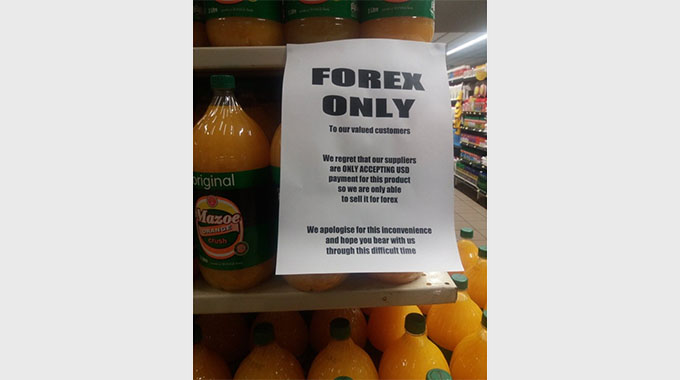
SEVERAL retailers have put up signs saying some products that we all thought were Zimbabwean products can only be paid for in foreign currency, or even more particularly, only in US dollars along with notices blaming their suppliers.
The Confederation of Zimbabwean Industries, which knows fully well this is a criminal offence, wants “proof” before it will comment on why some of its members are deliberately breaking the law, a fine piece of buck passing.
At least the Confederation of Zimbabwe Retailers agrees that this refusal to accept local currency is illegal and says it results from the desire by these manufacturers to charge them only in foreign currency and the complexities of the interbank exchange rate.
The Government does not fuss who is to blame. The law is the law and this attempt to redollarise parts of the economy is against that law. Minister of Finance and Economic Development Professor Mthuli Ncube was quite precise after the Cabinet meeting on Tuesday and made it clear that those who indulge in this will first have to pay the duty they were exempted from on particular imports and secondly they might lose their licences.
Already one manufacturer is reportedly facing duty bills for abusing the reductions in duty and there is a lot more that can happen.
Retailers say that a lot of suppliers either want foreign currency for their products or, since they legally have to accept local currency, are setting local currency prices using what they estimate the black market rate could be in a couple of months.
That sounds as though they are dual pricing in foreign and local currency outside the interbank rate plus 10 percent, and there are now regulations in place that ban this practice, backed by civil penalties that amount to a minimum of $20 million. These regulations need to be applied.
If a supplier pushes up their prices to some ridiculous figure in local currency, but offers a huge discount, based on a forward expectation of the black market rate, if you pay in US dollars, then they need to find out that a civil penalty can be applied in 48 hours.
This might require retailers and consumers to send in the information to the authorities. Of course the supplier could just push their prices through the stratosphere, and some are doing that, especially if they have an effective monopoly or can discreetly meet their competitors for a drink in a shady corner of their exclusive golf club and fix the prices.
The Confederation of Zimbabwe Retailers have now brought up the perennial problem in our small economy of lack of competition at the manufacturing level for a range of products.
We have a number of effective monopolies or duopolies and in some cases obvious cartels of a tiny number of suppliers. We, and others, have noted the way the three major bakers are refusing to compete on price, despite their different general costs, different recipes and different transport costs.
But there is a fair amount of genuine competition in many products and the Consumer Council of Zimbabwe has given consumers some excellent advice: shop on price rather than stay loyal to a brand.
Those who look at how products move in supermarkets will have noticed that this is happening more and more and that pricing in recent weeks can reflect the effects this is having on some manufacturers who thought their brand loyalty would allow them to behave in the most arrogant manner. We see prices actually falling in some cases.
We have reached the curious position that some pure imported products are selling for a lower price in Zimbabwe dollars than the Zimbabwean equivalent, suggesting that some Zimbabwean manufacturers are just plucking a factory price out of the air. This is the danger that manufacturers who think they are being clever by insisting on foreign currency, or who try to use forward estimated black market pricing, will come a cropper.
They forget what happened when Zimbabwe did dollarise in 2009. Cheaper imported goods flooded in and filled the shelves while local industry, using a currency that grew ever stronger relative to that used by their competitors outside the country, were continually losing market share.
The Herald archives are full of stories from that era of industrialists pleading for some sort of intervention to stop these imports of goods priced in what they saw as an undervalued currency, as if they had a right to overcharge their Zimbabwean customers.
The filling of shop shelves with Zimbabwean products only really took off when the local currency came back, and Zimbabwean cost advantages could finally surface. This is what makes the CZI’s silence on what some of their members are doing inexplicable.
They know the damage this sort of thing does and need to be in the lead to prevent it, rather than asking for the sort of proof that even a High Court judge might find excessive.
Meanwhile, consumers need to use their vast power to tame the industrialists and shopkeepers who are treating them as if they were third-class citizens by demanding foreign currency.
In a wide range of cases there is an alternative, and the competitor who treats the customer properly needs to be supported.
Even among retailers facing these sort of suppliers there are some who refuse to commit criminal offences, and refuse to treat their customers as if they were some sort of low life, and those retailers need to be supported.
Shopping around will produce some interesting differences in prices for both the same goods and for goods that are exceptionally similar. The mess can be contained. The Government is taking action, but needs to implement with publicity some of those civil penalties that prevent pricing using black-market rates.
Consumers need to use their muscle to reward the sensible and the honest and hammer the arrogant and the dishonest.
The measures now being undertaken to ensure the honest get their currency at auction for vital imports will help tame the arrogant, while those measures to deny speculators easy cash to play the black market should tame that iniquity. But we all need to be moving in the same direction to the same goal.



 Online Reporter