dyton mupawaenda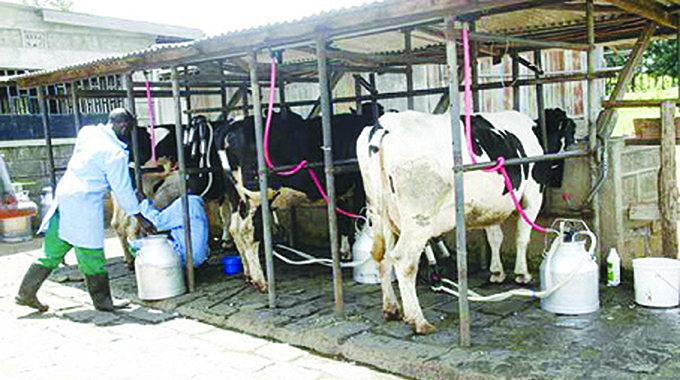
Last year Zimbabwean dairy farmers produced just under 100 million litres of raw milk, around 83 percent of present national consumption, following a nine percent rise over the 2022 output of 91,4 million litres.
Similar growth should see the country achieve basic self-sufficiency by the end of next year, so 2026 should be the first year without dairy imports and the thrust of the industry switching from catch-up to marketing, to make more products available at reasonable prices to more people, so the industry can continue to grow and more people can enjoy a wider diet.
Expanding milk-production is not an instant or simple task. You can get a big jump in say grain crops in a single season by allocating more land and more inputs and less than six months after you have started clearing a new field you are harvesting the grain.
Expanding any cattle herd takes longer, simply because you are dealing with an animal that has a gestation period of nine months. For dairy farmers the biology presents extra delays, with female cattle only just under half of all new-born calves and the need to get a dairy cow pregnant fairly frequently to maintain milk production.
The steady progress in increasing the dairy herd, the number of farmers involved in dairy production, and the quality of the cattle in the dairy herd has been a major programme of the Second Republic, year after year.
Efforts have been made to bring in more smaller-scale and medium-scale farmers into the industry by making specialised breeding stock available, and by encouraging dairy processors to make the necessary daily collections of milk from each farm. It is a highly perishable product, especially in a warm climate.
At the same time, the Ministry of Lands, Agriculture, Fisheries, Water and Rural Development has been encouraging the growing of suitable crops for silage, hay and other livestock feed.
Dairy cattle need a lot of high-nutrition feed, not just to maintain the animals as is the case with beef cattle, but to also produce the milk.
Stock feeds can contribute 70 percent of the costs of dairy production, a huge figure, hence the need for farmers to produce more of their own stock feeds and to encourage their neighbour crop farmers to include the required crops in their own farm production.
Dairy farmers still have to buy silage, hay and lucerne from their neighbours, but the costs will be lower than from commercial processors, if only because the processing and transport costs are lower.
The Ministry of Finance, Economic Development and Investment Promotion has also been contributing to the economics of increasing dairy production, not just through its normal input support that all farmers get, but also through adjustments to the tax regime. To ensure that the basic minimum demand for dairy products was met in Zimbabwe there were duty concessions for milk powder and cheese, allowing imported products to be sold at lower prices than would normally be the case.
The Government has been steadily reducing the quantity of such imported products that can be imported duty-free, to open more space for the Zimbabwean dairy farmers.
We now need to advance the programmes. One factor is to get more smaller-scale farmers involved in dairy.
The basic outline of a working policy is already known, and has to rest on having groups of farmers who live near each other so that the collection of milk, and keeping the collected milk cool and disease free, is simplified.
There are countries in Europe where dairy farming is built around small farms, but who combine in co-operatives or other groups so that each farmer is part of a larger system.
We can probably also start looking at more on-farm processing and production.
In theory cheeses can and should be made on farms, and in some parts of the world this highly-local production produces premium products and varieties.
At one time there was intense competition at events like the Harare Agricultural Show for the best cheeses, and the champion cheeses, with their small judging sample taken out, were bought by grocers and hotels and advertised as top show cheeses.
This variety largely fell away when the then Diary Marketing Board established a monopoly on commercial milk production, and the commercial processing of that milk. But we can restore the local industries.
This would help to add value to farm output, which would be useful for the farmers, and add a great deal more practical variety to the range of products that are on sale, where half a dozen cheeses is considered a full package and competing companies use brand and price to gain market share, although everyone agrees that until we move into surplus there is not much point in expanding the market.
There is a growing demand for dairy products, and potentially an even faster growth can be expected once the country moves beyond meeting the basic minimum demand and marketing steps forward as a critical part of the industry.
Cheeses, yoghurts, lacto products and milk are not aggressively marketed at the moment as producers often struggle to meet the existing demand from local production supplemented by a falling quantity of imports.
This means that farmers, processors and the Government should not be worried as they move up to the target of 100 percent of present local demand over the next couple of years.
The local demand is bound to rise, especially as spending power continues to increase as other economic reforms take effect.
We could even open doors for exports, again like our own imports for the products with longer shelf life, such as powdered milk, cheese and the like.
Some of the African market for these products is met by exporters outside the continent, so being inside the African Continental Free Trade Area with a 100 percent local product produced by 100 percent Zimbabwean farmers from 100 percent Zimbabwean cows and processed in Zimbabwean factories will have an advantage.
Again we are now in the realms of marketing, rather than just selling almost anything that is available and expecting our customers to buy it.
But having managed to grow our own industry and having built up the expertise among our farmers, along with figuring out ways of controlling feed costs, we should be well-placed to produce the products offering value for money for both the domestic and export markets.


 Online Reporter