Online Reporter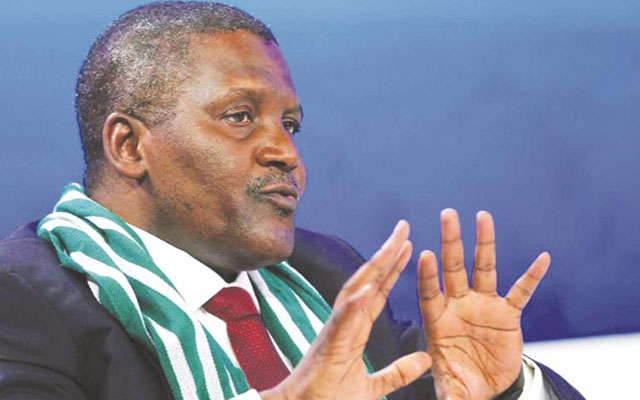
TODAY we welcome Africa’s top single investor and its richest person, Aliko Dangote, who now agrees Zimbabwe is serious about hosting investors and has a rapidly growing economy that needs investment into productive industries and energy.
Mr Dangote started off in business as a commodities trader in his native Nigeria, but while flourishing and successful in this area, only started climbing the ranks of global billionaires as he moved into production.
His business empire is now centred on production, mainly of seriously needed products, and stretches across Africa as he takes up opportunities.
Cement now forms the centre of his Dangote Group, Africa’s largest single cement manufacturer with production expanded to four West African countries including its Nigerian home, and to Southern Africa with factories in South Africa and Zambia.
He is now interested in closing the regional gap with a huge industrial, mining and energy complex in Zimbabwe requiring an investment generally estimated to lie between US$800 million and US$1 billion depending on just how large each piece will be.
The proposal starts with a cement factory.
Zimbabwe moved from self-sufficiency in cement to needing to pad out supplies with imports as a result of the rapid economic growth, driven by infrastructure investment by Government and business and housing requirements of a generally more prosperous population taking advantage of the stability and economic growth with widespread distribution that has become a hallmark of the Second Republic.
Mr Dangote sees the cement factory at the centre of the proposed investment complex as profitable but wants to be assured of raw materials and energy. So the investment proposal now being explored includes the limestone mine for the primary raw material, plus a coal mine for the rest along with energy, plus a thermal power station that will also tap the coal and provide the required electricity, with surpluses sold to the national grid, always on the lookout for extra input.
Such an industrial complex would be largely self-sufficient and be able to cope with economic cycles and the like with minimal problems. It also highlights Mr Dangote’s experience of investing in major production in his native Africa, where control of inputs is exceptionally useful if not essential.
An important part of Mr Dangote’s business expansion has been his willingness to see this in Africa, rather than diversifying around the world, and he and his production companies are keen supporters of the African Continental Free Trade Area, seeing this as critical both for their own businesses and for the continent generally.
His Zimbabwean investment proposals obviously fit into a general AfCFTA arena, and it makes sense to look at investment in an African country where the raw materials and a reasonable market for the final products both exist, providing a base for trade within Africa.
Mr Dangote did between 2015 and 2018 look hard at Zimbabwe as a possible investment. He had been discouraged in the earlier stages by corrupt officials wanting a payoff of some kind and found the investment climate even at the start of the Second Republic to be overregulated and overlicenced, with too many requirements over and above the basic environmental, safety and labour issues. It is probable he also wanted to see just how much the Second Republic was going to deliver on its promises to create a business friendly society.
The changes over the next seven years appear to have largely answered his questions most positively, considering the solid work already done to bring an investment proposal to the table. Corruption was an early target of the Second Republic and many investors have already noted that they are free of the rent-seeking activities that were so damaging in the past. Zimbabwe now trumpets honest investment openings for honest investors.
The gross over-regulation once seen has been slashed back, with more simplifications in the pipeline. While no one doubts some regulation is needed to protect the environment and the safety of employees and surrounding communities, the effective parts can be largely combined with the dross dumped.
Mr Dangote has now reached the stage where a personal visit is the next logical step, seeing for himself just what is there on the ground and meeting with Government and other officials, starting with the President himself, who has proved exceptionally willing to meet any major potential investor wanting both personal assurances as well as a warm welcome.
We have seen other major investors coming to Zimbabwe, but what is particularly welcoming of a visit by Mr Dangote is that he is African and Africa’s top investor. While all investors are welcome, one whose businesses anchor a significant chunk of the continent’s modern productive capacity is especially welcome.
We hope that all goes well in the talks and investigations we will see on this visit and that Zimbabwe will form one of the jewels in the investment conglomerate that has been built up by Mr Dangote that is so important a part of Africa’s industrialisation.