

 dyton mupawaenda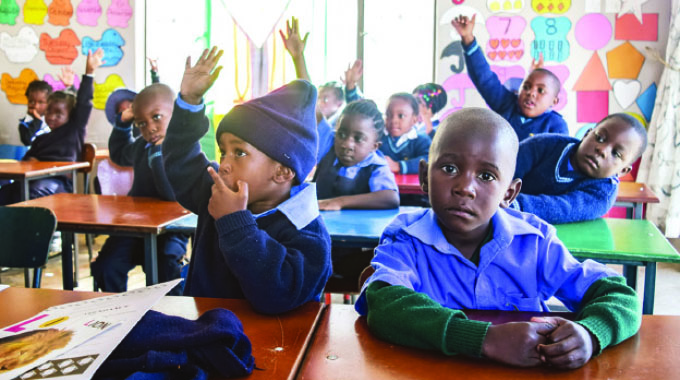
Extending primary education to nine years with a compulsory two years of early learning at the beginning before the more formal teaching in grade one of now well-prepared youngsters is a major advance, although there could be some logistical problems involving the distances some four-year-olds might have to walk.
The policy is not that new and brings to every child what the children of better-off urban families have been enjoying for decades, although with improvements and upgrades even for those more fortunate children.
Educational experts, and the best and most committed infant teachers, have known for many decades that a child who has been through a year or two of high-quality “nursery school”, as it used to be called, was ready and able for what in many ways is the most remarkable year of their lives, the year they learn to read and write.
This is why over the decades this pre-school education in the private sector moved from concentrating on child care, often given by caring and understanding women who had little training and no qualifications, to setting professional standards with formal training.
By the late 1990s, many of the higher-fee private primary schools had introduced a preschool year, a grade O, where the young children were also brought into the formal school system, and generally, these children had already had a previous year in a less formal environment but still under a qualified pre-school teacher.
The results were sufficiently impressive that they backed the experience of infant teachers and education theory. For a start that crucial process of learning to read and write went far more smoothly and as a result quite average children ascended the primary grades far better prepared and did rather well in their grade 7 exams at the end of primary school. That in turn meant that secondary education was far better absorbed and so again quite average children managed rather good O levels.
The exceptional child will almost always do well in almost any school environment, which is why we had that sprinkling of university graduates in colonial times who had started their education journey in barely adequate mission schools or even the poor excuse of a farm school. But most children are not exceptional by definition and need something a lot better to develop their full potential.
Some years ago the Ministry of Primary and Secondary Education, after winning a bit of extra budget for the extra teachers, was encouraging schools in the public sector to create this initial year of early curriculum development before grade 1. Not all were able to do so, at least immediately, since for a start an extra classroom was needed, but the development caught on rapidly and growing numbers of primary-sector primary schools.
Again the results more than justified the need for extra resources. Children, who now included many from families that were not able to afford the better quality private pre-schools, who had been through the growing formality of ECD years did in general perform so much better in the rest of the infant years and then in the upper grades. What had been the norm for the children of better off families for decades became the new norm for most children.
Now with the new Zimbabwe Early Learning Policy, abbreviated as ZELP by the educational experts, the whole formal infant curriculum has been doubled from two years to four years into a seamless whole, to make sure that all children are exceptionally well prepared to learn the basic literacy and numeracy they need to make a success of the rest of their educational journey and are not “left behind” in that journey.
Statistics from other countries, including some highly developed countries, at least economically, have shown that there is a surprisingly large group of children in a universal education system where no one cares who are for all practical purposes not functionally literate even in secondary school.
Zimbabwe quite rightly wants to avoid that. We cannot afford to waste resources, and more importantly waste talent and ignore the average person, just to create a pool of adults who will become unskilled labourers. We need, each person needs, the country for its own economic development needs, adults who can continue learning new skills, and who can earn a decent living. When we combine all those decent livings we suddenly find ourselves an upper middle-income country, and then an advanced country.
The Ministry has noted that the new curriculum will need a far higher degree of parental involvement, again based on practical experience as well as theory. But fortunately Zimbabwe has had exceptional levels of adult literacy for several decades and the huge post-independence expansion of education means that almost all parents, and often grandparents, can now be involved in a practical way.
There is in a few urban areas and in more rural areas the problem of getting four-year-olds to primary schools for these new early years. There is a limit to how far they can walk. In older urban high-density suburbs schools are sufficiently close that even a four-year-old can walk to school. In some lower density suburbs, and in many of the newer less-planned suburbs, this is difficult for some. In many rural areas schools are too far apart for the youngest children half-way between two to manage.
Communities have been active in building new primary schools, and most rural district councils, although too few urban councils to their shame, have given a high priority to new primary schools using their devolution funds. So gaps are being filled, although the urban councils need to be more active in this filling.
But the Ministry and the councils probably need to implement a policy of satellite infant schools in some areas, especially those rural areas where families are more scattered, to make sure that children aged four to seven are close to such a school. We do not see a serious problem for a primary school to have two or three extra infant blocks scattered through their zone. Some may grow to full primary schools in time, others might always remain a satellite infant school to a normal sized primary school, but so what.
This is the logistical problem the Ministry has already identified as it pushes ahead in upgrading primary education but Zimbabwe and Zimbabweans are increasingly finding innovative solutions to what might have seemed intractable problems in the past, and we just need to use our creativity to find the best solution for each community and each person.
The point is that the Ministry is adopting the best solutions on education backed by both experts and by practical experience, the ZELP, and the modest practical implications can be fixed, we are sure. ZELP is a very good policy, it will fill essential needs, so now we just need to make sure it works.



 Online Reporter