dyton mupawaenda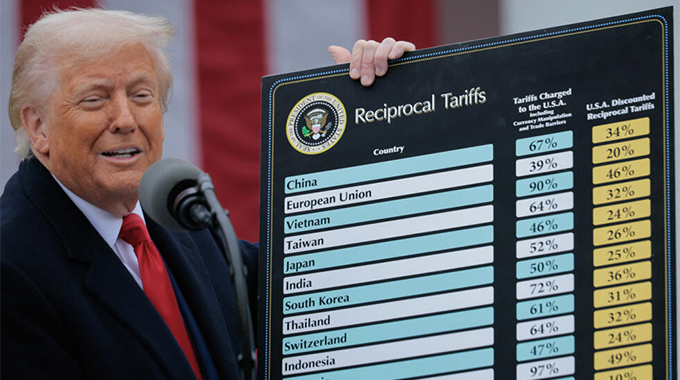
THE world might have budgeted for a disruptive, if not erratic, President Trump when he historically won the elections in November. However, a few would have guessed or imagined how deeply disruptive he would be to the world.
After blindsiding the world by abruptly dismantling USAID, itself also a haven for CIA operatives that were destabilising targeted governments around the world, he is now at it again.
Yesterday, his baseline tariff of 10 percent became effective.
On Wednesday, another round of what he calls “reciprocal tariffs” — specifically targeted at countries with which the United States has a trade deficit — will kick in.
Zimbabwe is also affected, as it will be slapped with an 18 percent tariff.
While we are going to take a hit, it is not likely to be huge as trade volumes between Harare and Washington are relatively low, largely because of sanctions against Zimbabwe.
According to statistics from the Office of the United States Trade Representative, trade volumes between the two countries stood at US$111,6 million in 2024.
US exports to Zimbabwe were US$43,8 million, while imports were US$67,8 million.
It means the US trade deficit with Zimbabwe was US$24,1 million in the period.
Clearly, the volume of trade is considerably dwarfed by the nearly US$2 billion trade between Zimbabwe and the United Arab Emirates (UAE), which, under the Second Republic, has become one of the country’s biggest trading partners.
So, Zimbabwe has more to celebrate than mourn after the latest developments.
Through the past seven years, President Mnangagwa has deftly reconfigured Harare’s foreign policy by pivoting on economic diplomacy through the engagement and re-engagement drive.
Undergirded by the philosophy of making the country “a friend to all and enemy to none”, this foreign policy thrust has seen Harare deepening relations with existing cooperating partners and seeking rapprochement with countries that consider themselves to be our adversaries.
But it is the deliberate strategy to translate political relations into mutually beneficial economic ties that has been richly rewarding.
In Abu Dhabi, Zimbabwe has also found a highly lucrative market.
The turning point was in 2019 when the UAE opened its embassy in Harare, while we opened ours in that country in 2021.
Trade between the two countries has resultantly grown from US$96 million in 2014 to US$1,9 billion in 2023.
Further, under President Mnangagwa’s stewardship, we have managed to extract economic benefits from our longstanding political relations.
Last year, for example, bilateral trade between Harare and Beijing rose by 23,9 percent year-on-year to US$3,8 billion.
This has seen a massive boost in export earnings, which rose to a record US$7,43 billion last year, up from US$7,2 billion a year earlier.
What made this performance remarkable is the fact that it happened at a time when global commodity prices were low and against the backdrop of the El Niño-induced drought.
With further opportunities to export more to these old and new markets, Zimbabwe’s exports can only grow higher.
But another happy development has been the rise of gold prices to record highs, driven by fretful investors seeking to hedge against volatile markets reeling from the new tariffs.
And this is happening at a time when the country’s gold export earnings increased by 8,6 percent in the first two months of 2025 to US$240,1 million, representing a marked increase from the US$221 million realised during the same period last year.
As gold remains the country’s single largest export commodity, the current developments can only mean glad tidings for Zimbabwe.
Again, it has to be remembered that the rich pickings in the gold mining sector can be traced to the President’s effective policies to reopen closed mines, such as Eureka in Mashonaland Central, and create a conducive environment for the industry, particularly for small-scale and artisanal miners, who contribute the bulk of the deliveries.
So, clearly, Zimbabwe is now increasingly finding itself reaping rich rewards from President Mnangagwa’s wise leadership at a time when the world has become both turbulent and unpredictable. His decision to suspend tariffs on US goods is yet another masterstroke.
It is precisely this leadership that will likely cushion Zimbabwe during these uncertain times for the world.
Suffice to say, Zimbabwe is in the right direction.



 Online Reporter