Online Reporter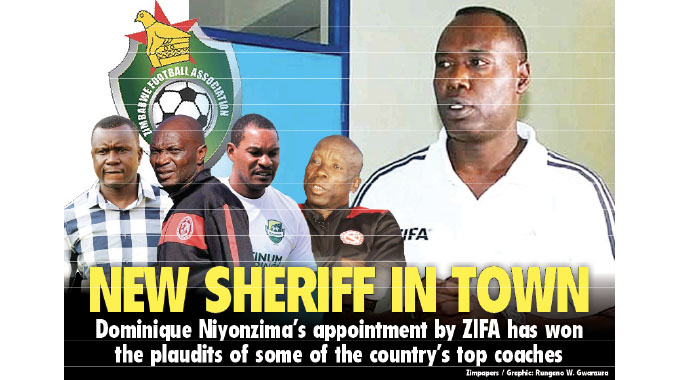
A REFRESHING development took place in the potential growth of the national game with the Zimbabwe Football Association (ZIFA) announcing the arrival of a new and expatriate head of technical – Dominique Niyonzima.
That the Burundian expert has worked as a FIFA consultant and was also for years the Confederation of African Football (CAF) deputy director of development, stands him in good stead to transform the Zimbabwean game which for years has suffered from stunted growth.
As reported earlier in this publication, Niyonzima’s appointment has already been embraced by the bulk of top coaches, who in 2014 made his first working visit to the country when conducting Zimbabwe’s maiden CAF A coaching course.
While we believe that the domestic football family must not only welcome Niyonzima, but also support and give him a chance to work, we do so with some guarded optimism.
This is because of ZIFA’s storied penchant for chaos, especially among the association’s structures where a low calibre of councillors, often elected into the affiliates, have not done much to help matters for decades.
There, however, is a wave of change, that has started to sweep through at ZIFA since the January 25, 2025 watershed election that ushered in a new leadership at the country’s flagship sporting association.
ZIFA have just completed a Skills and Human resources audit, which gave rise to the hiring of Niyonzima, who is endowed with 30 years experience in football coaching, development, coach education and consultancy spanning East, Central and West Africa.
During his stint in Switzerland, Niyonzima worked closely with the legendary Arsène Wenger who is FIFA’s Chief of Global Football Development.
Wenger’s role involves being responsible for overseeing and driving the growth and development of football worldwide, with a focus on both men’s and women’s football.
He also leads FIFA’s Talent Development Scheme, aiming to ensure that every talented player has a pathway to the professional game.
Niyonzima has a similar task in his sojourn to Zimbabwe, which is just emerging from being frozen out from holding any CAF coaching courses due to incessant corruption.
That alone shows that Niyonzima will have his cut out in trying to instil a change of mindset in an environment where there was a culture that was alien to professionalism, meritocracy and honesty.
And that FIFA will for the initial one year, pay for Niyonzima’s upkeep should afford ZIFA an opportunity to work with the expert in setting up systems that will guarantee sustained development long after the Burundian would have left this land.
It is also refreshing that according to ZIFA General Secretary Yvonne Manwa, Niyonzima will identify a group of coaches who will understudy him and transfer to them, some of the vast knowledge systems he has.
Among the other challenges that will confront the new ZIFA head of technical, is also reorienting focus from just senior glory to grassroots growth.
That is the biggest legacy that ZIFA president Nqobile Magwizi and his executive committee would have endowed on Zimbabwean football.
And in order to help him succeed on his mission, we call upon the ZIFA administration to give the new head of technical, commonly known as Technical Director (TD) the latitude to exercise his technical expertise and so visionary leadership to reshape the country’s footballing future.
A pivotal challenge to long-term success will be shifting the national mindset toward grassroots development and building a coherent development hierarchy.
Zimbabwean football has long prioritised the senior national team, the Warriors only, often at the expense of foundational development for both men and women.
The new Technical Director must now lead a cultural shift, convincing stakeholders, fans and administrators that sustainable success begins at the bottom.
That mindset shift involves redirecting attention from short-term results to long-term player development, resource allocation, advocating for funding, infrastructure and coaching support for youth programmes.
From a financial resources perspective, a successful senior national team should draw enough sponsors to ensure the team is well capacitated.
That then would allow for valuable FIFA Forward funds and CAF grants to flow to the development projects.
There have been some established ideas which may be wrong in our football and reversing them may be seen to be political suicide or unpopular, but ZIFA would have to bite the bullet.
It is also imperative or ZIFA to understand and appreciate the role that elite academies have been and continue to play in the country and manage and not just centre on schools.
The core business and purpose of a school is education, while core business and purpose of an elite academy is the development of footballers and ZIFA should establish systems via a Memorandum of Understanding with the Ministry of Primary and Secondary Education for a better and complementary working relationship with all the parties central to the growth of the game.
Short-termism and pressure to be popular and have good approval ratings often allow politics to outmuscle common sense planning.
Overcoming entrenched attitudes that equate prestige with senior team performance only will be a huge step for ZIFA especially in a year when soon all attention will soon be diverted the Warriors’ 2025 Africa Cup of Nations campaign which will be in Morocco in December.
The challenge, thus is not just administrative, it is philosophical.
Niyonzima’s success will depend on the director’s ability to inspire belief in a future built on nurturing talent from an early age.
He steps into a role that demands transformation, not just management, but his is not an insurmountable.


 Bongani Ndlovu