dyton mupawaenda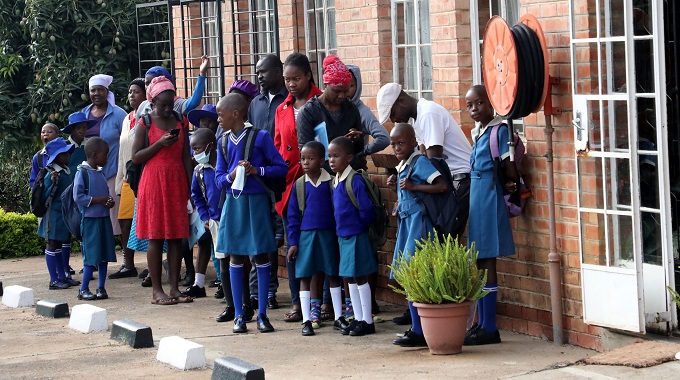
ALMOST all children in Zimbabwe have been going to school since the first couple of years of Independence when first closed schools were reopened and then the major policy of giving every child admission to four years in secondary schools was implemented with a major training programme for teachers and a building programme of schools and classrooms.
But this was just a start. We still had many children walking very long distances to school, and for some secondary schools even sleeping in shacks near the school, so far away were their homes when you had to calculate in daily two or three hour walks in each direction.
We had children starting in Grade one later than the year they turned six, not so much because there was no place but because that place was thought by parents to be too far away for a very small child to walk.
Land reform produced its own educational problems. There had been some primary schools on some farms, but these were far from universal and many were very sub-standard. So the new families moving in were faced with that for a start. Efforts were made so it was not a disaster, but it did mean once again long walks.
We have seen this in some urban areas with recent expansion, especially when this expansion was not well planned with the local authority services, so the schools have not been built in new suburbs, especially the land baron suburbs. This is something that needs to be fed into the development programme, since neighbouring suburbs cannot be expected to carry the overcrowding that might be involved.
The introduction of near universal early curriculum development, to get all children up to speed before they started to learn how to read and write in grade one, again showed up the problem of distance in some areas, with even younger children involved.
The Second Republic has seen a determined effort to get a far denser distribution of schools, so cutting walks, and to have smaller classes by having more teachers. So we have seen the number of schools, Government and non-Government, jump almost 2 900 in the last five years to 11 371, and the number of trained teachers jump from 127 962 to 153 453.
About two thirds of these schools are Government schools, which includes the local authority schools, and about a third are non-Governments schools.
As these are the statistics from the Ministry of Primary and Secondary Education we assume that the private schools are those that are registered and meet the minimum standards of the Ministry.
The State sector is fairly consistent and there are standard building plans so there is not that much difference between State schools, the major differences coming from other facilities that are provided by parents or through parental support via the levy system.
The private sector ranges from schools that are among the centres of excellence down to schools that only just meet those basic standards set by the Ministry, standards that should be under regular review for upgrading, both for schools in the State sector and schools in the private sector.
While there is a national curriculum that all schools must follow, with schools especially the best in the private sector allowed to add to the curriculum, although not subtract, we are now seeing potential problems with the introduction of practical subjects and adding application elements to the traditional curriculum.
State schools generally have the land that allows some of these applications almost instantly, and where extra facilities can be added for practical subjects. A large number of private schools do not have this opportunity and ways need to be found for a school that might just be a dozen classrooms in a commercial building to introduce the application side of the curriculum.
ECD has moved from something unusual and rare even just a decade ago and even in the non-Government schools, to almost universal in the primary sector, with only 45 of the 8 014 primary schools last year missing these classes.
There is a Government policy that no schoolchild should be more than a 5km walk from school, and even that is long-distance for many primary schoolchildren, especially those in the ECD and infant grades, although if schools are 10km apart then there will be very few children close to the 5km limit.
Some areas have been looking at having a sub-school for ECD and perhaps even grade one and two in every two or three villages, and then the children move on to the normal primary school when they are bit bigger.
Increasing the density of schools is important not just in the continued gap filling for primary schools where so much has been done in resettlement areas and the less densely populated rural areas, generally those where farmers have to look at ranching rather than intensive crop farming, but to make sure that secondary education is close to children’s homes.
In most urban areas it is quite possible to have two to four primary schools feeding a secondary school and there is the advantage that such a larger secondary school can have more facilities than average and a wider range of teaching. But trying that in rural areas simply breaches the 5km rule. We really need more of the double complexes, the secondary school and the primary school next door to each other.
Boarding schools can help, but this very English idea is not common outside that country and with other Government policies for electric lights in all houses, rural and urban, and decent water supplies, plus the steady improvement in most farmhouses, means that families can have the children at home and be able to spend the money on extras.
While the aim in Zimbabwe is to move towards free and compulsory school education, we are having to do this in stages.
At present parents who can afford fees must pay them, but 1,5 million children are now in the BEAM scheme, almost a third of all schoolchildren, so no one has to miss school because their parents are destitute.
It seems sensible to keep building up BEAM until we reach a time when we can abolish fees.


 Online Reporter