Chronicle Editor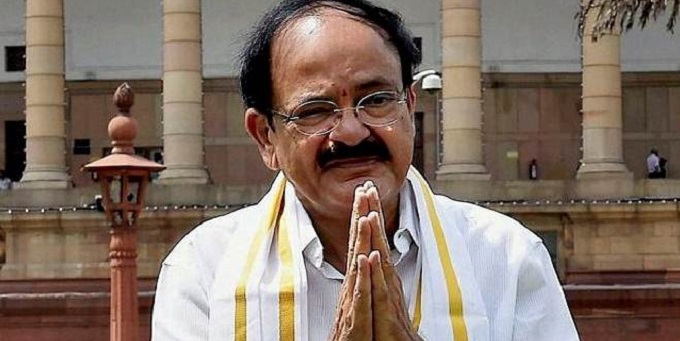
India Vice-President Venkaiah Naidu returned home yesterday after a highly successful three-day working visit to Zimbabwe that saw six agreements being signed.
This is the first high-level visit by a senior representative of the Indian government in 20 years.
The visit was important in a number of ways. Apart from highlighting further progress in Zimbabwe’s return to the family of nations after two decades of isolation, it cemented the bi-lateral social, economic and political relations between Harare and New Delhi.
Ties between India and Zimbabwe are centuries old, dating back to the time when traders from the Asian country came down here in search of ivory, metals and other resources.
Over the years thousands of Indians have settled in Zimbabwe, establishing themselves as one of the economically and socially strongest immigrant communities here as they are elsewhere in southern Africa.
In Harare on Saturday, VP Naidu and his local counterpart, Kembo Mohadi, witnessed the signing of the agreements which take the bilateral co-operation between the two countries to another level.
The deals are in health, media, sports, mining and ICT sectors.
Zimbabwe expects to receive an assortment of drugs, ambulances as well as benefit from India’s medical inventions to kick-start what is set to be a long term partnership between the countries in the health sector.
Yet another exciting development arising from VP Naidu’s visit is the announcement of a $333 million line of credit to Zimbabwe for the upgrade of Hwange Thermal Power Station and rehabilitation of Bulawayo Thermal Power Plant.
According to a joint statement released yesterday, $310 million will go towards the Hwange Thermal Power Station rehabilitation programme while $23 million will be used on the Bulawayo project.
India will also provide a $19.5 million soft loan for the Deka Water Pipeline project in Hwange.
“During the visit, Vice President Naidu announced a $310 million line of credit for upgradation of Hwange Thermal Power Station, additional $23 million line of credit for rehabilitation of Bulawayo Thermal Power Station and an additional $19,5 million line of credit for Deka Pumping and River Water Intake System,” read the statement.
“He also announced a grant for construction of Mahatma Gandhi Convention Centre, $2,93 million grant for upgrading of Indo-Zim Technology Centre and gifting of 10 ambulances to Zimbabwe, live-saving drugs and deputation of in five specialised areas. This gesture was deeply appreciated by the Zimbabwe side.”
The visit by VP Naidu has demonstrably been successful for both countries — Zimbabwe will secure essential support in the energy, ICT and health sectors while India will be able to buy diamonds from here, secure a market for a range of products and offer opportunities for investment.
It is exciting that India will provide $333 million for Hwange and Bulawayo thermal power stations. Both plants haven’t been running as they should in recent years, with the Bulawayo one actually not producing any electricity.
It has to be recalled that in October 2015, the Government announced that India Exim Bank had agreed to extend an $87 million line of credit to finance the upgrade of its Bulawayo Thermal Power Station.
The work was expected to extend the facility’s capacity to 70MW from the current 30 MW. Evidence on the ground suggests that three years down the line, the power station hasn’t undergone the rehabilitation.
We also recall that the Asian giant committed itself in October 2015 to providing $28,6 million to upgrade Deka Pumping Station which supports cooling of Hwange Power Station.
We doubt that that facility was provided, which is why the $19,5 million line of credit was put on the table according to the joint statement by both governments on Saturday.
Why both projects have not taken off may have been because of our country’s not-so-positive international outlook in the recent past.
It is not these two agreements only that failed as other deals signed between our country and China, for example, haven’t been executed for the same reasons.
Now that conditions have changed in a positive direction in our country, we are optimistic that the energy projects will be back on track while new ones agreed upon during VP Naidu’s tour would take off as soon as possible.
President Mnangagwa, hailing the high-profile visit, was particularly happy about the benefits that the country stands to realise in the medical field.
He told journalists on Saturday: “As we all know, India has excelled . . . in terms of economic development, particularly in the area of medicine. India is being rated worldwide as one of the most modern highly qualified centres in the whole world. Zimbabwe does not intend to reinvent the wheel.
We need to leapfrog and go India, have assistance from India for our people in that sector, to leapfrog and catch up with modern medical practices in India.
In fact, we would want India to have a high footprint here medically in Zimbabwe. We have discussed that and we feel that the opportunity is there.
We as Zimbabwe are ready, willing and committed to have the Indian government and through their companies to come and establish pharmaceutical companies in Zimbabwe.”
India has truly advanced its medical field. It has world class hospitals which provide affordable health care services and perform delicate medical procedures for millions from across the world, a good number from our country.
India’s drug manufacturers are some of the largest on the globe. As such a big proportion of drugs at local health institutions are made in that country.
We therefore expect more co-operation, as the President indicated, in the health industry not only in terms of Zimbabwe importing medicines and equipment from India, but also in terms of skills transfer and Indian companies investing in our country to manufacture drugs, building and running hospitals.



 derick.khumalo