admin
admin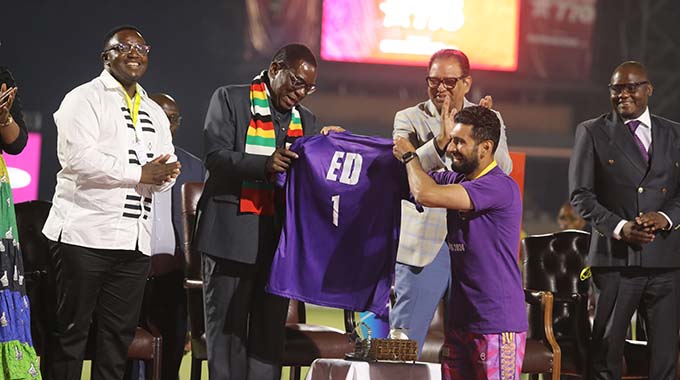
SPORT, recreation and the arts are not the only ways for productive Zimbabweans to enjoy themselves and pursue excellence with good fellowship and in good company, but also ways for a lot of people to earn a living, both as those who participate and those who provide and secure the services required.
Zimbabwe Cricket has been taking a lead in this, as President Mnangagwa noted at the weekend when he watched the final of the Zim-Afro T10 tournament in Harare, a new form of cricket competition that is building a very large global audience to join those who play and watch the traditional four-innings game, the one day series and the T20.
Zimbabwe has been among the leaders in extending this particular variety of the game, being last year in the first small group of countries that took it beyond the United Arab Emirates into a more global audience.
Cricket Zimbabwe, which admittedly does have access as a test-nation under the International Cricket Council to a share of the funds generated by the global television rights of test cricket, is also becoming a major investor in sport facilities in Zimbabwe.
Having created international-standard facilities in Harare and Bulawayo that can be used for both Test matches and the other international games, it is now developing three new stadiums in Victoria Falls, Gweru and Mutare, working with the Government and the city councils as it leases land and plans the development, which includes roadworks and other ancillary infrastructure.
While the prime purpose of the three new developments is for cricket, they will, and especially the one in Victoria Falls, have other users as they will be major sports facilities in these three cities.
The plan is to have a full set of international-standard grounds by 2026 for the co-hosting of the U19 Men’s World Cup and the Men’s World Cup itself the following year.
The creation of these sort of facilities also allows Cricket Zimbabwe to build an ever larger base of players, amateur, semi-professional and professional as it continues to make Zimbabwe a major cricketing nation and cricket one of the major sports in the country.
The sport does require fairly specialised grounds, the largest playing area for any team sport and detailed knowledge of how to prepare a wicket, hence the dedicated stadiums that have been built and are being built for the game.
The game is moving outward from its original elite roots and while it has yet to reach the sort of mass participation that is seen in the English-speaking Caribbean or the Indian sub-continent, it would be unrecognisable to the tiny cricket community of 1980.
We are now talking about both a growing popular sport and one that in all its facets supports a significant investment. This sort of single-mindedness by Cricket Zimbabwe to expand participation, continually improve quality and expand the range of facilities, including facilities licenced by the International Cricket Council for international matches, needs to be done by other sports within Zimbabwe, and some of those could also be able to tap their international organisations for assistance, and tap investors who can help with facilities.
Two sports where much could be done are soccer, obviously, and athletics, both the stadium events and the long distance events where organisation rather than expensive facilities are needed.
It is very sad that soccer has drifted into some rather bad times in Zimbabwe. The huge popular following, the very wide participation all the way from suburban social leagues to the very top premier division, and some determined efforts at schools, sports clubs and business premises to have at least basic playing grounds are not matched at the top level.
At one time major stadiums were built by city councils investing beer profits, but the moment they lost the monopolies that investment stopped and no attempt was made to bring in others or even to work out how income could be raised from the use of the facilities.
There is also that problem that Fifa require ever higher standards to approve soccer stadiums for international games, often for safety reasons as well as the simple rising quality of the game.
But the trend in Zimbabwe is to let facilities degenerate, instead of improving, and that makes future financing ever harder.
We agree admission charges have to be affordable, but with better facilities and better games, people will pay more, especially in a country where standards of living are improving. Declining facilities and fewer great games do not attract spectators.
In any case, one cannot help, but notice the branding on some great international stadiums, where the private sector has stepped in.
Athletics could be boosted once again, and it used to be a major community sport as well as a school sport.
Once again we have the lack of beer profits in high density suburbs, but other commercial taxes would work, and we have declining suburban sports clubs that used to provide so much, again largely as recreational centres since liquor licences were so hard to get.
As the President noted, some imagination, innovation and dedication could provide the answers. That is also needed in building up the long-distance events, to get the name recognition that is so important in the top belt of these.
And again possibilities exist; just for one example perhaps a marathon co-hosted by Victoria Falls and Livingstone that ended with the runners racing across the bridge, cooled by the spray from the Falls. The direction would alternate each year.
There are many other examples where modest investment at community level via councils, or with major commercial sponsorship, or where sheer investment will produce results. We can do a lot better than we have been doing, or at least better than most have been doing, and the lead shown by Cricket Zimbabwe, with that regular improvement year by year is where we all need to be.
And that in the end brings in ever more rewards, such as hosting international events and tournaments.



 Online Reporter