admin
admin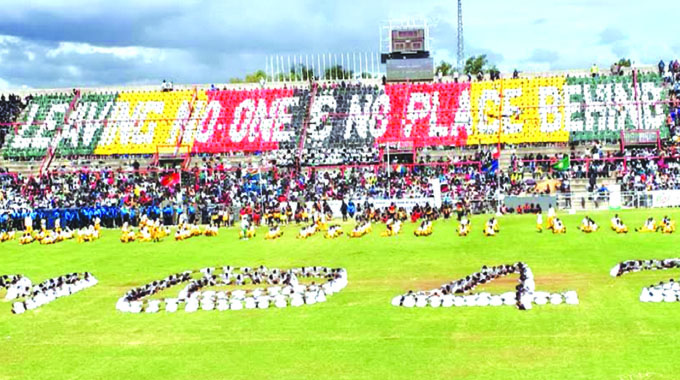
The theme of this year’s 42nd independence celebrations, “leaving no one and no place behind”, is as important as the economic growth that Zimbabwe is no enjoying after the economic fundamentals were sorted out by the Second Republic.
High levels of economic growth can be generated in an intensely unequal society becoming ever more unequal. This has happened and is still happening in many parts of the world and creates serious social problems.
For many people it does not really matter if their country gets a lot richer if almost all that extra money sticks to a very few hands, and it does not really matter if the method of wealth concentration is legal, morally dubious if not criminal or even the result of corruption and crime.
Many colonial societies with large indigenous populations inherited very high levels of inequality because of the way a small minority hogged all the opportunities to do business and create wealth on the basis of race.
Even though that original reason for the division and high inequality has gone, you still get the modern divisions between some types of work or business.
Zimbabwe still has this, with a small minority enjoying standards of living comparable with the better reaches of far more developed countries, a lot of people scraping by and a large group in poverty.
This has nothing really to do with ethnicity any more, with race not making it into the major breakdown of the population after a census since minorities are now a small fraction of a percent.
But the inherited divisions are there, and explain why by many measures South Africa is the most unequal society in the world.
Trying to remove inequality with wealth transfers is not that effective, except in the case of getting the richer to fund a higher proportion of common services, although even there is now a general agreement among economists that while shares of what must be funded can be distributed according to wealth, everyone should pay something to ensure that there is ownership by everyone.
The Second Republic has instead chosen a path that creates both high levels of growth and reduces a lot of inequality simultaneously, spreading the growth across the country and spreading it among the people, with particular emphasis on getting the people at the bottom of the heap into production.
Some of the development now being accelerated benefits everyone regardless of where they live or who they are. This includes new power stations and, so long as all sections of the national highway grid are worked on, the main highway network.
We all need more electricity and we all need a complete functioning national highway grid.
Then comes the stuff that must be spaced out. Irrigation dams are needed everywhere, but tend to benefit the people in their immediate area.
Even the exception, like the Gwayi-Shangani, benefits areas of Matabeleland North for irrigation with the pipeline to Bulawayo only really viable because there is a big city at the other end of it and while the raw water that far away will include transport costs in its pricing, treatment is vastly more expensive than raw water so this will not be serious.
One major area where Zimbabwe gets a serious double, that is production of what is needed plus a major push towards eliminating poverty, is the imaginative inputs schemes that have been transforming agriculture.
We have historically had a system where just a few thousand people owned half the farmland the by far the better half, and managed to feed the country, admittedly when the population was far lower, generating a high income for themselves, but retaining vast numbers in poverty.
With access to a finite resource shard more equally, the door was opened for the double of much higher production as well as a far more equal society by using the smallholder family farm as the unit.
The resulting significantly higher harvests are not just feeding or almost feeding Zimbabwe, but are pumping money into rural families and rural communities.
Even the declining small towns in rural Zimbabwe are suddenly expanding, led by the small towns in the tobacco belt, as business suddenly realises it needs to go where the money is and that in turn creates new business and continues spreading it further.
This is what happens when you make the laws of economics work for you. The shift of the main independence celebrations to Bulawayo this year could be seen as just a symbol, but sometimes symbols are important, very important.
As President Mnangagwa noted, no more Bambazonke. Bulawayo used to be much larger than Harare well into the 1950s. It fell back as political pressures moved stuff to the capital city, and then needed water and other resources.
Well now the political pressures are reversed and the critical resources are being provided and this is the case around the country.
Universities are now in almost all provinces, giving research centres on tap as it were, and when President Mnangagwa was reading out the lists of infrastructure his Government has been putting in place since he took office, it was noticeable that not only was there a lot done or where concrete is now being poured, but that the Government had been doing the work in a way that ensured all of Zimbabwe can press forward together.
This is important when we start talking about national unity. Everyone has to feel they belong and that they are being counted and that neither their area nor themselves as individuals are being left behind.
Devolution, rather than splitting the country, assists unity, by passing the message with some serious money behind it that we think everyone counts and we want you to decide what you need the most in capital development.
People will watch closely how the devolution budget is split, mind you, but so long as the criteria are rational they will be accepted.
And unity is important, despite the fact that we speak many languages, now all in the constitution, go to different churches live in different places and do different jobs.
This is because by pulling together we can make the sum greater than the parts, but that must be done by never degrading any of the parts, since they are all needed. The ethics, the economics and the politics rather neatly work together.


 Online Reporter