admin
admin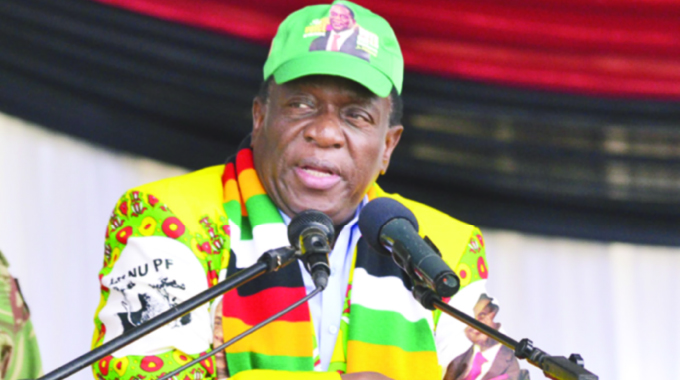
The only way that Zimbabwe can progress economically and socially is if everyone works hard and the conditions are in place to ensure that the hard work will be rewarded.
This, interestingly, formed the central message of President Mnangagwa’s election message in Mashonaland East, at his major rally at Mtawatawa Business Centre over the weekend.
He was careful not to promise handouts, not to look at some vague future where people could sit around and do nothing while goodies fell from heaven. This was straight talking.
On the other hand, he made it clear that the Government policies of backing that hard work will continue, so the hard work makes sense since the rewards will come.
So the Government will keep expanding the input schemes for farmers, will continue the huge infrastructure development of the last five years with more dams, more decent roads and the all the other things that hard working people need.
When we look at agriculture there has been a major transformation in Zimbabwe over the last five years since President Mnangagwa won the last Presidential election, as he and his Government implement the sort of programmes needed by hardworking farmers to first grow enough of their own food and then produce surpluses that they can sell.
A lot of praise has come the way of the Pfumvudza/Intwasa programme, which has done so much to ensure that smallholder farmers, still the majority of the Zimbabwean population, can become serious producers and earn some serious money from farming. Anyone will access to land to join the programme, although that access will be checked, and every smallholder farmer is welcome to climb aboard.
But from the very beginning the entrance criteria meant that farmers had to prove they were serious and ready to work hard.
New entrants have to go through basic training, which the Agriculture Ministry will arrange close to their home, and then have to dig at least one plot of the required holes and collect enough mulch for their plots.
That done the inputs arrive, guaranteed, and delivery is continually being brought forward so that when the rains start the bags of seed and fertiliser are on the farms. This is just logistics, but it does back the hard work that the farmers have already put in.
The second critical policy was to guarantee prices and a market for everything produced over and above what a farming family needs for its own needs in food and, increasingly, feed for stock.
This means that growing more is not a gamble and reliant on what some trader will pay in six months, but rather a sure way to make money.
Zimbabwe is now self-sufficient in grains and is about to resume exports of maize and traditional grains and to start exports of wheat. We have stopped paying other people to grow our food and are paying our own farmers to grow it instead, so the farmers earn the money.
We have concentrated, as we produce surpluses, on building up our grain stocks, but we are now starting to reach the stage where we have enough in stock and need to export if we are going to continue paying our farmers good prices.
We are also building other sectors where hard work can be rewarded. The dramatic expansion in mining, largely due to the investment-friendly policy of the Second Republic, has sorted out a lot of economic problems through the huge jump in exports, but for many Zimbabweans it means a decent job on a mine, or opportunities to open your own mine in say the gold sector.
Once again a Government policy has created the opportunities for people prepared to work hard to be rewarded for that work.
The President’s stress is important. The Government can do a lot to create the conditions that producers, from the smallest to the largest, need, but it does not produce anything important itself.
That, as the President noted, requires hardworking Zimbabweans grabbing the opportunities and doing the production and increasing the production.
But they in turn need the sort of policies the Second Republic has put in place. One without the other would not be much use.
This double will become ever more important. Land reform opened a lot of opportunities and created a far fairer society, and the farm policies of the Second Republic allowed that land to be used properly, at least by the hard working, but ever more of the future hard work will come from other areas. Already we are in the position where the Agriculture Ministry is seeing ever smaller annual increases in land being used for growing things and more stress on getting more tonnes from each hectare being used.
But this should open a whole lot more opportunity for the hardworking. If you go to a highly developed country where farms are still small, say most of France or Italy, and examine a rural community, you will find that while it is based on farming more than half the people are not farmers.
They are mechanics, they process what the farmers grow and sometimes process it into high-value luxury foods, they are the builders, they make things farmers need.
In other words while the inflow of money is from farming, a lot of other people can earn a living in other sectors.
This is why the Second Republic policies of spreading technical education, of opening vocational colleges, and of providing ever more resources to help hardworking youths with good ideas open their own businesses is so important. Once again it creates the framework that the hardworking need to increase production and earn a decent living.
In his campaigning the President has been stressing how his Government has been building up the infrastructure and the policy framework to open the doors. Now he is also stressing that to go through those doors you need to be ready to put in the effort required. Zimbabwe is not carrying passengers, but is at an ever-increasing rate making sure that those ready to put in the work and the effort can win through.



 Online Reporter