admin
admin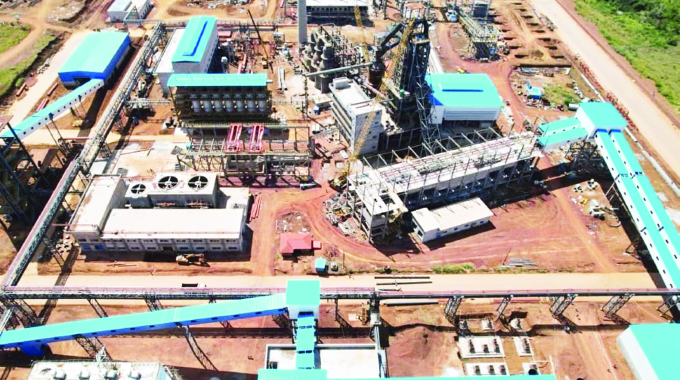
THE largest investor, and among the most committed and successful investors in Zimbabwe, is Tsingshan Holdings through its local wholly-owned subsidiary Dinson Iron and Steel Company which is now just a few weeks away from commercial steel production at its huge Manhize steelworks.
Over the weekend, the critical processes and equipment were tested and they all worked, so everything is on course for the formal commissioning of the plant and the start of production next month. Already 1 700 workers have been employed, with the full workforce for the first phase to rise to 3 000, making Dinson one of the largest employers in Zimbabwe.
The development of Manhize, rising basically out of the veldt, has been a complex process. The site was chosen as it was close to the pair of mines Dinson needed for its two bulkiest raw materials, iron ore and limestone.
These are mined almost in sight of the steelworks so transport costs are a very minor cost. Having the two raw materials in almost the same place was critical for the siting.
The third main raw material, the coke for the steelworks and some coal for a thermal station, does have to come from Hwange, but the coke is the processed product from coal mines so is a lot less bulky. Dinson runs its coking plant in Hwange near the coal mining to achieve that aim.
The farmers who had to be moved to make way for the mines, the town and the steelworks, were properly resettled, each family getting a decent house on its new farm, as Dinson exceeded the minimum requirements for relocation and that is probably the main reason why there have been no complaints from the local community.
Tsingshan was founded as a private company in 1988 by Xiang Guangda early in the massive Chinese economic expansion and has prospered through innovation, adoption of the latest technologies and tight management, plus a willingness to move into suitable investments in developing countries, Indonesia being the first.
That willingness was coupled with the realisation that it might need to construct a fair proportion of the infrastructure it needs and that may well have been the position even in China when it started operations.
The scale of the business can be seen from what was tested this weekend: thermal power station, the blast furnace, the sintering plant, the limestone processing plant and the oxygen plant.
The substation connected to the very high-voltage new grid line from Sherwood near Kwekwe is now also operational. One critical addition to the infrastructure is a railway line to Manhize to connect the steelworks to the Southern Africa railway network.
Even in the first phase, Manhize will be producing 600 000 tonnes of steel a year, almost 12 000 tonnes a week. By the time the third phase is commissioned we are talking about 3,2 million tonnes a year, more than 60 000 tonnes a week. Steel is a heavy and bulky product.
Dinson need to be able to get this product out to local users, to regional users and down to Beira for export further afield as efficiently as possible and that means the railways.
The National Railways of Zimbabwe is starting to modernise and rehabilitate its network, and knows that the Manhize link, which is not very long to connect to the existing network, is a top priority.
A lot has been discussed about steel becoming a primary export of Zimbabwe, the Manhize steelworks being so much larger than is needed for local demand, but the full potential of those exports require the railway.
President Mnangagwa played a critical role in attracting Tsingshan to Zimbabwe, personally meeting Mr Xiang on a visit to China near the beginning of his term of office and giving him the necessary assurances.
Zimbabwe has made its investment code direct and transparent, so investors know exactly what to expect and know that they can call on Government to sort out any bumps on the road to fulfilment.
Mr Xiang knew about the mining licences, the environmental safeguards, the planning requirements, the labour law and the tax code, including the concessions and offsets offered to new investment. These he had no problems with.
But he also wanted assurances that no one would try and put some sort of bite on him for corruption payments, that his investment would be secure, and that the Government would help smooth out any problems.
The President was persuasive that what was on the table was all that was required. Next month he will no doubt be delighted to fulfil his bold moves by commissioning the new steelworks.
Dinson are adding to the generating capacity of Zimbabwe. There is not only the back-up thermal of 50 megawatts, but also the Manhize steelworks will be generating a fair amount of its own power, basically for free, using the waste heat from the blast furnaces to generate steam to drive turbines.
In the end when going flat out, it will generate another 100MW, with a planned solar plant adding 100MW and a planned wind plant yet another 100MW.
Zimbabwean industrialists and others, such as the construction industry, need to be positioning themselves as downstream users of Dinson products.
After a long pause Zimbabwe once again has the ultimate heavy industry and needs to take advantage of this. As the steelworks develop, Dinson plan to introduce stainless steels, the two main extra raw materials being chrome and nickel, produced in Zimbabwe and with Dinson already smelting ferrochrome.
One reason for choosing Zimbabwe, besides having the main raw materials in the country and most in sight of the steelworks, must have been the advent of the African Continental Free Trade Area. Manhize is inside AfCFTA, and since more than 99 percent of raw materials and all production will be in and from Zimbabwe, will meet any conceivable rule of origin, so can be a major supplier of steel to Africa.
But it will also advertise Zimbabwe’s readiness and eagerness to accept investment, and will be a major source of raw materials for several other potential investors who need access to steel before they can commit. So it will multiply its already significant input into the development of Zimbabwe.


 Online Reporter